
Most of the concessions older Londoners use are closed to visitors, but one is not: anyone aged 60 or over can buy a Senior Railcard for £35, load it onto an Oyster card and pay a third less on off-peak travel for the rest of the trip. That, plus a little planning around lifts and rest stops, changes a London week more than anything else.
London is a walking city with a transport network that was mostly built before lifts were thought necessary. Neither of those things makes it a difficult place to visit at 70 or 80. They just mean the day needs shaping differently: fewer sights, more sitting down, and a route chosen around the stations that have a lift rather than the ones that look closest on the map.
This page is about age rather than disability. If you use a wheelchair or a walking frame, or you need step-by-step help from station staff, our guide for wheelchair users and our page on step-free travel on the network go much further than we do here. What follows is for people who walk perfectly well but would rather not walk ten miles a day, and who want to know which discounts they can actually use.
Age discounts at a glance
- Senior Railcard
- £35 for one year, £80 for three. Age 60+. Visitors can buy it online as a digital card.
- On London transport
- A Senior Railcard added to an Oyster card gives a third off off-peak pay as you go, and lowers the off-peak daily cap.
- Freedom Pass and 60+ Oyster
- London residents only. Not available to visitors.
- Attraction concessions
- Some start at 60, some at 65. Always ask, and carry your passport or a photo ID.
- Free museums
- No age rule at all: the big national museums are free for everyone.
The concessions you will read about and cannot use
Two schemes come up constantly in anything written about older people and London transport, and neither is open to a visitor.
The Freedom Pass gives free travel to older and disabled Londoners, and the 60+ London Oyster photocard does something similar for residents aged 60 and over. Both are funded by London's boroughs for people who live in Greater London, and both require a London address. There is no visitor equivalent and no short-term version.
The gap between that and what a visitor pays is real. A resident with a 60+ photocard pays nothing for a Tube journey; you will pay £3.00 to £3.60 for a single trip inside Zones 1 and 2 (September 2026 fares). It is worth knowing this before you arrive, so that advice from a London friend does not send you looking for a card you cannot have.
One small consequence catches people out at Gatwick. Contactless and Oyster are valid on the trains between Gatwick and central London, but the 60+ Oyster photocard is specifically excluded from that stretch, which is a reminder that these cards carry their own rules even for the people who hold them.
The Senior Railcard: the discount that does travel with you
The Senior Railcard is for anyone aged 60 or over, and it has no residency condition. It costs £35 for one year or £80 for three (September 2026), and the scheme's own frequently asked questions confirm that visitors to Britain can buy one online. Choose the digital version and it arrives as a code for the Railcard app, which avoids waiting for post to reach a hotel. You will need a passport or other accepted photo ID and a card to pay with.
On National Rail it takes a third off Off-Peak and Advance fares, which matters for day trips. But the part most visitors miss is what it does inside London. Staff at any Tube station, and at some Overground and Elizabeth line stations, can add the Railcard discount to an Oyster card. From then on, off-peak pay as you go fares drop by a third, and so does the daily cap.
| Off-peak daily cap | Adult rate | With Senior Railcard on Oyster |
|---|---|---|
| Zones 1–2 | £8.90 | £5.90 |
| Zones 1–3 | £10.50 | £6.95 |
| Zones 1–4 | £12.80 | £8.50 |
| Zones 1–6 | £16.30 | £10.85 |
Two conditions decide whether this is worth doing. The discount applies off-peak only, so it does nothing between 06:30 and 09:30 or between 16:00 and 19:00 on weekdays, and the peak cap stays at the adult rate. And the Railcard has to sit on an Oyster card, which costs £10.50 and cannot be loaded onto a contactless bank card or a phone.
So the sums look like this. Two people aged over 60 pay £70 for two Railcards and £21 for two Oyster cards: £91 before a single journey. If they travel after 09:30 every day and would otherwise hit the Zones 1–2 cap, they save £3.00 each per day, or £6.00 a couple. That takes about fifteen days to repay, which is longer than most holidays.
The case changes if you are here for a fortnight, if you are taking trains out of London, or if you already own a Senior Railcard from a previous trip, because it lasts a full year. A couple making a few day trips out of London, to Oxford or the Kent coast, will usually cover the £35 on those fares alone, and the London discount then comes free. Our page on railcards worth buying as a visitor compares the different cards in detail.
Buy the Railcard before the Oyster card, not after. Station staff add the discount to an Oyster card that already exists, so buy the Oyster first, then ask at the ticket window with the Railcard open on your phone. Doing it in the other order means a second queue.
Where the price drops at 60, and where you wait until 65
British attractions are inconsistent about the age at which a concession starts, and the difference is worth real money for a couple. There is no national rule, so the only reliable method is to look at the ticket page before you book.
| Attraction | Adult | Older visitor | Age |
|---|---|---|---|
| Tower Bridge | £18.00 | £13.50 | 60+ |
| Tower of London | £37.00 | £29.50 | 65+ |
| St Paul's Cathedral | £27.00 | £24.00 | 65+ |
| Churchill War Rooms | £34.00 | £30.60 | 65+ |
Prices are the standard online adult rates in September 2026, before any voluntary donation is added, and they change. Check each attraction's own ticket page on the day you book.
Notice how small some of these reductions are. Three pounds off a £27 ticket is not a reason to choose one cathedral over another. The far bigger saving is that the national museums charge nothing at any age: the British Museum, the National Gallery, the Natural History Museum, Tate Modern and the rest. Our list of London's free museums is the single most useful page on this site for anyone watching the budget.
Carry proof of age. Staff will usually take your word for it, but a passport photocopy or a driving licence saves an awkward moment, and some box offices genuinely do ask.
A seat on the Tube, and the badge that asks for one
Every Tube, Overground, Elizabeth line and DLR carriage has priority seats near the doors, and every bus has them downstairs at the front. They are marked, and most Londoners give them up when asked. The difficulty is asking.
Transport for London's answer is a free "Please offer me a seat" badge and card. You do not have to explain why you need it to staff or to other passengers, and it works across the Tube, buses, Overground, Elizabeth line, DLR, trams and the river boats. It does not guarantee a seat, but it removes the need to start a conversation with a stranger.
The catch for a visitor is delivery. TfL will only send the badge to an address in the United Kingdom. If you are staying somewhere for a week or more, your hotel counts as a UK address, so you can order it before you leave home and ask the hotel to hold post for your arrival. Order it at tfl.gov.uk or by calling TfL on 0343 222 1234.
Beyond the badge, timing does more than anything. Fares are cheaper off-peak for a reason: between 09:30 and 16:00 on a weekday you will usually get a seat on the Tube without asking anyone. Our guide to avoiding rush hour sets out the worst stretches.
Lifts, stairs and how far it really is between platforms
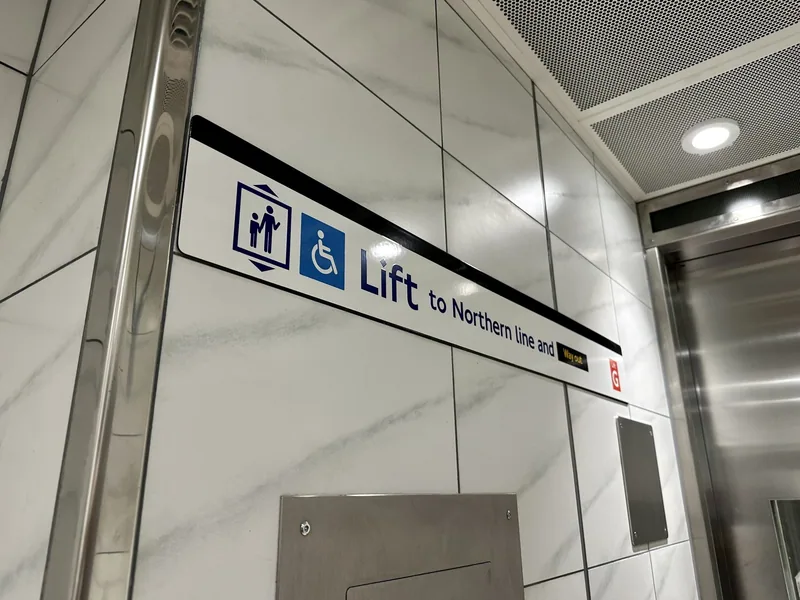
Ninety-five Tube stations are step-free, more than a third of the network, along with every Elizabeth line and DLR station and more than sixty Overground stations. That still leaves most of the older central stations with stairs, and some of them with a lot of stairs.
Two habits help. First, use TfL Go or the Journey Planner with step-free mode switched on, even if you do not need full step-free access, because it routes you away from the deep interchanges. Second, remember that a station being step-free from street to platform is not the same as a short walk. Interchanges at Bank, Green Park and King's Cross St Pancras involve long tunnels whether or not there are lifts.
TfL also runs a turn-up-and-go service on the Tube, Overground and Elizabeth line with no booking required. Staff will walk you to the train, meet you at the other end and help at interchanges, and if no step-free route exists they will pay for an accessible taxi. You do not have to be a wheelchair user to ask.
The Elizabeth line is the kindest line in London for tired legs. All 41 stations are step-free from street to platform, the trains are wide and level with the platform between Paddington and Woolwich, and it crosses the whole centre in a straight line. If your hotel is near one of its stations, plan around it.
Buses: the slowest way to see London and often the best
A bus costs £1.75 (rising to £1.85 on 1 November 2026), stops close to where you want to be, has no stairs if you stay downstairs, and shows you the city at street level. Buses and trams have a daily ceiling of their own at £5.25, well below the £8.90 that Zones 1 and 2 cost on the Tube, so a bus-only day is the cheapest sightseeing there is.
Routes 11, 15 and 24 pass a remarkable number of famous buildings between them, and the top deck of a normal red bus gives much the same view as a tour bus for a fraction of the price. If you would rather have the commentary and the freedom to get off, our comparison of the hop-on hop-off tours explains what you get for the extra money.
The river is the other gentle option. Uber Boat by Thames Clippers runs a proper boat service rather than a cruise, with seats, a bar and toilets on board, and holders of a Freedom Pass, 60+ or Veterans card get 50% off. Visitors pay the full fare, and river journeys do not count towards the daily cap, so check the price first on our page about the river bus.
Pacing a day so it does not end badly
The single most common mistake is planning by distance on a map. The British Museum and the National Gallery are less than two kilometres apart, which sounds like nothing, and then you have walked four kilometres inside the museums before you start.
A workable shape for a day looks like this: one major indoor sight in the morning, a sit-down lunch of at least an hour, and one lighter thing in the afternoon, with the return journey planned before you set out. Two large museums in one day is a bad idea at any age.
Book timed entry slots for the middle of the day rather than first thing, so you are not rushing across town in the rush hour to make a 10:00 ticket. And build in a spare afternoon. If the weather is bad or your knees have had enough, our list of things to do on a rainy day is mostly indoor and mostly seated.
Toilets, benches and somewhere to sit down
This is the practical question nobody writes about and everybody needs answered. TfL says its own station toilets are free to use, though not every station has one and opening hours vary; staff can let you in outside those hours. Toilets run by other organisations may charge. Our page on finding a public toilet in London lists the reliable places.
The other reliable stops are the free national museums, which all have toilets and cafés and do not mind you sitting down, and the big department stores. Every Royal Park has benches, and St James's Park, Green Park and the Victoria Embankment Gardens are all within a few minutes of Westminster.
Pubs are more welcoming in the afternoon than the evening. Buying a pot of tea or a half of beer buys you a table for as long as you like, and our guide to how pubs work explains ordering at the bar if you have not done it before.
Days and times to avoid
Saturday afternoon on Oxford Street and Sunday at Camden Market are the two experiences most likely to make a visitor wish they had stayed at the hotel. Crowds slow you to a shuffle and there is nowhere to stop.
Weekday mornings before 09:30 and evenings between 16:00 and 19:00 are best avoided on the Tube entirely. Bank holidays bring engineering work on the railways, and some lines close for weekend repairs, which our page on bank holidays and opening hours covers.
Industrial action is the other thing that can wreck a carefully paced day, because the fallback is usually a crowded bus or a long walk. Check before you travel, as our guide to visiting during a strike explains, and keep the apps worth having on your phone so you find out early.
Frequently asked questions
Can tourists use a Freedom Pass or a 60+ Oyster card in London?
No. Both are funded by London's boroughs for people who live in Greater London and require a London address, and there is no short-term version for visitors. The concession that is open to visitors is the Senior Railcard, which anyone aged 60 or over can buy online for £35 a year.
How do I get a third off Tube fares with a Senior Railcard?
Buy an Oyster card (£10.50), then ask staff at any Tube station, or at some Overground and Elizabeth line stations, to add the Railcard discount to it. Show the Railcard when you ask. The discount then applies to off-peak pay as you go fares and to the off-peak daily cap. It cannot be added to a contactless bank card or a phone.
What age do senior discounts start at in London?
There is no single rule. Tower Bridge gives its concession from 60, while the Tower of London, St Paul's Cathedral and the Churchill War Rooms use 65. Theatres, cinemas and tour operators all set their own ages. Ask before you buy, and carry photo identification.
Is the London Underground difficult if you cannot manage stairs?
Ninety-five Tube stations are step-free out of more than 270, so it depends entirely on which stations you use. The Elizabeth line, the DLR and most of the Overground are much better. Plan routes with step-free mode in the TfL Go app, and ask staff for help at the gateline: no booking is needed on the Tube, Overground or Elizabeth line.
How much walking should I expect on a normal day in London?
More than you plan for. Museums alone can add several kilometres, and Tube interchanges at stations such as Bank or King's Cross involve long underground walks. A realistic day is one big indoor sight, a proper lunch break and one smaller activity, with buses or the river used instead of the Tube where the route allows.
Sources
- Senior Railcard - Are you eligible? and Where to buy (checked September 2026)
- Senior Railcard - Frequently asked questions (visitors to Britain) (checked September 2026)
- Transport for London - Pay as you go caps (checked September 2026)
- Transport for London - Please offer me a seat (checked September 2026)
- Transport for London - Step-free access (checked September 2026)
- Historic Royal Palaces - Tower of London tickets and prices (checked September 2026)
- Tower Bridge - Entry prices (checked September 2026)
- Transport for London - Public toilets in London (checked September 2026)