
Three parts of London's network work reliably in a wheelchair: the Elizabeth line, the DLR and every bus. The Underground works in patches, and the patches are not where most visitors expect them. When a lift fails, Transport for London's own rule is that it must get you where you are going, paying for an accessible taxi itself when no other route exists.
That last sentence is the one worth remembering, because the thing that goes wrong in London is almost never the train. It is a lift, and it is usually the lift at the station you were relying on.
Our guide to step-free and accessible transport in London explains how the network is laid out and how to plan a route, and accessible London covers hotels, museums and toilets. This page picks up where those stop: which lines are genuinely usable, which door of the train to aim for, what to do at a broken lift, and the equipment and paperwork that make a difference.
What works, and what to carry
- Most reliable
- Elizabeth line, DLR, trams and every London bus
- Least reliable
- Deep-level Tube lines in central London, and any interchange
- Assistance
- Turn up and go, no booking, on Tube, Overground and Elizabeth line
- Booked assistance
- Passenger Assist, at least two hours ahead: 0343 222 2000. DLR: 0808 281 6655
- If the lift is out
- TfL books an accessible taxi at its own expense when no reasonable alternative exists
- Worth printing
- TfL's Travel Support Card, which you can download and print yourself
The honest picture, line by line
London's railway was built between 1863 and the 1930s in tunnels too narrow to retrofit easily, and that history decides everything. Broadly, the newer the line, the better it works.
| Line | Realistic verdict |
|---|---|
| Elizabeth line | The backbone. Level boarding at every central station, four wheelchair spaces per train, wide platforms |
| DLR | Level throughout, every station usable, no steps anywhere on the system |
| Jubilee | Level along the whole platform east of Westminster, which makes Canary Wharf, Greenwich Peninsula and Stratford easy |
| District, Circle, Hammersmith & City, Metropolitan | Sub-surface lines with shallower stations and more lifts, but many stations still have a large gap |
| Victoria | A handful of very good stations and a lot of stairs in between |
| Central, Northern, Piccadilly, Bakerloo, Waterloo & City | Deep-level lines. Usable at specific stations only; not a network you can rely on |
| London Overground | More than sixty usable stations, but patchy, and different on each of the six lines |
| Buses and trams | Every vehicle has a ramp and a wheelchair space. The limit is that there is only one space |
The practical consequence is that a wheelchair user's map of London looks different from everybody else's. A journey that a walking visitor would make on the Piccadilly line in twenty minutes may be better done on the Elizabeth line and a bus in thirty-five, with no lifts and no ramps. Plan around the Elizabeth line first and treat the rest as a bonus.
Interchanges are the real weakness. A station can be perfectly usable from the street and impossible to change lines in. Check the change as carefully as the two ends, and consider leaving the system and taking a bus for one leg instead.
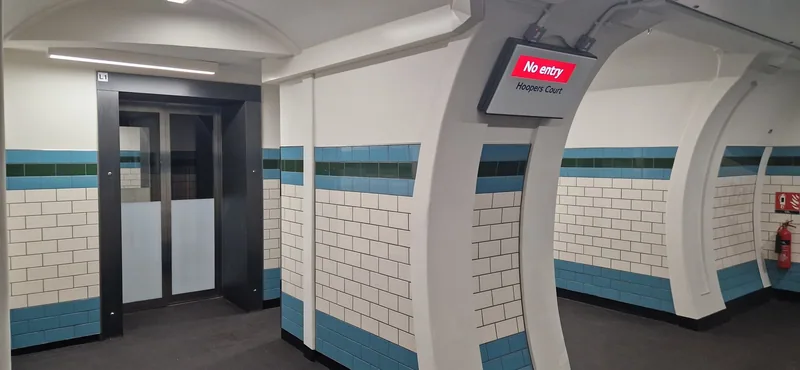
Photo: Chris Wood / Knightsbridge Tube Station Hoopers Court lower lift lobby · CC BY-SA 4.0 · Wikimedia Commons · resized
Finding the right door: where the boarding point is on each line
Where a platform has a raised section giving level access, it lines up with two sets of double doors on the train, and the position varies by line and by direction. Look for the "Board here" sign on the platform's back wall, and use this table to know roughly where to wait before the train arrives.
| Line | Eastbound and northbound | Westbound and southbound |
|---|---|---|
| Bakerloo | Carriage 2 | Carriage 6 |
| Central | Carriage 7, first double door | Carriage 7, first double door |
| Jubilee | Carriage 5, second double door, and carriage 6, first double door | The same |
| Northern | Carriage 5, second double door | Carriage 2, first double door |
| Piccadilly | Carriage 5, second double door | Carriage 2, first double door |
| Waterloo & City | Carriage 2 | Carriage 3 |
| District, Hammersmith & City, Metropolitan | Carriage 4, third door, and carriage 5, first door | The same |
| Victoria | Carriages 4 and 5 | Carriages 4 and 5 |
| Elizabeth line | Carriage 5, whether or not you need a ramp | Carriage 5 |
Carriage 5 on the Elizabeth line generally stops near the middle of the platform, and blue wheelchair signs on the wall and floor mark the spot. Getting this right saves a long push along a crowded platform after the doors open.
Mini ramps and boarding ramps are two different things. A mini ramp covers a small remaining gap and is available at a long list of Tube stations, including the Windrush line platforms at Whitechapel. A full boarding ramp is for the bigger drop at stations that are only level as far as the platform. Ask for either by name and staff will know exactly what you mean.
Boarding safely: what TfL asks passengers to do
TfL publishes a short set of instructions for using its platforms in a mobility aid, and they are worth following because the staff are trained to expect them.
- Wait parallel to the track, close to the back wall, not facing the platform edge, and stay behind the yellow line.
- Switch a powered chair or scooter off while you wait. Platforms are crowded and an accidental nudge of a joystick is a serious thing at a platform edge.
- Raise a hand as the train comes in, if you can. It tells the driver you are waiting and want to board. A member of staff will do this for you if one is with you.
- Let people off first, then move to the double door. You can use either of the two doors at the boarding point.
- Apply the brake once you are on, and avoid manoeuvring while the train is moving.
- Note the emergency alarm in the accessible carriage; it is set at a reachable height and connects you to the driver.
On buses, the ramp is at the middle door, and single-door buses have one too. Wheelchair and mobility aid users have priority in the bay. A pushchair may share the space if the driver judges there is room and you agree, but the driver will ask the buggy to move if you need the whole bay. Our guide to London buses covers boarding and paying.
When the lift is out: the procedure, step by step
This is the scenario that spoils days, so it is worth knowing exactly what happens.
- Check before you set out. TfL publishes planned work affecting stations, lifts and escalators, and live status on the same pages that show line delays. The TfL Go app shows the same information.
- Tell staff as soon as you arrive. At a Tube, Overground or Elizabeth line station, staff will look for another route to where you are going.
- If no sensible alternative route exists, the taxi is on TfL. It will run you either to the nearest usable station so the journey can continue, or all the way to the station you were heading for, anywhere inside Greater London, whichever gets you there sooner.
- Use a Help Point if you cannot find anybody. Help Points sit in ticket halls, on platforms and in walkways, and have two buttons, one for information and assistance and one for emergencies. Many have an induction loop for hearing aids, and staff test them daily.
- Claim a refund if you were badly delayed. The Overground refunds delays of thirty minutes or more, and the DLR fifteen minutes or more.
Do not queue outside a station if there is a queue at the entrance; disabled passengers, and the personal assistants or carers with them, should be let in without waiting. Make yourself known to a member of staff rather than joining the back of the line.
Always check the lifts for the return journey too. A lift can be working at 10:00 and out of service at 18:00, and a station that is fine in one direction can be unusable in the other. Look again before you leave the museum, not when you reach the station.
Turning up, or booking: which is better in practice
Nothing needs booking on the Tube, the Overground or the Elizabeth line. A member of staff walks you to the train, puts out a ramp if one is wanted, rings ahead so somebody is waiting where you change and where you finish, and will push a manual chair for you.
There is one limit worth knowing: staff accompany you as far as the lift but do not ride in it with you. They go round and meet you when the doors open on the right floor. This surprises people the first time.
Booking in advance through Passenger Assist is better in two situations: when you are changing between TfL and a National Rail train company for a day trip, and when you need help with luggage, which is only offered as part of a booked assistance journey at the stations that provide it. Book at least two hours ahead.
If your plans include a train out of London, book the assistance for the whole journey in one go rather than separately for each operator. Our guide to the main railway stations sets out how each terminus is arranged, and buying UK train tickets covers the fares side.
Mobility scooters: the rules that are different
A mobility scooter is not treated the same as a wheelchair, and the difference catches visitors out.
- Buses, trams, the Tube, trains, the cable car and some boats take mobility scooters, subject to the vehicle's size.
- Taxis do not. A black cab takes a wheelchair but not a mobility scooter, which rules out the usual fallback.
- Some boats do not either, so check with the operator before you plan a river journey around one.
- TfL runs a Mobility Aid Recognition Scheme to confirm that a particular scooter is suitable for its buses. If you are hiring a scooter in London for a fortnight, ask the hire company whether the model carries that recognition.
TfL's travel mentoring service can talk through a specific route and a specific machine before you travel, which is more useful than a general rule.
Borrowed wheelchairs, and the cards worth having
Some National Rail and Elizabeth line stations in London keep a complimentary wheelchair that you can borrow to cross the station. National Rail's station pages say which ones do. No Underground, Overground or DLR station offers this, and neither does anywhere else on the TfL network, so do not plan a journey on the assumption that a chair will be waiting.
Two pieces of paper are worth having. TfL's Travel Support Card lets you write down what help you need and show it to staff instead of explaining each time; it works across every TfL service, and you can download and print your own rather than waiting for one to be posted. The "Please offer me a seat" badge, by contrast, is only posted to UK addresses, which puts it out of reach of most visitors arriving from abroad.
The Taxicard scheme, which subsidises taxi and minicab journeys, is run by London Councils for London residents. Visitors cannot use it, so budget for full taxi fares; our guide to black cabs, minicabs and Uber has the rates. Holders of a UK Disabled Persons Railcard can have it added to an Oyster card by station staff, which takes a third off the fare at any hour of the day, peak or not. It is the only London discount that does not stop at 09:30.
The river, the cable car and the days out
The river is the most pleasant accessible journey in London and one of the most overlooked. Every Uber Boat by Thames Clippers vessel takes wheelchairs, with a ramp at the pier, and staff are used to it. River fares sit outside the daily cap, so price them separately; our guide to the river bus has the zones and fares.
The IFS Cloud Cable Car is level at both terminals and gives a view over the Thames that no viewing platform charges less for. Each cabin takes up to ten people and they arrive every thirty seconds, so there is no rush to board.
For days out beyond the centre, the DLR opens up Greenwich, Canary Wharf and London City Airport with no steps at any point, and the Elizabeth line reaches V&A East Storehouse and the Olympic Park at Stratford. Those two networks together cover a great deal of east London without a single ramp.
A step-free day that works
Here is a day in central London built entirely on the reliable parts of the network, as an example of how the planning changes.
- Morning: Elizabeth line to Tottenham Court Road, level boarding, then a short push to the shops and galleries around Soho and Bloomsbury.
- Midday: a bus east along Oxford Street and Holborn rather than the Central line. Buses are slower but there are no lifts to fail.
- Afternoon: Elizabeth line to Canary Wharf, then the DLR or the river to Greenwich.
- Evening: the river bus back to Tower or Embankment, which avoids the evening crush entirely.
Notice what is missing: no deep-level Tube line, no interchange between two Underground lines, and no journey that depends on a single lift. That is the shape of a London day that does not go wrong. Our guides to visiting London with a disability and London for older visitors apply the same thinking to the sights themselves.
Frequently asked questions
What happens if the lift is broken at a London Underground station?
Tell station staff at once. They will try to find you another level route, and where none exists TfL pays for an accessible taxi itself. That taxi takes you either to the nearest usable station so you can carry on, or straight to the station you were aiming for, anywhere in Greater London.
Which London Underground line is best for wheelchair users?
The Jubilee line east of Westminster, where platforms are level along their whole length, and outside the Underground itself, the Elizabeth line and the DLR. The deep-level lines, including the Central, Northern, Piccadilly and Bakerloo, are usable only at certain stations and are not a reliable network.
Do I need to book assistance on the Tube in London?
No. Assistance is given on the spot, without booking, across the Tube, the London Overground and the Elizabeth line. Booking through Passenger Assist, at least two hours ahead on 0343 222 2000, is worth doing if you are connecting to a National Rail train or need help with luggage.
Can I take a mobility scooter on London transport?
On buses, trams, the Tube, trains, the cable car and some boats, yes, depending on the size of the scooter. Taxis do not take mobility scooters, and neither do some boats. TfL runs a Mobility Aid Recognition Scheme that confirms whether a particular model is suitable for its buses.
Are there wheelchairs to borrow at London stations?
At some National Rail and Elizabeth line stations only, and National Rail's station pages say which. Underground, Overground and DLR stations do not lend wheelchairs, so do not build a journey around the assumption that one will be available.
Sources
- Transport for London - Wheelchair access and avoiding stairs (checked September 2026)
- Transport for London - Help from staff (checked September 2026)
- Transport for London - Passenger Assist (checked September 2026)
- Transport for London - Step-free access (checked September 2026)
- Transport for London - DLR (checked September 2026)
- Transport for London - Please offer me a seat (checked September 2026)
- Transport for London - Railcard discounts on Oyster (checked September 2026)