
Eltham Palace is two buildings pretending to be one: a 1470s royal great hall where Henry VIII grew up, and a 1930s art deco mansion built onto the side of it by a millionaire couple who wanted underfloor heating and a centralised vacuum cleaner. It is run by English Heritage, it sits in south-east London, and it costs from £15.38 for an adult booked in advance (September 2026).
Most visitors reach it after they have already done the big royal houses. If you have not, our guides to the State Rooms at Buckingham Palace, Kensington Palace and Henry VIII's palace at Hampton Court cover those. This page is about the one that is unlike all of them, and about the practical problem of getting to zone 4 and back without wasting an afternoon.
Eltham Palace in brief
- Address
- Court Yard, Eltham, London SE9 5NP
- Run by
- English Heritage
- Adult ticket
- From £15.38 booked online (off-peak), £17.00 standard, £19.29 peak; £20.00 at the gate. Prices without the optional donation, September 2026
- Child (5–17)
- From £7.65 booked online
- Nearest station
- Mottingham (National Rail), about a 10–15 minute walk
- How long
- Two to three hours with the gardens
Why a medieval hall has a 1930s house attached to it
Eltham was a proper royal palace for three centuries. Edward IV built the Great Hall in the 1470s, and the young Henry VIII spent much of his childhood here. Then the court moved to Greenwich and Hampton Court, the Civil War finished the job, and by the 1800s the hall was a barn.
In 1933 Stephen and Virginia Courtauld, from the textile family, took a lease on the site. Rather than restore a ruin or knock it down, they repaired the hall and built a new house against it, finished in 1936. The result is a single ticket that takes you from a hammerbeam roof into a room panelled in Australian blackbean veneer, with a few steps in between.
That contrast is the reason to come. It is also the reason the palace divides people: if you want an unbroken medieval experience you will find the 1930s wing an intrusion, and if you came for the art deco you may find the hall an anticlimax. Most people end up liking the mansion more than they expected.
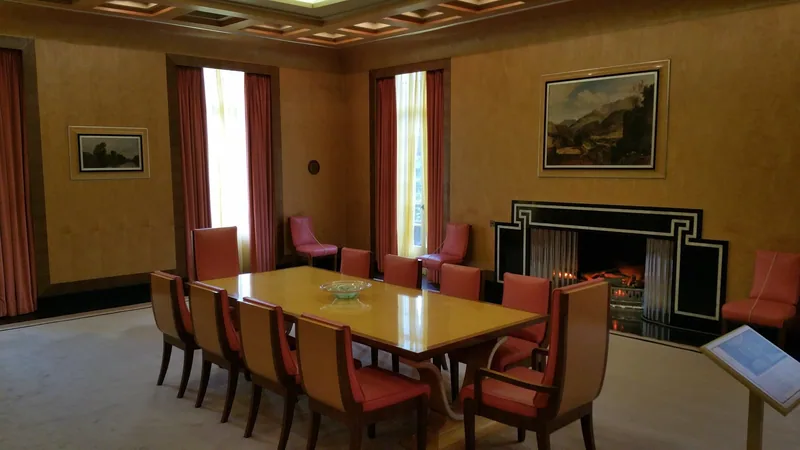
Photo: JRennocks · CC BY 4.0 · Wikimedia Commons · resized
What is actually inside the house
The entrance hall is the set piece: a circular room under a concrete-and-glass dome, lined with marquetry panels showing Italian and Scandinavian scenes. English Heritage's audio guide plays a 1930s soundtrack through it, which is either charming or heavy-handed depending on your mood.
From there you move through the dining room, with its aluminium-leaf ceiling and black-and-silver doors, and up to the bedrooms. Virginia Courtauld's bathroom, lined in onyx with a gold-plated mosaic niche above the bath, is the single most photographed room in the building. There is also a cage that belonged to Mah-Jongg, the Courtaulds' pet ring-tailed lemur, complete with a heated sleeping quarter and a bamboo ladder down to the ground floor.
The lift at Eltham was out of service in September 2026. English Heritage's own page says the upper floors of the house can then only be reached by stairs, and offers a virtual tour through the multimedia guide instead. If the bedrooms and the bathroom are the reason you are going, check the property page on the morning of your visit.
The gardens, the café and the bit children like
The grounds run to about 19 acres and are included in the ticket. There is a moat with a medieval bridge still carrying traffic into the site, a sunken rose garden, a rock garden, and a long south lawn that is the best picnic spot on the property. The planting is Arts and Crafts in feel rather than formal, so it holds up in autumn better than a bedding-scheme garden would.
The Orchid House café is in a glasshouse near the visitor centre, and there is a playground and a shop. Families tend to do house first, lunch second, gardens and playground third, which works because the house is the part where small children run out of patience.
If you want more green space in the same trip, Greenwich Park is a short train ride away and makes an easy second half to the day.
Ticket prices, and the trick that makes them cheaper
English Heritage uses three price bands, shown in its booking calendar as Super Saver, Saver and Standard. Weekdays in quiet months are the cheapest, weekends and holidays the dearest. Booking online by midnight the day before gets you the lower price; turning up and paying at the door costs more.
| Ticket | Booked online, off-peak | Booked online, standard | Booked online, peak | At the gate (standard) |
|---|---|---|---|---|
| Adult | £15.38 | £17.00 | £19.29 | £20.00 |
| Child 5–17 | £7.65 | £8.50 | £9.60 | £10.00 |
| Concession | £13.85 | £15.38 | £17.76 | £18.10 |
| Family (2 adults) | £38.59 | £42.50 | £48.28 | £50.00 |
| Family (1 adult) | £23.12 | £25.50 | £28.90 | £30.00 |
All of these are the prices without the optional charity donation, correct in September 2026. Adding the donation raises each figure by ten per cent, and English Heritage will give you the lower price if you ask for a ticket "without donation". Always check the current calendar on the English Heritage site, because the band depends on the date you pick.
Show a travel ticket at the desk and take 20% off the walk-up price. English Heritage works with Good Journey at Eltham: arrive by train, Tube, bus or bicycle, show your ticket or your contactless and Oyster app at the point of purchase, and you get a fifth off the on-the-day price. That turns a £20 adult gate ticket into £16, which beats the £17 standard online fare. Santander Cycles do not count.
English Heritage membership starts at £44 a year and covers this site plus more than 400 others, with up to six children free per adult member. For a family planning two or three English Heritage days, it pays for itself quickly. Eltham is not covered by the London Pass, so if you are weighing that up, read our assessment of whether the London Pass is worth buying before you add it to the sums.
Opening days change sharply after October
Through the autumn Eltham is open daily, 10am to 5pm, with last entry at 4.30pm. From the end of October the site drops to a 4pm close, and from 2 November it opens at weekends only, 10am to 4pm, apart from the days around Christmas and New Year and the February half-term week. Early 2027 follows the same pattern: weekends only until mid-February, then a Wednesday-to-Sunday week from late February.
The practical consequence is simple. If you are in London on a Tuesday in January, Eltham is shut, and no amount of planning will change that. Check the prices and opening times page before you commit, and keep an alternative in reserve; our list of things to do in London on a wet day has indoor options that do not close midweek in winter.
Getting to Eltham from central London
The nearest station is Mottingham, about half a mile away, which English Heritage describes as a 10-minute walk on its directions page and a 15-minute walk on the property page. Allow 15 and you will not be rushing. Trains run from London Bridge, Cannon Street and Charing Cross via Lewisham, and the journey from London Bridge takes a little over 20 minutes.
Eltham is in fare zone 4, so a pay as you go journey is covered by the usual daily cap rather than a separate ticket; our guides to how the travel zones work and Oyster against contactless explain what that means in practice for a day of this shape.
TfL bus routes 124, 126, 160 and 161 all stop near the site. There is a car park, but it is small, free only for members displaying a valid sticker, and English Heritage says it gets very busy at weekends and in school holidays. Given the 20% public-transport discount, driving is the worse choice twice over. Both the Capital Ring and the Green Chain Walk pass close by if you would rather arrive on foot.
How Eltham compares with the other London palaces
Eltham is smaller, quieter and much less crowded than the central royal sites. You will not queue, you will not be moved along, and on a weekday morning there may be four people in the Great Hall. The trade-off is travel time and a shorter visit.
Come here if
- You like twentieth-century design and have already done the obvious palaces
- You want a historic house without a timed-entry scrum
- You are travelling with someone who tires of medieval rooms after twenty minutes
- You are an English Heritage member, in which case it is free
Skip it if
- You have three days in London and have not yet seen the Tower or Westminster
- You are visiting in winter on a weekday, when it is closed
- Stairs are a problem and the lift is still out of service
- You want a full day out of a single site
If your interest is really the building rather than the royalty, two other pages in this section suit the same taste: the small, strange Banqueting House on Whitehall, and Apsley House and Wellington Arch at Hyde Park Corner. For the wider list, our landmarks and historic buildings section has the rest.
Making a day of it in south-east London
Eltham on its own is a half-day. The neat pairing is with Greenwich, ten minutes back up the railway line, where you can eat at the market and walk up the hill. Note that the Royal Observatory closes for rebuilding in November 2026, so check what is open before you plan that half of the day around it.
With children, the Eltham playground and the lemur cage carry more weight than any of the interiors, and the gardens give them somewhere to run; our family guide to London has more on pacing a day like this. If the weather turns, the Design Museum in Kensington is the obvious follow-on for anyone who came for the 1930s rooms, though it is right across town.
Frequently asked questions
Do you need to book Eltham Palace in advance?
No. You can buy a ticket when you arrive, but you pay the higher gate price. Booking online by midnight the day before gets you the discounted rate, and tickets are valid all day, so you can arrive whenever you like within opening hours and stay as long as you want.
Is Eltham Palace covered by English Heritage membership?
Yes. Members go free, and up to six accompanying children under 18 within the family group are free with an adult member. Membership starts at £44 a year (September 2026). Members can still book a slot online if they prefer, and should bring their card.
Is Eltham Palace suitable for wheelchair users?
The ground floor and most of the gardens are manageable, but the house lift was out of service in September 2026, leaving the upper floors reachable only by stairs. English Heritage offers a virtual tour of those rooms through the multimedia guide. Check the property's access page and the live notice on its website before travelling.
How long should I allow at Eltham Palace?
Two hours covers the house and the Great Hall at a comfortable pace. Add an hour for the gardens, the café and the playground, and closer to four hours if you are visiting on a warm day and intend to picnic on the south lawn.
Can you see the Great Hall without paying?
No. The Great Hall is inside the ticketed area and cannot be visited separately. English Heritage does open the site free of charge for Heritage Open Days in September, but those dates are announced each year and booking arrangements vary, so watch the property page in late summer.
Sources
- English Heritage - Eltham Palace and Gardens: prices and opening times (checked September 2026)
- English Heritage - Eltham Palace and Gardens (checked September 2026)
- English Heritage - Directions to Eltham Palace and Gardens (checked September 2026)
- English Heritage - Plan your visit to Eltham Palace and Gardens (checked September 2026)
- Transport for London - Daily and weekly capping (checked September 2026)