
Banqueting House is one room, and the room has a Rubens ceiling. It stands on Whitehall, it costs £10 for an adult, children under 16 go free, and Charles I was beheaded on a scaffold built against its wall in 1649. The catch is that it is not open all year: in 2026 general admission ran only from 1 August to 20 September, with two single Open Days in November and December.
That last point matters more than anything else on this page. Plenty of guidebooks still describe Banqueting House as a daily attraction. It is not. Read the dates before you build an afternoon around it, and if they do not work, our guide to touring the Houses of Parliament covers the nearest alternative on the same street.
Banqueting House at a glance
- Address
- Banqueting House, Whitehall, London SW1A 2ER
- Run by
- Historic Royal Palaces
- Adult ticket
- £10.00 without donation, £11.00 with (September 2026)
- Children
- Free, ages 0–15; £5.00 for 16–17
- Open in 2026
- Summer opening 1 August – 20 September, Thursday to Monday, 10:00–16:00, last admission 15:00. Open Days on Sunday 1 November and Sunday 20 December
- How long
- Historic Royal Palaces suggests about 45 minutes
When you can actually get in
For most of the year the building works as a venue: private hire, weddings, school groups, community partners and booked tour parties. Public admission is concentrated into a summer season and a handful of announced dates.
In 2026 that meant a summer opening from 1 August to 20 September, Thursday to Monday, closed on Tuesdays and Wednesdays, 10:00 to 16:00 with last admission at 15:00. After the season closed, Historic Royal Palaces listed a members-only day on 27 September, Candlelight Concerts on 11 October and 14 November, a Deaf-led guided tour on 2 December, and two public Open Days: Sunday 1 November and Sunday 20 December.
Check the Whitehall dates before you leave your hotel. The building also closes early for events at short notice, and the summer season runs on half-hour time slots that cannot be guaranteed if you turn up late. Historic Royal Palaces publishes the current list on the Banqueting House pages of hrp.org.uk.
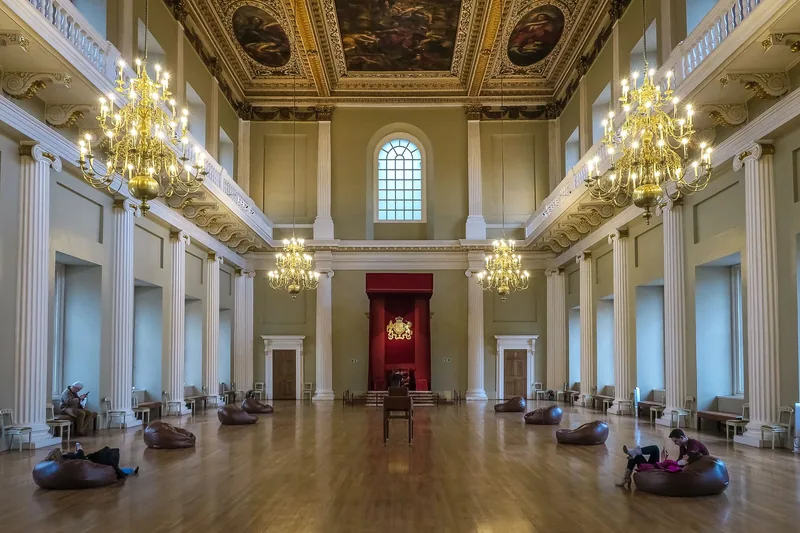
Photo: Grahampurse · CC BY-SA 4.0 · Wikimedia Commons · resized
What the ceiling is, and why it is the point
The hall was built in 1622 to designs by Inigo Jones, for James VI and I, as a stage for court masques. In 1636 his son Charles I installed nine painted canvases by Peter Paul Rubens across the ceiling, celebrating his father's reign and the union of the crowns. They are still in the frames Rubens painted them for, which is unusual: most surviving Rubens ceilings of that scale were broken up, moved or lost.
The composition runs in three bands. The central oval shows James being carried to heaven. The panels around it deal with peace, plenty and wise government, painted in the flattering language a Stuart king expected. The practical problem for a visitor is that they are 17 metres up, so the room is furnished with beanbags and mirrored trolleys to save your neck. Use them. Standing and craning for forty minutes is the commonest mistake here.
There is a second, smaller space below: the Undercroft, a low vaulted room James used as a private drinking den. It is included in the ticket and takes five minutes.
The execution of Charles I
On 30 January 1649 Charles I walked through this building, out through an opening in the north end, and onto a scaffold built against the outside wall. He had watched his father glorified on that ceiling for thirteen years. It is the only English king to have been tried by his own subjects and publicly executed, and the room is the last interior he saw.
Historic Royal Palaces marks the site rather than dramatising it, which is the right decision and also means there is less to look at than people expect. The interpretation panels and the short films do the work. If you want the political story rather than the royal one, the Churchill War Rooms a few minutes' walk away take the same city into the twentieth century.
The palace that burned down around it
It is easy to walk past Banqueting House without registering that it is a survivor. For nearly two centuries this was one building inside the Palace of Whitehall, the largest royal residence in Europe, a sprawl of halls, lodgings, galleries, tennis courts and cockpits that filled the ground between the Thames and St James's Park.
In January 1698 a fire started in a laundry and took almost all of it. Whitehall Palace never recovered; the court moved to St James's and Kensington, and the site was gradually rebuilt as the government quarter it is today. Banqueting House came through because it was newer, stone-faced and slightly apart from the rest.
That is why the building sits at an odd angle to the modern street, and why it feels like a fragment rather than a frontage. Everything around it is nineteenth and twentieth-century ministry architecture. The one classical façade in the middle of Whitehall is the last significant piece of the palace that gave the street its name.
Knowing that changes the visit. The room you stand in was the ceremonial heart of a vanished complex, and the ceiling above you was commissioned to be seen by ambassadors arriving through rooms that no longer exist. Historic Royal Palaces tells that story in its history pages, and the short films inside cover it as well.
Ticket prices, including the ones nobody tells you about
Historic Royal Palaces publishes two columns, with and without the optional ten per cent charity donation. You can always ask for the lower figure.
| Ticket | Without donation | With donation |
|---|---|---|
| Adult (18–64) | £10.00 | £11.00 |
| Child 5–15 | Free | Free |
| Child 0–4 | Free, no ticket needed | Free |
| Young person 16–17 | £5.00 | £5.50 |
| Senior 65+ | £8.00 | £8.80 |
| Full-time student 18+ | £8.00 | £8.80 |
| Disabled concession | £8.00 | £8.80 |
| Carer or companion | Free | Free |
| Groups of 15 or more | £9.20 per person | — |
Two adults and two children under 16 pay £20 at Whitehall. Children aged 5 to 15 go free here, which almost no other central London historic interior offers. There is also a £1 ticket for anyone receiving Universal Credit, Working Tax Credit or Pension Credit. Both are worth knowing if your budget is doing the choosing; our page on free things to do in London covers the rest.
A London Pass is accepted and you do not need to pre-book if you are using one: bring it to be scanned on arrival. Tickets bought directly are non-refundable, though Historic Royal Palaces will change the date of an unused admission ticket for a fee if you call 0333 320 6000 at least three working days before the new date. Do not simply book a second ticket; you will not get the first one back.
Rules inside: photographs, bags and costume
You may take photographs for personal use without flash. Tripods and selfie sticks are not allowed, and some items may be signposted as not for photography. This is a more relaxed regime than most royal interiors, and the ceiling rewards it. Our summary of photography and drone rules in London covers the wider picture.
There is no left luggage at Banqueting House and no on-site parking; the nearest public car park is Q-Park Trafalgar. Adults are not admitted in fancy dress unless it is part of an official event, and staff can ask you to change or come back another day if your clothing carries offensive slogans. Only Blue Badge Tourist Guides are permitted to guide groups inside, so a guide you have hired elsewhere may not be able to work in the room.
Getting there, and what is within five minutes
Banqueting House sits on the east side of Whitehall, roughly halfway between Trafalgar Square and Parliament Square, opposite Horse Guards. Westminster, Embankment and Charing Cross stations are each a short walk, and almost every Whitehall bus stops within a minute of the door.
Because the visit is short, the sensible plan is to slot it between two bigger things. The Changing of the Guard ceremonies take place a few hundred metres away, Westminster Abbey is ten minutes south, and the National Gallery and Trafalgar Square are five minutes north. Big Ben and the Elizabeth Tower close the walk at the southern end.
Our guide to Westminster as a neighbourhood sets out how the whole strip fits together, and if you are compressing everything into a single day, the one-day itinerary shows where a 45-minute stop can be squeezed in without breaking the rest.
The concerts, and whether they are a better way in
If the summer dates do not suit, the Candlelight Concerts are the other realistic way to stand under the Rubens ceiling. They are evening events, ticketed separately through Historic Royal Palaces, and the room is lit low. You see less detail in the paintings than you would at eleven in the morning, and you get an atmosphere that no daytime visit can match. Which of those you prefer is a genuine choice rather than a trick question.
For the wider picture of concerts in historic London rooms, our guide to classical music in London lists the regular venues. For more small, cheap, quickly-done sights of this kind, the ruined church garden at St Dunstan in the East and the unusual double building at Eltham Palace are both in our landmarks section.
Frequently asked questions
Is Banqueting House open every day?
No. It opens to general visitors for a summer season and on a small number of announced Open Days. In 2026 the season ran from 1 August to 20 September, Thursday to Monday, and the two Open Days were Sunday 1 November and Sunday 20 December. Check hrp.org.uk before travelling.
How much does Banqueting House cost?
An adult ticket is £10.00 without the optional donation, or £11.00 with it (September 2026). Children aged 15 and under go free, 16 and 17-year-olds pay £5.00, and seniors, students and disabled visitors pay £8.00. Groups of 15 or more pay £9.20 a head.
How long does a visit take?
Historic Royal Palaces recommends allowing about 45 minutes. You may stay as long as you like within opening hours, but there is one main room, the Undercroft and some interpretation, so most people are done inside an hour.
Can you see where Charles I was executed?
Yes, in the sense that the site is marked and explained inside the building. The scaffold itself was a temporary structure built against the outside wall in January 1649 and dismantled afterwards, so there is nothing physical left of it to see.
Can you take photographs of the Rubens ceiling?
Yes, for personal use and without flash. Tripods and selfie sticks are banned, and staff may point out specific items that cannot be photographed. Mirrored trolleys and low seating are provided so you can look upwards comfortably.
Sources
- Historic Royal Palaces - Banqueting House (checked September 2026)
- Historic Royal Palaces - Banqueting House tickets and prices (checked September 2026)
- Historic Royal Palaces - Banqueting House frequently asked questions (checked September 2026)
- Historic Royal Palaces - The Rubens ceiling (checked September 2026)