
Greenwich Park is the oldest of London's enclosed deer parks, about 74 hectares of grass, ancient trees and steep hillside in south-east London. It is free, open from 6am every day, and the view from the top of the hill is the best one in this half of the city. The Royal Observatory inside it closes on 2 November 2026 for rebuilding; the park itself stays open throughout.
Most visitors come for the Observatory and the Prime Meridian, and our guide to the Royal Observatory and the Cutty Sark covers the tickets, the meridian line and what is inside. This page is about the park: the hill, the deer, the gates, and what is worth your time once the Observatory has closed its doors.
The short answer for a first-time visitor is that Greenwich Park works as a two-hour walk rather than a destination in itself. You arrive at the bottom by the river, climb the hill, look at the view, and come down the other side into the village. The Royal Parks describes the summit as the park's most popular spot, and on a sunny Sunday it feels it.
Greenwich Park at a glance
- Entry
- Free, no ticket
- Opening
- Pedestrian gates from 6am, vehicle gates from 7am; both close at dusk, which changes through the year (8pm in September 2026)
- Size
- About 74 hectares (roughly 180 acres); the perimeter is around 2 miles
- Nearest stations
- Cutty Sark and Greenwich on the DLR; Greenwich and Maze Hill on National Rail
- Deer
- In the fenced Wilderness Deer Paddock, not loose in the park
- Dogs
- Generally off-lead, but not allowed in the Flower Garden, the deer paddock or the Observatory garden
The climb, and where the view actually is
The hill is steeper than it looks from the river. From the Cutty Sark end you cross flat ground for five minutes, then the ground rises sharply in one push to the terrace by the Observatory, where General Wolfe's statue stands at the railing. The whole panorama opens at once: the Queen's House and the colonnades of the Old Royal Naval College below, then the river, then the towers of Canary Wharf, with the City behind them on a clear day.
You do not need a ticket to stand there. The terrace is outside the Observatory's paid area, and it stays open when the Observatory does not. Two practical notes: the railing is crowded from about 11am at weekends, and the light is behind the towers in the morning, so late afternoon photographs better.
For a quieter version, walk east to One Tree Hill, which the Royal Parks recommends for views away from the crowds. It is lower and the angle is different, over the river towards the Isle of Dogs, but you will often have the bench to yourself. In spring and summer the path up it is meadow, humming with bees and meadow brown butterflies. Our comparison of London's paid and free viewing platforms puts this view in context against the ticketed towers, and the best free viewpoints in London covers the other hills.
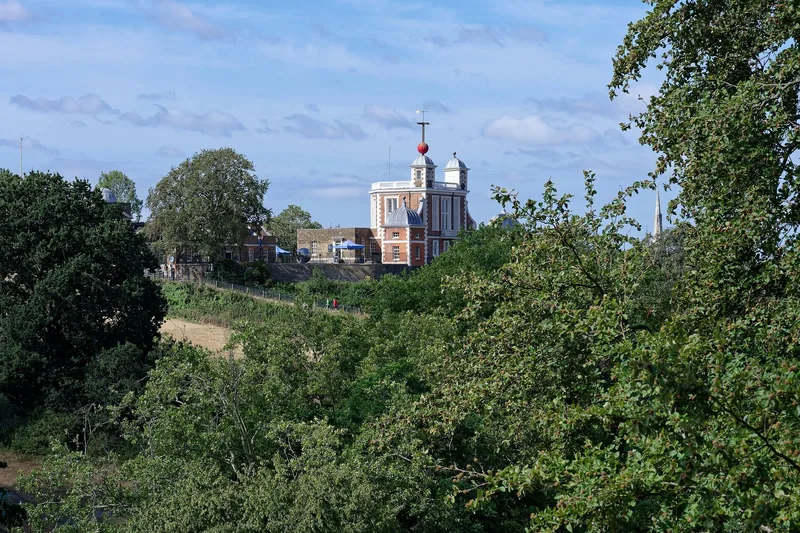
Photo: Jakub Hałun · CC BY 4.0 · Wikimedia Commons · resized
The deer, and why they are behind a fence
Henry VIII, who was born at Greenwich, brought deer to the park, and the Royal Parks calls it the oldest of London's deer parks. The herd today lives in the Wilderness Deer Paddock, a fenced enclosure of rough grass and trees in the south-east corner of the park, towards the Blackheath end.
This is the main difference between Greenwich and the two big deer parks upriver. In Richmond Park and Bushy Park the deer roam free and you must keep 50 metres away from them. Here they are enclosed, which means you can walk right up to the fence, watch them at close range, and take a photograph without any risk. For families with small children or nervous walkers, that is a real advantage, not a disappointment.
You will not always see them: the paddock is large and wooded, and on a hot afternoon the herd lies up in the shade. Early morning and late afternoon are the reliable times. Feeding any animal in the Royal Parks is not allowed, and dogs cannot go into the paddock area.
Come in from the Blackheath side for the deer. If the deer paddock is your main reason for visiting, enter at the top of the park from Blackheath rather than climbing up from the river. You start at the high end, see the deer first, then walk downhill to the Observatory terrace and the town, which is a much easier route with children.
What the Observatory closure means for your visit
Royal Museums Greenwich is rebuilding the Observatory site in a project called First Light. The timetable, as published by the museum, is specific.
- The rest of the Royal Observatory is open until 2 November 2026.
- From November the site closes temporarily.
- The Meridian Courtyard, with the Prime Meridian line, is due to reopen in summer 2027, with tickets going on sale in January.
- The whole project is due to be complete by spring 2028.
- The Peter Harrison Planetarium and the Astronomy Centre have already been closed since September 2025.
Nothing else changes. The park, the hill, the terrace, the view, the deer, the Flower Garden and the boating pond all stay open the whole time. The Cutty Sark, the National Maritime Museum and the Queen's House also stay open, and the last two are free. If your trip falls between November 2026 and summer 2027, the honest advice is to treat Greenwich as a park-and-museum day rather than a meridian day, and to give the extra hour to the Maritime Museum.
You cannot stand on the meridian line from November 2026 to summer 2027. The marked strip is inside the Meridian Courtyard, which is part of the paid Observatory site and closes with it. The free brass line that some visitors expect to find outside the gates does not exist. Plan around it rather than arriving and hoping.
The Flower Garden, the lake and the old trees
Most people never walk into the eastern half of the park, which is where the gardening is. The Flower Garden is a formal enclosure of beds, mature specimen trees and a small lake, quiet even when the hill is full. It is a good place to sit with a coffee, and at dusk pipistrelle bats hunt over the water.
The park holds more than 3,000 trees, including sweet chestnuts planted about 400 years ago whose trunks have split and twisted into hollow shapes; the Royal Parks keeps them because the crevices are habitat for bats, beetles and fungi. Much of the southern part of the park is acid grassland, one of Britain's rarer habitats. On Croom Hill in spring the slope turns dark red with sheep's sorrel.
Around 70 species of wild bird have been recorded here, including woodpeckers and tawny owls, and the park is designated a Site of Metropolitan Importance for Nature Conservation. Dogs are not allowed in the Flower Garden at all, which is part of why the birdlife is good.
A Roman temple and Anglo-Saxon burial mounds
Greenwich Park has been in use for a very long time, and two pieces of evidence sit in plain sight. Between about AD 100 and 400 a Roman temple stood close to where the bandstand is today, and its remains are marked. To the east of it is a cluster of low, distinct mounds: an Anglo-Saxon cemetery, unusually well preserved because the land has been royal parkland rather than farmland or building plots ever since.
Neither is signposted as an attraction and both are easy to walk past. They are worth ten minutes if you like the idea that the hill you are standing on has been a landmark for two thousand years. The park is also a Grade I listed landscape, laid out in the French style in the early 1600s, and a long restoration programme has been re-cutting the historic avenues and paths.
The boating pond, the playground and the tennis courts
The family end of the park is at the bottom, near the Park Row gate. There is a large playground, a boating pond with pedalos, and a café beside them, so a parent can sit while children work.
Pedalo hire costs £4.90 for an adult and £3.45 for a child aged 15 or under for 20 minutes, with a family ticket for two adults and two children at £14.50 (September 2026). Payment is by card or phone only, there is no booking, and the hut runs daily in school holidays and at weekends from April to October, 10am to 6pm. A minimum of two people is needed per boat. Our guide to boat hire and pedalos across London compares it with the other park lakes.
The park also has tennis courts, bookable through the Royal Parks, with adult and junior coaching running through the autumn. There is no charge for simply walking, running or using the open grass.
Gates, hours and which station to use
Pedestrian gates open at 6am and vehicle gates at 7am. Both close at dusk, which means a 4pm closing in midwinter and around 8pm in September, so an evening visit in the darker months has to be early. Times for the current week are published on the park's own page, and gates can close for events or maintenance.
- Cutty Sark DLR is the usual arrival: you come out next to the ship, walk through the town and enter at the river end, then face the whole climb.
- Greenwich (DLR and National Rail) is a similar distance from the western gates.
- Maze Hill (National Rail) puts you at the north-east corner, closer to the Flower Garden and the deer paddock, and avoids the crowds around the market.
- Blackheath (National Rail) is the top-of-the-hill option: you walk in level and go downhill all the way.
- By river, the boat lands at Greenwich Pier by the Cutty Sark. Our guide to the river bus explains the fares, which sit outside the daily cap.
Our page on the DLR and the London Overground covers how the driverless trains work if you have not used them.
Cafés, toilets and getting around the slope
There are cafés in the park, including the Ignatius Sancho Café, which also has the park's Changing Places toilet. Accessible toilets are on The Avenue, at the Blackheath gates and beside the playground.
The hill is the main accessibility issue, and it is a serious one: the direct route from the river to the terrace is steep. Visitors who cannot manage it should approach from the Blackheath end, where the ground is level and the view is reached without a climb. Our guide to accessible London has more on step-free routes across the city.
What to do with the rest of the day
Greenwich rewards a full day rather than a park visit. The Old Royal Naval College and its Painted Hall are at the bottom of the hill, Greenwich Market is covered and open most days, and the London Cable Car crosses the river from North Greenwich if you want to end somewhere different. Our Greenwich neighbourhood guide puts the whole day together, and staying in Greenwich covers the hotels if you would rather not commute in.
If you have enjoyed this kind of park and want more of it, Crystal Palace Park is the other big south London park with a hill, a view and something odd at the bottom of it.
Frequently asked questions
Is Greenwich Park free to enter?
Yes. The park, the hill, the view from the terrace, the Flower Garden and the deer paddock all cost nothing. Only the Royal Observatory and the Cutty Sark charge for entry, and the National Maritime Museum and the Queen's House are free.
Can you see the deer in Greenwich Park?
Yes, in the fenced Wilderness Deer Paddock in the south-east corner of the park, near the Blackheath gates. Unlike Richmond and Bushy Parks, the deer here are enclosed, so you watch them from the fence rather than keeping 50 metres away. Early morning and late afternoon are the best times, and dogs are not allowed in the paddock.
Is Greenwich Park still worth visiting after the Observatory closes?
Yes. The Observatory closes on 2 November 2026 and its Meridian Courtyard is due to reopen in summer 2027, with the full project finishing in spring 2028, but the park itself is unaffected. The hill, the free view over Canary Wharf, the deer, the gardens and the boating pond all stay open, as do the Cutty Sark and the free National Maritime Museum.
What time does Greenwich Park open and close?
Pedestrian gates open at 6am every day and vehicle gates at 7am. Both close at dusk, which varies through the year: around 8pm in September and much earlier in midwinter. Check the current week's times on the Royal Parks page before an evening visit.
How steep is the hill in Greenwich Park?
The climb from the river end to the Observatory terrace is short but steep and can be hard work with a pushchair. Entering from Blackheath at the top of the park avoids it entirely and gives you a level walk to the same view.
Sources
- The Royal Parks - Greenwich Park (checked September 2026)
- The Royal Parks - Greenwich Park frequently asked questions (checked September 2026)
- The Royal Parks - Wildlife in Greenwich Park (checked September 2026)
- The Royal Parks - Boating in Greenwich Park (checked September 2026)
- Royal Museums Greenwich - Royal Observatory transformation (First Light) (checked September 2026)
- Royal Museums Greenwich - Plan your visit (checked September 2026)