
The Design Museum's permanent collection is free and needs no ticket. Its temporary exhibitions are paid, starting at about £15.29 for an adult. The building it all happens in is a 1960s exhibition hall with a swooping concrete roof, and for a lot of visitors that roof is the best thing in the place.
It stands at 224-238 Kensington High Street, at the corner of Earl's Court Road, right at the entrance to Holland Park. The museum was founded in 1989 by Sir Terence Conran, moved here in 2016 and was named European Museum of the Year in 2018.
Most guides describe it as a paid museum, which is only half true. This page separates what costs money from what does not, explains how the building works floor by floor, and says plainly who will enjoy it and who will not.
The Design Museum at a glance
- Address
- 224-238 Kensington High Street, London W8 6AG
- Free
- Designer Maker User on Level 2, plus several other displays and the garden
- Paid
- Temporary exhibitions, adult from £15.29 (September 2026)
- Open
- Monday to Thursday 10:00 to 17:00; Friday to Sunday 10:00 to 18:00; open on bank holidays
- Payment
- Cards and digital payments only, everywhere in the building
- Nearest station
- High Street Kensington, 10 minutes on foot
What is free, and it is more than people think
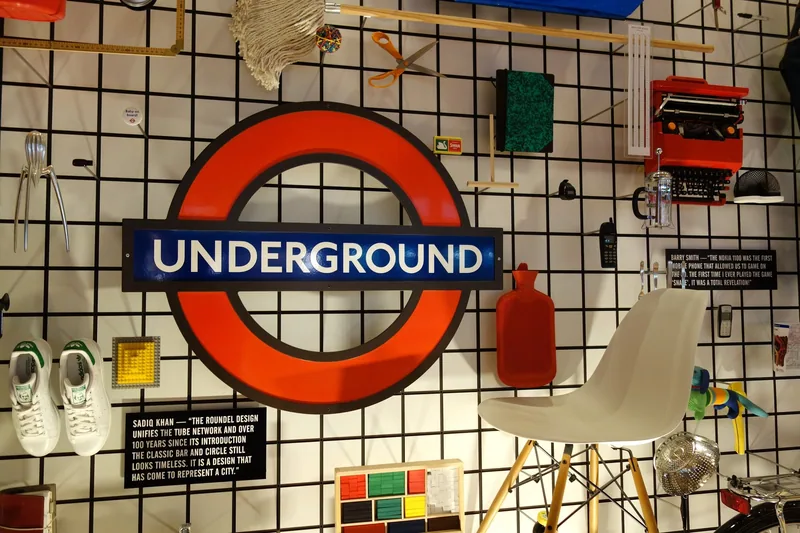
Designer Maker User, on Level 2, is the permanent collection display and it costs nothing. Nearly a thousand objects of twentieth- and twenty-first-century design are arranged around three roles: the person who designed the thing, the person who made it, and the person who used it. It spans architecture, engineering, digital products, fashion and graphics, and there is a crowdsourced wall of objects chosen by the public.
The museum recommends an hour for it, which is about right. It is family-friendly and has a downloadable trail for children.
Other free displays come and go around the building. In September 2026 those included PLATFORM: Simone Brewster on Level 1, running until January 2027; Fables for our Time, a triptych on environmental themes shown on the tri-wall on Level 2; and Dwellings, Rehomed, a collection of designer birdhouses in the museum garden with a sensory structure called The Nest, up until June 2027. None needs a ticket.
You can spend a satisfying ninety minutes here without paying anything. The permanent collection, the rotating free displays and the garden are all open to walk-ins. Buy an exhibition ticket only if the subject genuinely interests you, not because you assume the museum is otherwise closed to you.
What the exhibitions cost
The paid shows are what the museum is known for, and they are usually monographic: a designer, a brand, a movement. In autumn 2026 the main one was NIGO: From Japan with Love, on Level -1 until 4 October, covering the Japanese designer's work in street style and music alongside vintage objects and traditional crafts from his own collection.
| Ticket | From |
|---|---|
| Adult | £15.29 |
| Student or concession | £11.47 |
| Child | £7.65 |
| Members | Free, with no booking, even when sold out |
Prices move with demand, which is why they carry pence. Concessions cover visitors aged 65 and over, disabled visitors with a free carer ticket, NHS staff with a visible staff pass, people on Universal Credit or Jobseeker's Allowance, and Museums Association members; the Blue Light card is not accepted. Student tickets are for anyone aged 16 or over in full-time education, and British and non-British student cards are both accepted.
Tickets are non-refundable and non-exchangeable, so check the date before you buy. They can be bought on the day if the show has not sold out, but the museum advises booking. Educational groups must pre-book, and bookings are capped at 34 students at a time.
The museum expects most visitors to spend at least an hour in its largest exhibition space and slightly less in the smaller one. A ticket plus the free displays makes a comfortable half-day.
The building
The museum occupies the former Commonwealth Institute, a listed exhibition hall of the 1960s whose most striking feature is a great sweeping roof, hung between four corners so that it curves downwards in the middle. Inside, that roof gives you a full-height atrium with the galleries stacked around it and staircases crossing the space.
Practically, this means the museum reads as a single vertical volume rather than a sequence of rooms. Level G is the entrance, Level -1 has the biggest gallery and the lockers, Level 1 has a display space, and Level 2 has the permanent collection and the Design Kitchen. Stand on the top landing and look down before you do anything else; that is the view people come for.
The building is being altered again. Under a strategy the museum calls Transformation 2029, aimed at its fortieth anniversary, the café and shop spaces on Level G are being rebuilt, and the museum warns of low-level noise at times while the work goes on.
Lockers, food and the small print
Lockers are on Level -1, in three sizes, the largest 115cm by 52cm by 48cm. They cost £1, which is a non-refundable coin and goes to the museum, and if you have no coins you can buy a token with a card at the atrium shop. At busy times, expect to queue for one to become free.
Everything in the building is cashless, including the ticket desk, the shops and the cafés. Bring a card.
Food comes from the Design Café on the ground floor, which is small and does hot drinks and snacks, and the Design Kitchen on Level 2, which is bigger and serves meals. During the Level G rebuilding a pop-up café and shop have been operating, and individual days are affected: the Design Kitchen and café have both been closed for one-off days in 2026. You may eat your own food on the seating in the atrium and on the mezzanine, but not in the galleries, where only bottled water is allowed. There is a water fountain on Level -1.
Photography on your own device is fine without flash; tripods and selfie sticks are not allowed, and some areas are signed no photography. Trained assistance dogs are welcome; other pets are not, and the nearest dog toilet is in Holland Park.
The museum is closed for occasional whole days. In 2026 it shut completely on 2, 3, 4 and 18 September, and it closes on 24, 25 and 26 December. The galleries also begin closing fifteen minutes before the building does, so a 16:45 arrival on a Monday is not a visit.
Getting there, and the ULEZ point
The closest station is High Street Kensington, served by the Circle and District lines, ten minutes away on foot heading south-west along the high street. Holland Park on the Central line is fifteen minutes through the park itself, which is the nicest approach in good weather. Kensington (Olympia) is fifteen minutes north-east, Earl's Court fifteen minutes north, and South Kensington about twenty-five minutes from Exhibition Road.
Buses 9, 10, 27, 28, 49 and C1 stop nearby. Cycle parking sits in front of the museum and along the high street, and there are Santander docking stations around it.
One correction worth making. The museum's own getting-here page states that it lies outside both the Congestion Charge and the Ultra Low Emission Zone. The first half is right: the Congestion Charge zone does not reach this far west. The second is not. Transport for London's ULEZ covers every London borough and the City of London, which includes Kensington and Chelsea, so a non-compliant vehicle driving here pays £12.50 a day. Our guide to London's driving charges has the boundaries and the payment deadlines.
Who will enjoy it, and who will not
Come if
- You care about how everyday objects came to look the way they do
- You like modern architecture and want to stand under that roof
- You want a free display that takes an hour rather than a museum that takes a day
- The current exhibition subject is one you would read a book about
Skip it if
- You are travelling with small children who need things to climb on
- You have one day in London and have not yet seen the big free museums
- You want historic objects; almost nothing here predates the twentieth century
- You are hoping for a cheap wet afternoon and the exhibition is the part you want
What else is nearby
The museum stands at the gate of Holland Park and the Kyoto Garden, which is a better lunch break than anything on the high street. Walk east and you reach South Kensington in about twenty-five minutes, where the V&A is the obvious next stop for anyone interested in design and is free.
North of the park is Notting Hill; south is Earl's Court, where the museum has an off-site installation of a low-carbon stone construction prototype from its Future Observatory research programme. The Serpentine Galleries in Kensington Gardens are twenty minutes east and free, and make a good architecture-and-art morning with this.
For design of a different kind, London Transport Museum holds the poster and graphic design collection that shaped the look of the city, and Battersea Power Station is the most-discussed recent conversion of an old building in London. During London Fashion Week the museum usually has something on. There is a whole guide to the museums in London that charge nothing.
Frequently asked questions
Is the Design Museum free?
Partly. The permanent collection display Designer Maker User on Level 2 is free and needs no ticket, as are several rotating free displays and the garden. The temporary exhibitions are ticketed, starting at about £15.29 for an adult in September 2026.
How long do you need at the Design Museum?
About an hour for the free permanent collection, which is the museum's own recommendation, and at least another hour for a paid exhibition in the main gallery. Half a day covers everything comfortably, including the café.
What is the Design Museum building?
It is the former Commonwealth Institute, a listed 1960s exhibition hall with a dramatic curving roof, converted and reopened as the Design Museum in 2016. The interior is a full-height atrium with galleries around it, and the roof is visible from almost everywhere inside.
Which Tube station is nearest to the Design Museum?
High Street Kensington, about ten minutes' walk, which the Circle and District lines both serve. Holland Park on the Central line is fifteen minutes if you cut through the park, and Kensington (Olympia) and Earl's Court are roughly the same.
Can I take a bag into the Design Museum?
Lockers on Level -1 take coats and bags in three sizes, up to 115cm by 52cm by 48cm, for a non-refundable £1 coin. If you have no coins, buy a token by card at the atrium shop. At busy times there may be a wait for a free locker.
Sources
- Design Museum - Plan your visit (checked September 2026)
- Design Museum - FAQ for visitors (checked September 2026)
- Design Museum - Getting here (checked September 2026)
- Design Museum - Exhibitions and displays (checked September 2026)
- Design Museum - Designer Maker User (checked September 2026)
- Design Museum - About the museum (checked September 2026)
- Transport for London - Ultra Low Emission Zone, where and when (checked September 2026)