
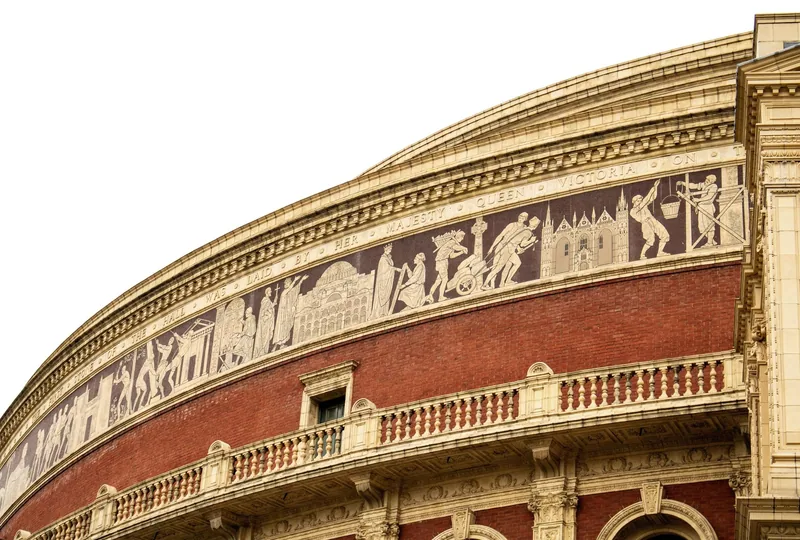
The Royal Albert Hall is the domed red-brick concert hall on the south side of Kensington Gardens, opened in 1871 and named after Prince Albert. You can get inside in two ways: buy a ticket for something, or take one of the daytime guided tours, which run most days and last about 90 minutes.
It is a working venue, not a museum, and that shapes everything about visiting. There is no permanent exhibition to wander through, no admission ticket for the building itself and no set opening hours for the public. What there is instead is a programme that runs from the BBC Proms to Cirque du Soleil, and a tour that gets you into the auditorium when nothing is on.
The address is Kensington Gore, SW7 2AP, directly opposite the Albert Memorial across the road in Kensington Gardens. It sits at the top of the museum quarter, five to ten minutes' walk above the V&A and its neighbours.
Royal Albert Hall: the basics
- Address
- Kensington Gore, London SW7 2AP
- Box office
- Door 12
- Main tour
- Royal Albert Hall Tour, about 90 minutes, most days
- Other daytime options
- Stories from the Archive tour, themed archive tours, Inside Out tour, afternoon tea, and a combined tour and tea
- Tour prices
- Shown when you select a date on the Hall's booking page; see the note below
- Listing
- Grade I
- Nearest stations
- South Kensington and High Street Kensington
- Membership
- Friends from £60 a year, for priority booking
We could not confirm the tour prices, and we will not guess at them. The Hall publishes its tour prices only inside the booking system, once you have chosen a date, and its website blocks automated checking. Pick your date on the Hall's own site and the price appears then. Treat any figure you see on a third-party site with caution.
The tours, and which one to take
There are several daytime options and they are not interchangeable.
- The Royal Albert Hall Tour is the standard one, about 90 minutes with a guide. It takes you into the royal areas of the building and into the auditorium itself, and covers the Hall's founding, the story behind why it was built and the long struggle with the building's echo. If an artist happens to be doing a soundcheck while you are in the auditorium, you hear it.
- Stories from the Archive is a different proposition: a tour built around the Hall's collection of documents and objects rather than the rooms. There are also themed versions that take a particular angle.
- The Inside Out Tour goes outside as well as in, setting the building in the wider South Kensington cultural quarter created after the Great Exhibition.
- Afternoon tea, on its own or combined with the standard tour, takes about 90 minutes. Our guide to afternoon tea in London compares it with the hotel versions.
For a first visit, take the standard tour. The archive tours are better as a second visit, and the Inside Out tour makes most sense if you are spending the whole day in the area anyway.
One small saving worth knowing: tour guests get 10% off in the Hall's shop, café and Verdi Italian Kitchen between 12pm and 4pm on the day of the tour. Book a late-morning tour and lunch immediately afterwards and the discount is worth having.
Two things the Hall tells on its own tours
The Hall's own description of the tour promises two stories worth repeating. The building once hosted a séance. And for one opera concert the auditorium floor was flooded with 56,000 litres of water.
The third is the echo, which is the thing you notice standing in the auditorium. For decades a sound made on the stage came back off the great dome a fraction of a second later. The array of discs hanging under the roof is the engineering answer to that problem, and the guides treat solving it as one of the Hall's defining achievements. Look up as soon as you get inside.
Booking a concert: what to think about before the seat plan
The Hall is a circle, and that single fact determines whether you enjoy the evening. Seats run all the way round, which means some of them are behind or to the side of the performers. For an orchestra that is usually fine and sometimes interesting. For a stand-up comedian or a rock band with a video screen it is not.
Prices, seat categories and the shape of the stage change from event to event, because promoters hire the building and lay it out as they wish. There is no permanent answer to "which seats are best", and anyone who gives you one is guessing. What you can do is use the seating plan on the Hall's own booking page, which shows the view from the sections before you commit, and read the restricted-view labels carefully rather than assuming they refer to a minor obstruction.
Two practical rules that hold across events. Tickets in the highest gallery are the cheapest and the sound up there is generally good, but the stage is a long way down. And boxes are sold as complete boxes rather than as individual seats for many events, so they suit a group of four or five and are poor value for two.
The box office is at Door 12, and that is also where London Passes are redeemed. The Hall states that London Passes can only be used on the day to secure a place on a tour, and must be presented in person at the box office. You cannot book a tour slot in advance with one, which matters on a busy Saturday; see our assessment of whether the London Pass is worth it.
The programme beyond the famous concerts
Most visitors think of the Hall as the home of the BBC Proms, which it is. In 2026 the season opened on 17 July and closed on 12 September. How the standing tickets and the season work is set out in our guide to the BBC Proms; no 2027 dates had been published by September 2026.
The rest of the year is broader than people expect. Recent and forthcoming programmes have included films screened with the score played live by an orchestra, from Harry Potter and the Philosopher's Stone to Home Alone and a John Williams tribute; a Cirque du Soleil residency; ballet; and a steady run of rock and pop.
Cheaper and much less known is the Elgar Room, a small space inside the building with its own programme. It has run Late Night Jazz evenings, a comedy night for parents with babies in the room, storytelling and music sessions for under-fives and soundbaths for parents and babies. For anyone who wants to be inside the building without paying arena prices, this is the way.
Exhibitions and the free spaces
The Hall mounts small exhibitions in its public areas, drawn from its own archive or from visiting collections; one of the Royal Photographic Society's collection ran from 10 August to 1 October 2026. These are not always ticketed in the way a gallery show is, so check what is on before you pay for anything.
There is no free public access to the auditorium, however. The building's corridors are not a place to wander in the way the foyers of the Southbank Centre are. If your budget is the constraint, a cheap ticket to something in the Elgar Room will get you further than a tour.
Booking, and the Friends scheme
Everything is booked through the Hall's own website or its box office at Door 12. Popular concerts sell out on the day they go on sale, and the Hall runs a membership scheme, Friends, from £60 a year, which gives priority booking before general release.
Whether £60 is worth it depends entirely on how many times you expect to book. For a single visitor on one trip to London it is not. For anyone who intends to come back, or who has set their heart on one particular sold-out night, it is the only legitimate way to get ahead of the queue. Group bookings and some packages are handled by telephone rather than online, so read the notes on the booking page before you assume everything can be done in a browser.
Do not buy from resale sites. The Hall sells its own tickets, and the box office is the only counter that can help if something goes wrong on the night.
Getting there, and getting away afterwards
South Kensington, on the Piccadilly, District and Circle lines, is the station most people use; the walk up Exhibition Road takes about ten minutes and passes the museums. High Street Kensington, on the Circle and District lines, is a similar distance from the western side. Our Underground guide explains which lines serve which.
The problem is the end of the evening. When a full house leaves at once, South Kensington station is overwhelmed and the queue for a taxi on Kensington Gore is long. The sensible options are to walk ten minutes east through Hyde Park towards Knightsbridge, or to plan on staying for a drink for twenty minutes and letting the crowd clear. Our guide to London at night covers late transport more generally.
Making a day of it in South Kensington
The Hall stands at the head of the group of institutions that grew up in South Kensington after the Great Exhibition. The Science Museum, the Natural History Museum and the V&A are all free and all within ten minutes. The Serpentine Galleries are across the park.
Our neighbourhood guide to South Kensington has where to eat between them. For the wider picture of who plays where in London, see live music venues, classical music in London and the O2 and the big arenas, and for opera the Royal Opera House.
Frequently asked questions
Can you go inside the Royal Albert Hall without a concert ticket?
Yes, on a guided tour. The main Royal Albert Hall Tour lasts about 90 minutes and takes you into the auditorium and the royal areas. There are also archive tours, an Inside Out tour that covers the surrounding quarter, and afternoon tea. All are booked through the Hall's own website.
How much does a Royal Albert Hall tour cost?
The Hall shows tour prices only once you select a date in its booking system, so we cannot quote a figure we have verified. Choose your date on the Hall's official website to see the current price, and be wary of prices quoted elsewhere.
Which are the best seats at the Royal Albert Hall?
It depends entirely on the event, because promoters lay out the stage differently and the auditorium is a circle with seats all the way round. Use the seating plan on the Hall's booking page, which shows the view from each area, and read restricted-view warnings carefully. Boxes are often sold whole, which suits groups rather than couples.
Which Tube station is nearest to the Royal Albert Hall?
South Kensington, on the Piccadilly, District and Circle lines, about ten minutes' walk up Exhibition Road. High Street Kensington, on the Circle and District lines, is a similar distance from the western side. Expect long queues at South Kensington immediately after a big concert.
Is the Royal Albert Hall only used for the Proms?
No. The Proms take up roughly eight weeks of the summer, opening in mid-July and finishing in September. Across the rest of the year the Hall hosts films with live orchestras, circus, ballet, comedy, rock and pop concerts, and a separate programme of smaller events in the Elgar Room.
Sources
- Royal Albert Hall - Royal Albert Hall tour (checked September 2026)
- Royal Albert Hall - What's on (checked September 2026)
- BBC Proms (checked September 2026)