
Royal Museums Greenwich runs four sites within a short walk of each other: the Royal Observatory, where you can stand on the Prime Meridian, the tea clipper Cutty Sark, and the free National Maritime Museum and Queen's House. The Observatory costs £24 and Cutty Sark £22 for an adult (September 2026), and the Observatory closes for building work after 2 November 2026.
Greenwich lies on the south bank of the Thames in south-east London, about 20 minutes from Tower pier by river bus. It was a royal riverside town for centuries, and its palace, naval college, park and observatory together form a UNESCO World Heritage Site, listed in 1997. Most visitors come for two things: to put one foot in the eastern and one in the western hemisphere on the Prime Meridian line, and to walk under the copper-covered hull of the Cutty Sark.
This guide explains what each of the four sites offers, what they cost, how the Day Pass works, and what the Observatory's long closure means if you are planning a trip for late 2026 or 2027. It is easy to fill a whole day here, and with two of the four sites free, Greenwich can be good value.
Royal Museums Greenwich: the four sites
- Royal Observatory
- Adult £24, child (4-15) £12; September 2026 hours 10am-6pm, last entry 5pm; closed from November 2026, Meridian Courtyard reopening summer 2027
- Cutty Sark
- Adult £22, child £11; daily 10am-5pm, last entry 4.15pm
- Greenwich Day Pass
- Observatory and Cutty Sark: adult £38, child £19
- National Maritime Museum
- Free; daily 10am-5pm
- Queen's House
- Free; daily 10am-5pm, closed 24-26 December
- Under-4s
- Free at all sites
- Nearest station
- Cutty Sark (for Maritime Greenwich) DLR; Greenwich and Maze Hill rail stations
The Observatory shuts its gates after 2 November 2026. Royal Museums Greenwich is rebuilding the site in a project called First Light. The Peter Harrison Planetarium has been closed since September 2025, the rest of the Observatory stays open until 2 November 2026, and the Meridian Courtyard with the Prime Meridian line is due to reopen in summer 2027, with tickets on sale from January. The whole project is due to finish by spring 2028.
The Royal Observatory and the Prime Meridian
King Charles II founded the Royal Observatory in 1675 to solve a practical problem: sailors could not work out their longitude, their position east or west, and ships were lost as a result. Astronomers here spent generations measuring the stars, and in 1884 an international conference in Washington chose the Greenwich meridian as the world's Prime Meridian, zero degrees longitude. Greenwich Mean Time and the world's time zones are based on it.
Standing on the line
The meridian is marked by a metal strip set into the Meridian Courtyard. Standing astride it for a photo is the classic Greenwich picture, and at busy times there is a queue for it. The courtyard is inside the paid area, so you need an Observatory ticket to stand on the official line. At night a laser beam marks the meridian across the sky, and Royal Museums Greenwich says it can be seen from more than 20 km away, depending on the weather.
What else is inside
The oldest building is Flamsteed House, designed by Sir Christopher Wren. Its Octagon Room, completed in 1676, still has astronomical instruments and clocks around its walls. Nearby are John Harrison's marine timekeepers, H1 to H4, the clocks that finally allowed ships to find their longitude at sea. H4 looks like a large pocket watch and is one of the most important timepieces ever made. The Great Equatorial Telescope, under the onion-shaped dome you see from the park, is more than eight metres long and the largest of its kind in the UK.
In 2026 the Meridian Courtyard also holds Mirror Moon, a two-metre stainless steel sphere by the artist Luke Jerram, built from NASA data, which you are allowed to touch. The audio guide is free and plays on your own phone, so bring headphones. Guided tours cost extra: in September 2026 the Treasures Tour ran daily at 11am and 3pm for £5 per adult on top of the entry ticket.
The view from the hill
The Observatory stands on a steep hill in Greenwich Park, and the terrace outside gives one of the best views in London: the Queen's House and the old naval college below, the river beyond, and the towers of Canary Wharf behind. The view from the park itself is free, so even if you skip the paid areas, walk up the hill. We cover more lookouts in our guide to London's best free viewpoints.
Cutty Sark, the tea clipper in dry dock
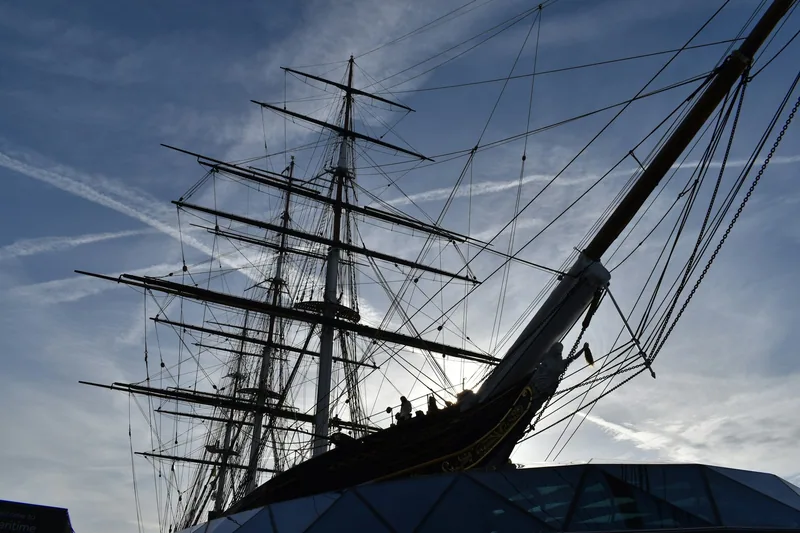
Cutty Sark is a British sailing ship built in 1869 to carry tea from China, and Royal Museums Greenwich describes her as the fastest ship of her time. Her name, and her figurehead of a witch, come from a poem by Robert Burns. The ship was badly damaged by fire in 2007 during conservation work and reopened to visitors in 2012, raised up in a glass-walled dry dock.
The visit has three levels. Inside the hull you see how cargo was stored and how the crew lived. On the main deck you walk among the masts and rigging and can look into the cabins. The most unusual part is underneath: you can stand below the gleaming copper hull and look up at the whole ship above you. The café is also down there, and only ticket holders can use it.
Volunteer explainers and costumed "characters" bring the ship's history to life, especially at weekends in term time, and sea shanty groups sing on board on the first weekend of each month. An audio guide is available free on your phone. With younger children we would choose Cutty Sark over the Observatory, because there is more space to move and more to touch.
Tickets, prices and the Day Pass
The National Maritime Museum and Queen's House are free. The Royal Observatory and Cutty Sark charge for entry. These are the adult, child and student prices shown on the official tickets page in September 2026:
| Site | Adult (16+) | Child (4-15) | Student |
|---|---|---|---|
| Royal Observatory | £24 | £12 | £18 |
| Cutty Sark | £22 | £11 | £16.50 |
| Day Pass (Observatory and Cutty Sark) | £38 | £19 | £28.50 |
| National Maritime Museum | Free | Free | Free |
| Queen's House | Free | Free | Free |
Children under 4 go free everywhere. For two adults and two children aged 4-15, the Day Pass costs £114, against £138 if you buy the two sites separately. A couple pays £76 with Day Passes. Note that the official website is not fully consistent: its drop-down menu showed an older-looking figure of £18 for adults at both paid sites, and one table gave £12 for a Cutty Sark child ticket and £18 for a student. Always check the price at the booking stage on the official tickets page.
Tickets are sold online with an entry time, and Royal Museums Greenwich recommends booking in advance to guarantee entry; tickets on the day are subject to availability. Art Pass holders get half-price entry, and English Heritage and Museums Association members get discounts. A free carer ticket is available for anyone accompanying a disabled visitor. Before buying a sightseeing pass for Greenwich, check which sites it covers; our look at whether the London Pass is worth it explains how to compare.
Cutty Sark costs £10 on Tuesdays this September. Royal Museums Greenwich ran a time-limited "£10 Tuesdays" offer for Cutty Sark on Tuesdays from 8 to 29 September 2026, redeemed through its booking site. Offers like this come and go, so it is worth checking the tickets page before you pay full price.
The free museums: National Maritime Museum and Queen's House
The National Maritime Museum is the largest of the four sites and it is free. Its galleries cover exploration, trade, the navy and the oceans, from the Arctic to the Pacific. You do not need to book, although a free timed ticket guarantees entry at busy times. Families should look for AHOY!, the children's gallery, and The Cove, a sea-themed playground. In 2026 the museum also hosts two paid extras: the ZWO Astronomy Photographer of the Year exhibition (£12 for adults) and Astronomers Take Over, a hands-on astronomy space with an optional planetarium show that partly replaces the closed Observatory planetarium (£8, or £18 with the planetarium, for adults).
The Queen's House, next door, was designed by Inigo Jones for Anne of Denmark, the wife of James I, and it was the first classical building in England. Its white cube shape and the geometric floor of its Great Hall influenced British architecture for centuries. Inside is an art collection that includes the Armada Portrait of Elizabeth I, one of the best-known images of the Tudor queen. Entry is free, with free tours and audio guides, and you can usually turn up without booking.
If free museums are what you enjoy, our guide to free museums in London lists many more across the city.
How to plan a day in Greenwich
You can see the highlights in half a day, but a full day is more relaxed. The paid sites have timed entry, so fix those first and fit the free sites around them. One sensible order:
- Morning: arrive by boat or DLR and start at Cutty Sark, which is right by the pier and the station.
- Late morning: walk through the old town to the National Maritime Museum and the Queen's House.
- Lunch: eat at Greenwich Market or one of the museum cafés.
- Afternoon: climb the hill through Greenwich Park to the Royal Observatory. Book your Observatory slot for after lunch, and allow 15 minutes or so for the steep walk up.
Be aware of one-off early closures. In autumn 2026 the Observatory closed at 5pm on 19, 23 and 25 September, and all Royal Museums Greenwich sites closed at 3.30pm on Wednesday 7 October 2026 for a staff event. Our Greenwich neighbourhood guide covers the rest of the area, from the park to the pubs. From North Greenwich station on the Greenwich Peninsula, a bus ride away, the IFS Cloud Cable Car crosses the river if you want a different way back.
Getting to Greenwich by DLR, train or boat
The DLR is the simplest option. Cutty Sark (for Maritime Greenwich) station is in the town centre, about two minutes' walk from the ship and seven minutes from the National Maritime Museum. The DLR connects with the Tube at Bank, Canary Wharf, Tower Gateway and Stratford, and every DLR station is step-free. Our guide to the DLR and London Overground explains how it works. DLR trains from Bank to Greenwich pass through West India Quay; if you break your journey there, the free London Museum Docklands is three minutes from the station and makes a good extra stop.
By train, direct services run from London Bridge and Cannon Street to Greenwich and Maze Hill stations. Greenwich station is closest to Cutty Sark; Maze Hill is closer to the Maritime Museum, the Queen's House and the Observatory. Both have step-free access to the platforms. Pay-as-you-go contactless and Oyster work on these routes as on the Tube.
The river is the most enjoyable way to arrive. Uber Boat by Thames Clippers runs to Greenwich Pier, next to Cutty Sark, and Royal Museums Greenwich gives journey times of about 20 minutes from Tower pier, 25 minutes from London Bridge and 45 minutes from the London Eye. You can pay with contactless or Oyster, but boat fares do not count towards the daily cap, so it costs more than the DLR. See our guide to the Thames river bus for fares, or compare it with slower sightseeing cruises with commentary. Combining the Tower of London in the morning with a boat to Greenwich works well; see our Tower of London guide.
If you are walking along the Thames Path from the north bank, the Greenwich Foot Tunnel under the river comes up right beside Cutty Sark. By car, the National Maritime Museum has a car park on Park Row, open at weekends, on bank holidays and in school holidays, from £14 for the day; spaces can be booked with your tickets.
Visiting Greenwich with children
Greenwich is one of London's easiest family days out. The park has plenty of space, the free museum has a playground and a children's gallery, and the ship gives children decks to explore. Under-4s go free everywhere, and child tickets are half the adult price. The Observatory is the least child-friendly part: many of its treasures are clocks and instruments behind glass, the rooms are small, and the hill is steep with a pushchair. With young children, we would put Cutty Sark and the Maritime Museum first and treat the Observatory as optional. More ideas are in our London with kids guide.
Frequently asked questions
Is the Royal Observatory open in November 2026?
No. Royal Museums Greenwich says the Observatory is open until 2 November 2026 and then closes temporarily for its First Light building project. The Meridian Courtyard, with the Prime Meridian line, is due to reopen in summer 2027, with tickets on sale from January.
How much does it cost to stand on the Prime Meridian?
The official meridian line in the Meridian Courtyard is included in a Royal Observatory ticket, which cost £24 for an adult and £12 for a child aged 4-15 in September 2026. Under-4s go free. The view from Greenwich Park outside the Observatory is free.
Is the Greenwich Day Pass worth it?
If you want to see both the Royal Observatory and Cutty Sark, yes. The Day Pass cost £38 for an adult in September 2026, against £46 for the two tickets bought separately. If you only want one of them, buy a single ticket.
Are the National Maritime Museum and Queen's House free?
Yes. Both are free to enter and open daily from 10am to 5pm. Booking a free ticket is optional and guarantees entry at busy times. Some special exhibitions at the Maritime Museum are paid.
What is the best way to get from central London to Greenwich?
The DLR to Cutty Sark (for Maritime Greenwich) station is the cheapest and simplest, and the Uber Boat to Greenwich Pier is the most scenic, taking about 20 minutes from Tower pier. Direct trains also run from London Bridge and Cannon Street to Greenwich and Maze Hill.
Sources
- Royal Museums Greenwich - Tickets and prices (checked September 2026)
- Royal Museums Greenwich - First Light: transforming the Royal Observatory (checked September 2026)
- Royal Museums Greenwich - Royal Observatory closures (checked September 2026)
- Royal Museums Greenwich - Stand on the Prime Meridian line (checked September 2026)
- Royal Museums Greenwich - Cutty Sark (checked September 2026)
- Royal Museums Greenwich - Queen's House (checked September 2026)
- Royal Museums Greenwich - Getting here (checked September 2026)