
The large domed building facing the west front of Westminster Abbey is not part of the Abbey. It is Methodist Central Hall, a Methodist church and conference centre opened in 1912, and the place where the first General Assembly of the United Nations met on 10 January 1946.
It stands at Storey's Gate, across the road from the Abbey's twin towers, and thousands of people photograph its dome every day believing they are looking at the Abbey. The Abbey has no dome. Central Hall is a separate building, run by a different church, with a history of its own that most visitors walk straight past.
Our guide to Westminster covers the area as a whole, and our Westminster Abbey page covers the Abbey's tickets and opening hours. This page is about the building on the other side of the road: what it is, why the UN met there, and what you can see of it.
Methodist Central Hall at a glance
- Address
- Storey's Gate, Westminster, London SW1H 9NH
- What it is
- A Methodist church, and a conference and events venue run as Central Hall Westminster
- Opened
- 1912; built 1905-11 to designs by Lanchester and Rickards
- Listing
- Grade II*, listed in 1958
- Best known for
- The first United Nations General Assembly, from 10 January 1946
- Café
- On site and open to the public; hours vary, so check before you go
- Nearest Tube
- St James's Park (District and Circle), Westminster (Jubilee, District and Circle)
- Telephone
- 020 7222 8010
Why everyone mistakes it for Westminster Abbey
The confusion is easy to understand. Central Hall sits directly opposite the Abbey's west towers, a few steps from where the Abbey's visitors gather, and its dome is the largest thing in the view. Many photographs labelled "Westminster Abbey" on social media actually show this building.
The three buildings with "Westminster" in their names are not connected. Westminster Abbey is the Church of England's coronation church, Gothic, with two towers and no dome. Westminster Cathedral, ten minutes away on Victoria Street, is the mother church of Roman Catholics in England and Wales, built in striped brick. Methodist Central Hall belongs to neither: it was built as the headquarters of the Wesleyan Methodist Church, one of the bodies that later formed today's Methodist Church of Great Britain.
The dome is Central Hall; the twin towers are the Abbey. If you are meeting someone "outside the Abbey", say which. The two buildings face each other across Broad Sanctuary, and a group waiting under the dome can miss a friend standing at the Abbey's north door.
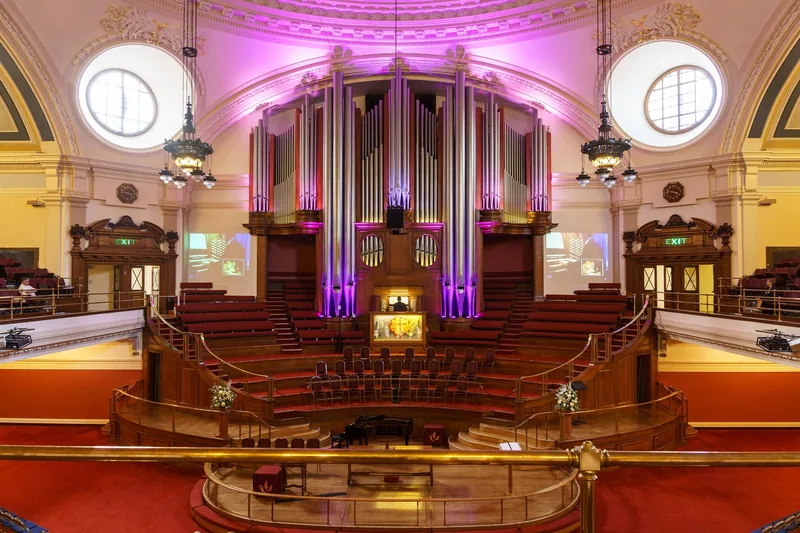
Photo: © User:Colin · CC BY-SA 4.0 · Wikimedia Commons · resized
A guinea each from a million Methodists
The money was raised in an unusual way. According to the United Methodist Church's account, the Wesleyan Methodists asked every member to give one guinea, an old coin worth £1.05, and no more. The target was one million guineas from one million members, and the collection reached 1,024,501 guineas.
The building was meant to be more than a church. It was to house a worshipping congregation and the denomination's offices, and also to serve, in the words of its founders as the UMC quotes them, as a place for "conferences on religious, educational, scientific, philanthropic and social questions". That second purpose is why it is still hired out for events today, and why its history includes so much that has nothing to do with Methodism.
The site was a deliberate choice. Building the headquarters of a Nonconformist church across the road from the Abbey, the coronation church of the Church of England, was a statement about where Methodism stood in Edwardian Britain. For the older story of John Wesley himself, his house and his chapel on City Road, see our page on Wesley's Chapel and Nonconformist London.
The building, as the listing describes it
Historic England lists Central Hall at Grade II* and dates it to 1905-11, by the architects Lanchester and Rickards. The outside is faced in Portland stone over an early reinforced concrete frame, built on what the listing calls the Kahn system, with a steel-trussed, lead-clad dome. The style is described as Edwin Rickards' "sophisticated Continental Baroque", disciplined by giant Corinthian columns and building up to a massive square French dome with a cupola on top.
Henry Lanchester's contribution was the plan inside. The main hall is raised above the ground floor and surrounded by offices and smaller rooms on four sides. The grand staircase rises from the entrance in two flights, meets, divides again and returns to hall level under a wide arch, with a scrolled bronze balustrade. Over the Great Hall itself is a vast coffered saucer dome. Open House, which includes the building in its September festival, calls it the second largest self-supporting ferro-concrete dome in the world.
10 January 1946: the first United Nations General Assembly
When the United Nations held its first General Assembly, it chose London. The United Nations Regional Information Centre's account explains why this hall: nearby Church House was used for the first meeting of the Security Council on 17 January, but a larger room was needed for the Assembly, and Central Hall had come through the war intact. The Foreign Secretary, Ernest Bevin, had to persuade the minister, the Revd Dr William Sangster, and his congregation to give up their hall.
Seats were removed, carpets laid and translation booths built, and tables 40 feet long were set out for the delegations of the 51 nations taking part. The Prime Minister, Clement Attlee, gave the opening speech. Eleanor Roosevelt, a member of the United States delegation, used the session to present an "Open Letter to the Women of the World". Around 800 journalists came, slightly more than the delegates, and the session ran until 14 February. A plaque on the outside of the building records the meeting.
The choice of venue had a wartime background. Sangster had arrived at Central Hall at the start of the Second World War and organised an air-raid shelter in the basement, where he and other Londoners lived and slept for 1,688 days, according to the UMC. If the war years interest you, the Churchill War Rooms are about five minutes' walk to the north, beneath the Treasury building off Horse Guards Road.
The day the World Cup went missing
The hall's oddest footnote is footballing. In March 1966, a few months before England hosted the World Cup, the Jules Rimet trophy was put on display at a stamp exhibition in Central Hall, and on 20 March it was stolen. It was found a week later wrapped in newspaper in a south London garden by a dog called Pickles.
The building has also hosted public inquiries, concerts and religious rallies, and, according to the UMC, the first public performance of Joseph and the Amazing Technicolor Dreamcoat: Andrew Lloyd Webber's father, William, was Central Hall's director of music. None of this is on display in any organised way, which is part of the reason the building is so little known.
What a visitor can actually see
Central Hall is a working venue first. The Great Hall and the upper rooms are booked for conferences, exams, concerts and private events, so what is open on a given day depends on the diary. The hall says visitors can take a guided tour and use its café, which is open to the public, but the times on its own web pages do not agree with each other, and its customer service desk keeps weekday office hours only.
So treat a visit as a short stop rather than a planned attraction. Look at the outside and the plaque, step into the entrance if it is open, and ring 020 7222 8010 before you go if seeing the Great Hall or joining a tour matters to you. We could not confirm tour days or prices from the hall's own website when we checked in November 2026, so we do not print them here.
For access, Open House reports step-free routes, a hearing loop, accessible toilets and baby changing, and says the whole building is easily accessible except the dome. The Methodist congregation still worships here; check service times with the hall rather than relying on older listings.
Thirty seconds from the Abbey queue
The reason to know about Central Hall is its position. If you are queuing for the Abbey, it is the building across the road. If you arrive at the Abbey to find it closed to sightseers, as it is on Sundays and by mid-afternoon on other days, Central Hall is the nearest place to sit down indoors, and its café is a calmer alternative to the busy streets around Parliament Square. Our page on the best time to visit Westminster Abbey explains when that queue is shortest.
St James's Park station is about five minutes away on foot, along Tothill Street, and Westminster station about seven, past Parliament Square. Buses including the 11, 24, 88, 148 and 159 pass close by, and an adult bus fare is £1.85 (November 2026). For a full lunch rather than a coffee, see our guide to where to eat near Westminster.
Central Hall pairs well with other buildings in this guide that people pass without entering. The Royal Hospital Chelsea, three stops away on the District and Circle lines at Sloane Square, has a free Sunday service in a Wren chapel. And if you have been inside the Abbey and want more of Parliament, our page on Houses of Parliament tours explains how to get in there too.
Frequently asked questions
What is the domed building opposite Westminster Abbey?
It is Methodist Central Hall Westminster, a Methodist church and conference centre opened in 1912. It is not part of Westminster Abbey, which has two towers and no dome. Central Hall stands at Storey's Gate, across Broad Sanctuary from the Abbey's west front.
Where was the first United Nations General Assembly held?
In the Great Hall of Methodist Central Hall in Westminster, London, opening on 10 January 1946. Delegations from 51 nations attended, and the session ran until 14 February. The first meeting of the Security Council was held a week later at nearby Church House.
Can you go inside Methodist Central Hall?
Its café is open to the public and the hall says visitors can take a guided tour, but it is a working events venue and access to the Great Hall depends on what is booked. Ring the hall on 020 7222 8010 before you go if seeing the interior is important to you.
Who paid for Methodist Central Hall?
The Wesleyan Methodist Church asked each of its members to give one guinea, and no more, towards a fund of one million guineas. According to the United Methodist Church, the collection reached 1,024,501 guineas, and the hall opened in 1912 as the church's headquarters.
Sources
- United Nations Regional Information Centre - In Pictures: first-ever UN General Assembly in London 80 years ago (checked November 2026)
- Historic England - Methodist Central Hall, Westminster, list entry 1264457 (checked November 2026)
- United Methodist Church - Serving the world from the heart of London: Methodist Central Hall (checked November 2026)
- Open House Festival - Methodist Central Hall Westminster (checked November 2026)
- Central Hall Westminster - Visitors info (checked November 2026)