
The Royal Hospital Chelsea is still doing the job Charles II founded it for: it is the home of nearly 300 retired British Army soldiers, the Chelsea Pensioners. Visitors can see a free exhibition from Tuesday to Sunday without a ticket, but the Great Hall and Wren's chapel are seen on a paid guided tour led by a Pensioner, from £30 for an adult (November 2026), or free at Sunday morning worship.
It is not a hospital in the modern sense and not a museum that happens to have residents. It is a working home, and the visit is arranged around the people who live there: tours run at set times, some areas close at short notice, and nothing happens on a Monday. Our guide to Chelsea as a neighbourhood covers the streets around it. This page is about getting inside and what you see when you do.
The Royal Hospital Chelsea at a glance
- Visitor entrance
- Chelsea Gate, Royal Hospital Road, London SW3 4SR
- Free exhibition
- Soane Stable Yard, Tuesday to Sunday 09:00 to 17:00, last admission 16:30. No ticket
- Public guided tour
- £30 adult, £17.50 child, about 90 minutes to two hours (November 2026)
- Wellington Hall Museum tour
- £15 adult, £7.50 child aged 5 to 15, one hour at 14:00; running every Wednesday until 9 December 2026 (checked November 2026)
- Tours released
- Bookable through to 9 May 2027 when we checked (November 2026); dates are released up to twelve months ahead
- Closed
- Mondays: no tours and no exhibition
- Chapel services
- Sundays 09:00 and 11:00, open to all, free
- Nearest Tube
- Sloane Square (District and Circle lines)
What you can see for free, and what needs a ticket
The free part is the Interactive Exhibition in the Soane Stable Yard, just inside Chelsea Gate. It tells the story of the hospital and of the Pensioners through the centuries, and it is open from Tuesday to Sunday, 09:00 to 17:00, with last admission at 16:30. The yard also holds a shop, a post office and a café, so it works as a short stop even if you never go further in.
The main buildings are a different matter. The Great Hall, where the Pensioners eat, the chapel and the courtyards are seen on a guided tour. The hospital's own museum, the Wellington Hall Museum, is not part of the free exhibition at all: it is described by the hospital as the Pensioners' private regimental museum, normally kept for the residents, and it opens to the public only on a separate, shorter tour.
The one free way into a Wren interior is to attend a service. The chapel holds Holy Communion at 09:00 and Choral Matins at 11:00 every Sunday, and the hospital says all are welcome. Treat it as worship, not sightseeing: arrive before the start, stay to the end, and leave the camera in your bag.
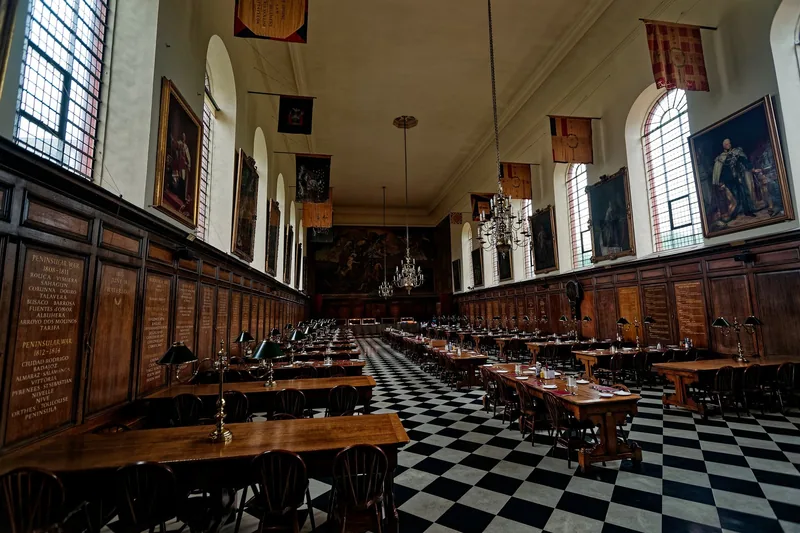
Photo: Txllxt TxllxT · CC BY-SA 4.0 · Wikimedia Commons · resized
The Pensioner-led tour: times, length and what it costs
Every public tour is guided by a Chelsea Pensioner, which is the reason to book it. You get the buildings and their history, but also a resident's account of what living there is like, from the small rooms known as berths to the daily routine. Tours are limited to 25 people and typically last 90 minutes, sometimes two hours if the group asks a lot of questions.
In the busy season there are two public tours a day, Tuesday to Sunday, at 10:30 and 14:00. Off-peak there is usually one a day, alternating between the two times, so check the booking calendar before you fix a date. The meeting point is the Soane Stable Yard, reached through Chelsea Gate.
| Tour | Adult | Child | Two adults and two children |
|---|---|---|---|
| Public guided tour of the site | £30 | £17.50 | £95 |
| Treasures tour of the Wellington Hall Museum | £15 | £7.50 | £45 |
| Private group tour, minimum 10 people | £25 | £15 | - |
Prices are from the hospital's tour page (November 2026). The hospital recommends the tours for guests aged 14 and over; younger children can come, but it asks families to email first. For most families with small children the free exhibition and a walk past the buildings will be the better use of an hour.
Royal Hospital tour tickets cannot be refunded. All sales are final. A change of date is possible with at least four weeks' notice and costs £2.50, and the hospital may refuse entry to a group more than 30 minutes late. If your plans are loose, book closer to the day rather than months ahead.
Wren's building, and the parts that are older or newer than you think
Charles II founded the hospital by Royal Warrant on 7 December 1681 for soldiers "broken by age and war", almost certainly with the Hôtel des Invalides in Paris in mind. The buildings came from Sir Christopher Wren, then busy rebuilding St Paul's Cathedral, and Historic England's list entry dates the main range to 1682-1702. The first 99 Pensioners moved in on 4 February 1692 and a further 377 followed on 28 March that year.
The plan is three courtyards open on one side, in dark brick with stone dressings. The central one, Figure Court, faces the river and holds a gilded statue of Charles II, listed at Grade I in its own right. The block in the middle of the main range has a pedimented portico and a cupola, with the hall on one side of the vestibule and the chapel on the other. The main buildings are listed at Grade I.
Wren's work is the obvious attraction, but the visitor entrance is a later addition. The Soane Stable Yard was designed and built in 1814-17 by Sir John Soane, the architect of the Bank of England, who was the hospital's Clerk of Works for 30 years. It held stalls for 25 horses and space for nine carriages, and it is listed at Grade II* (the hospital's own web pages give two different grades; Historic England's entry says II*). It was recently restored with National Lottery Heritage Fund money.
If you are planning a Wren day, the hospital pairs naturally with its sister foundation for sailors at Greenwich, now the Old Royal Naval College, which Wren also designed. They are at opposite ends of central London, so allow most of a day for both.
Inside the chapel and the Great Hall
The chapel was built between 1681 and 1687 and consecrated in 1691. It was designed for about 500 people, and services were once compulsory twice a day. The panelling and pews are original, carved by Sir Charles Hopson with additional work by William Emmett, and the apse holds a painting of the Resurrection by Sebastiano Ricci, dated 1714 and probably a gift from Queen Anne.
The Great Hall is still the Pensioners' dining hall, which is why you see it with a guide rather than wandering in. It is also where the Duke of Wellington lay in state after his death in 1852, before the funeral at St Paul's. The duke's London house is now a museum at Hyde Park Corner; our page on Apsley House and the Wellington Arch covers it.
Who the Chelsea Pensioners are
A Chelsea Pensioner today is a British Army veteran who has reached State Pension age and chosen to live at the hospital. Residents surrender their Army pension in return for board, lodging and care. The hospital describes them as men and women, and it puts the current number at nearly 300.
The scarlet coats are worn for formal occasions and when Pensioners represent the hospital in public, so you will not necessarily see one on an ordinary weekday. The name once covered more people: until 1955 the hospital paid Army pensions to veterans living elsewhere, the Out-Pensioners, and only those who lived in were In-Pensioners. Today the title is kept for residents.
The biggest day of their year is Founder's Day, or Oak Apple Day, held near 29 May, Charles II's birthday. The Pensioners wear oak leaves and the statue in Figure Court is dressed in them, in memory of the king hiding in an oak tree after the Battle of Worcester in 1651. Attendance is by invitation only. The hospital also has a plot of its own in Brompton Cemetery, a mile and a half to the west.
Flower Show week changes everything
Each May the RHS Chelsea Flower Show fills the hospital grounds, including Ranelagh Gardens, where an 18th-century pleasure garden once stood around a rotunda almost the size of the Royal Albert Hall; Mozart played there as a boy in 1764. The 2027 show runs from 18 to 22 May, and our Chelsea Flower Show guide has the tickets and the public days.
For an ordinary visitor this matters in two ways. The streets around Royal Hospital Road are crowded all week and some are closed, and the grounds belong to the show while it is on. If you want a quiet tour and an unhurried look at the buildings, avoid the second half of May and check the tour calendar for gaps around the show dates.
Getting there from Sloane Square and Victoria
The nearest Tube station is Sloane Square, on the District and Circle lines. From there walk south down Lower Sloane Street to Royal Hospital Road. It is not the five-minute stroll it looks on a map: TfL's journey planner gives 18 minutes on foot to the hospital's postcode, and about 15 minutes to Chelsea Gate is a fair expectation. Victoria is the nearest main-line station.
Bus 170, between Victoria and Roehampton, stops right outside. Buses 11, 137, 211, 360 and 452 stop a short walk away, and an adult fare is £1.85 whichever you take (our guide to London buses explains paying with a card). There is very little on-street parking and resident schemes cover the area, so do not drive.
The hospital says the tour route is wheelchair accessible and keeps a spare wheelchair to lend. The Soane Stable Yard has accessible toilets, a Changing Places toilet with an adult changing table and hoist, and baby changing.
Fitting it into a Chelsea day
The National Army Museum is next door, free, and also closed on Mondays, so the two make an obvious pair from Tuesday to Sunday. The Chelsea Physic Garden, a few minutes west along Royal Hospital Road, is the opposite: open Sunday to Friday and shut every Saturday.
For lunch, the café in the Soane Stable Yard is run by Heidi Bakery, rated 5 for food hygiene at its inspection in August 2026, and it is open daily from 08:00 (09:00 on Sundays and bank holidays). North of the hospital, Duke of York Square and its Saturday food market are ten minutes away on foot, with the King's Road beyond.
Tuesday to Friday is the best window for a Royal Hospital visit. Everything nearby is open, the Physic Garden included, and you avoid the weekend crowds on the King's Road. A 10:30 tour, lunch in the stable yard and the Army museum in the afternoon fills a day comfortably.
Frequently asked questions
Is the Royal Hospital Chelsea free to visit?
Yes, in part. The Interactive Exhibition in the Soane Stable Yard is free and needs no ticket, Tuesday to Sunday from 09:00 to 17:00. The Sunday services in the Wren chapel at 09:00 and 11:00 are also free and open to all. The Great Hall and the rest of the main buildings need a paid guided tour.
How much is a tour of the Royal Hospital Chelsea?
A public guided tour led by a Chelsea Pensioner costs £30 for an adult and £17.50 for a child (November 2026), so £95 for two adults and two children. The shorter Wellington Hall Museum tour is £15 for an adult and £7.50 for a child aged 5 to 15. Tickets are non-refundable.
Is the Royal Hospital Chelsea open on Mondays?
No. Guided tours do not run on Mondays and the free exhibition opens from Tuesday to Sunday only. The National Army Museum next door is also closed on Mondays, so the whole of Royal Hospital Road is best avoided on that day.
How many Chelsea Pensioners live at the Royal Hospital?
The hospital says it is home to nearly 300 Chelsea Pensioners, all former soldiers of the British Army who have reached State Pension age. They give up their Army pension in exchange for accommodation, meals and care, and they live in small private rooms called berths.
Can I see the Chelsea Pensioners in their scarlet uniforms?
The scarlet coats are worn on formal occasions, at events and when Pensioners represent the hospital in public. The simplest way to meet one is to book a tour, because every public tour is led by a Pensioner. Before the Sunday morning service there is often a parade in Figure Court.
Sources
- Royal Hospital Chelsea - Book a Tour (checked November 2026)
- Royal Hospital Chelsea - Interactive Exhibition (checked November 2026)
- Royal Hospital Chelsea - A New Chelsea Pensioner-Led Tour of Wellington Hall Museum (checked November 2026)
- Royal Hospital Chelsea - Wren Chapel and Services (checked November 2026)
- Royal Hospital Chelsea - Our Origins (checked November 2026)
- Royal Hospital Chelsea - Soane Stable Yard (checked November 2026)
- Historic England - The Royal Hospital: main hospital buildings, list entry 1226301 (checked November 2026)
- Food Standards Agency - food hygiene rating for Heidi, Royal Hospital Chelsea, SW3 4SR (checked November 2026)