
Westminster is the part of central London where the country is governed: Parliament, Westminster Abbey, the government offices of Whitehall and the royal parks around Buckingham Palace all sit within a short walk of each other. It is best explored on foot in daylight, and most of what you see from the street is free.
The name can be confusing. The City of Westminster is a large London borough that also covers Soho, Mayfair, Marylebone and Covent Garden. When Londoners talk about "going to Westminster", though, they usually mean the small area around Parliament Square, Whitehall and St James's Park. That is the area this guide covers.
For a first-time visitor it is the London of postcards: the clock tower of Big Ben, the Gothic river front of the Houses of Parliament, soldiers in red tunics and black bearskin hats. It is also a working district of civil servants, politicians, lawyers and police, which shapes how it feels at different times of day. Behind the famous buildings there are quiet Georgian streets that few visitors ever walk down.
Westminster in brief
- Main sights
- Houses of Parliament, Big Ben, Westminster Abbey, Whitehall, Churchill War Rooms, St James's Park
- Nearest stations
- Westminster (Jubilee, District, Circle); St James's Park (District, Circle); Charing Cross at the northern end of Whitehall
- Best time to walk
- Weekday mornings for the ceremony and buzz; early evening for quieter streets and river views
- Free things
- Watching debates in Parliament, St James's Park, Tate Britain, the Whitehall memorials
- Less good for
- Cheap food, late-night life, anything open on a Sunday evening
What the area is like, hour by hour
Westminster has a strong daily rhythm. On weekday mornings, commuters pour out of Westminster station and cross Parliament Square in a hurry, and the pavements on Westminster Bridge are already crowded with tour groups by about 10am. From late morning until mid-afternoon the bridge, the square and the area outside the Abbey are the busiest places in the district, with selfie sticks, coach parties and street sellers. If you dislike crowds, this is the time to be inside a museum.
Lunchtime brings office workers into St James's Park with sandwiches, and the benches by the lake fill up quickly on sunny days. By early evening the civil servants have gone home, the coaches have left and the light on the river front is at its best. After about 8pm most of the district is very quiet. A few pubs stay busy, but there are few restaurants and almost no nightlife, and on Sunday evenings the streets can feel almost empty.
That quietness is the main thing to understand if you are thinking of staying here. Westminster is safe and central, but it is not a lively place to come back to in the evening. Many visitors prefer to sightsee here by day and spend their evenings in Soho or on the South Bank.
Parliament Square, Big Ben and the Palace of Westminster
The Houses of Parliament, officially the Palace of Westminster, fill the river side of Parliament Square. Most of the building was rebuilt in the Gothic Revival style after a fire in 1834; the medieval Westminster Hall survived and is still part of it. The clock tower at the north end is officially the Elizabeth Tower, and Big Ben is the name of its great bell.
You do not need a ticket to look. The best free views are from Westminster Bridge and from the far bank of the river near the London Eye, where you can see the whole length of the building. Parliament Square itself is ringed by statues of politicians and national figures, including Winston Churchill, Nelson Mandela and the suffragist Millicent Fawcett.
Going inside is easier than many people think. Visitors from the UK and overseas can watch debates and committee hearings in both the House of Commons and the House of Lords free of charge, and Prime Minister's Questions takes place on Wednesdays at 12 noon when the Commons is sitting. Paid guided tours are open to all visitors on Saturdays throughout the year and from Monday to Saturday during parliamentary recess. Our full guide to touring the Houses of Parliament explains the options.
| Parliament visit (from 1 September 2026) | Adult price | Notes |
|---|---|---|
| Guided tour, 90 minutes | £40 (£43 on the day) | Saturdays, plus Monday-Saturday in recess |
| Self-guided audio tour | £31 (£34 on the day) | One child free per paying adult |
| Big Ben (Elizabeth Tower) tour | £55; child 11-17 £35 | Ages 11 and over only; 334 steps |
| Watching a debate | Free | Subject to sitting days and security checks |
For a couple, a guided tour booked in advance costs £80, compared with £86 if you buy on the day. Tours can be cancelled at short notice because of parliamentary business, and there is airport-style security, so arrive about 20 minutes early. Check current prices and dates on the UK Parliament tour prices page.
Big Ben tickets go on sale three months ahead, at 10am on a set Wednesday. The tower tour is no longer limited to UK residents, but places are small in number. Tickets are released on the second Wednesday of each month for dates three months later, so put a reminder in your calendar if a climb up the clock tower matters to you. The details are in our guide to Big Ben and the Elizabeth Tower.
Westminster Abbey and the streets around it
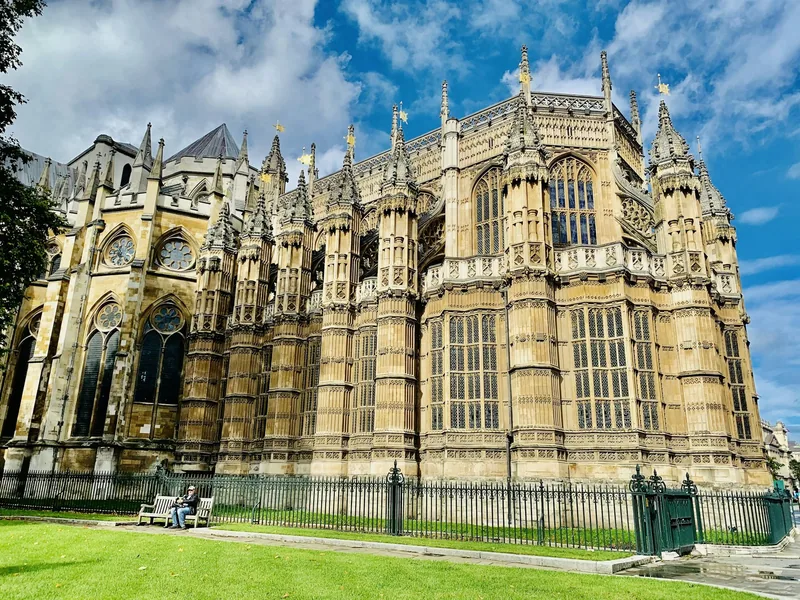
Across the square from Parliament stands Westminster Abbey, where English and British monarchs have been crowned since 1066 and where many of them are buried. It is also a working church. Its sightseeing hours are shorter than many visitors expect, and it closes to sightseers for services, so check times and prices on the Abbey's official visiting page before you plan your day around it.
Next to the Abbey is St Margaret's Church, the parish church of the House of Commons. Walk through the arch into Dean's Yard, a quiet green courtyard surrounded by buildings of Westminster School, and you leave the crowds behind almost immediately.
Opposite the Palace of Westminster, the Jewel Tower is a small 14th-century survivor of the medieval royal palace, run by English Heritage. Its three floors of displays cover its later use as a House of Lords archive and as the office that set official weights and measures. It is open daily from 10am to 5pm (last entry 4.30pm), and it takes less than an hour.
On the west side of Parliament Square, the UK Supreme Court occupies the former Middlesex Guildhall. The building is open to the public from Monday to Friday, 9am to 5pm (last entry 4.30pm), and closed at weekends and on bank holidays. When a case is being heard you can sit in the public seats and watch, as long as you do not take photos or make calls in the courtroom.
Walking up Whitehall
Whitehall is the broad street that runs north from Parliament Square to Trafalgar Square, and most of the buildings along it are government ministries. Walking its full length takes around 15 minutes without stops, and it is one of the most rewarding short walks in London. Our advice on getting around central London on foot shows how often walking beats the Tube in this part of town.
Heading north from the square, you pass the Cenotaph, the national war memorial in the middle of the road, and then the entrance to Downing Street on the left. The street itself is closed behind security gates, so you can only look down it from Whitehall. Further on, also on the left, are the arches of Horse Guards, where mounted sentries of the Household Cavalry stand on duty during the day and pose patiently for photographs. Keep a respectful distance from the horses: they are working animals, not a petting zoo.
Behind Horse Guards is Horse Guards Parade, the large open ground where Trooping the Colour takes place each June. Opposite, on the east side of Whitehall, is the Banqueting House, the only large surviving part of the old Palace of Whitehall, with a ceiling painted by Rubens. It is run by Historic Royal Palaces and opens on a limited timetable, so check before you go.
Whitehall ends at Trafalgar Square, with Nelson's Column, the National Gallery and the Fourth Plinth, where Tschabalala Self's sculpture Lady in Blue was unveiled on 10 September 2026.
Churchill War Rooms and Westminster's wartime past
Under the Treasury building at the St James's Park end of King Charles Street are the Churchill War Rooms, the underground offices from which Winston Churchill and his staff ran much of Britain's Second World War effort. The map room, the transatlantic telephone room and Churchill's bedroom have been kept much as they were, and a museum about his life is attached.
It is one of the most popular paid sights in the area and the corridors are narrow, so booking a time slot is sensible. An adult ticket costs £34 and a child aged 5-15 £17 (September 2026), which means a family of two adults and two children pays £102. It is open daily from 9.30am to 6pm, with last entry at 5pm. There is no cloakroom and suitcases are not allowed. Check the Imperial War Museums booking page for current prices.
St James's Park, the Mall and Buckingham Palace
West of Whitehall, St James's Park is the prettiest green space in central London. A long lake runs through the middle, and the bridge across it gives a classic view of Buckingham Palace in one direction and the rooftops of Whitehall in the other. The park is famous for its pelicans: the first were presented to King Charles II by a Russian ambassador in 1664, and more than 40 have lived here since. They often sit on the benches by the lake.
The Mall runs along the north side of the park to Buckingham Palace. In 2026 the palace State Rooms are open to visitors in summer only, until 27 September, and they are closed on Tuesdays and Wednesdays in September. Outside, the Guard Change happens at 11am on certain days, usually Mondays, Wednesdays and Fridays, with the new guard forming up at Wellington Barracks at 10.30am. Dates vary, so read our guide to watching the Changing of the Guard and check the official Household Division calendar for your day.
The barracks railings on Birdcage Walk beat the palace gates. The railings in front of Buckingham Palace are packed long before 11am. The new guard forms up and is inspected at Wellington Barracks on Birdcage Walk, on the south side of St James's Park, from about 10.30am, so you can see soldiers and band up close there with far less pushing, and then follow them to the palace.
The quiet streets most visitors miss
South of the Abbey, a few minutes from Parliament, is a small grid of early 18th-century streets that look almost untouched. Lord North Street, Cowley Street and the streets around Smith Square are lined with brick terraces, iron railings and old lamps. Many politicians have lived here, and on a weekday evening the only sound may be your own footsteps. Smith Square has a baroque former church, St John's, in the middle.
North of St James's Park station, Queen Anne's Gate is another short street of fine early Georgian houses, with a small statue of Queen Anne. Walk a little further south along the river and you reach Victoria Tower Gardens, a narrow riverside park beside the Lords end of Parliament. It has a cast of Rodin's The Burghers of Calais and a colourful Victorian drinking fountain that commemorates the abolition of slavery, and it is a good place to sit with the river in front of you.
Two larger sights lie a short walk from the centre. Westminster Cathedral, near Victoria station, is the main Roman Catholic church in England and Wales, a striped red-brick building with a dark, mosaic-covered interior. It is open daily from 7.30am to 7pm, but Mass is celebrated several times a day, so move quietly. About 15 minutes' walk south along Millbank is Tate Britain, which is free, open daily from 10am to 6pm and home to one of the best collections of British art from 1500 to the present.
Eating and drinking around Westminster
Honestly, Westminster is not a food destination. Around Parliament Square and Whitehall you mostly find sandwich chains, coffee shops and pubs that serve standard pub food at central London prices. For a more interesting meal, walk 10 to 15 minutes north to Soho or Covent Garden, or cross the river to the South Bank.
The pubs are the exception, and some are worth seeking out for their interiors alone. Several old pubs along Whitehall and around St James's Park have Victorian wood, glass and tiles, and they fill with civil servants straight after work. Our guide to London's historic pubs picks out the best of them across the city.
Westminster works well for
- First-time visitors who want the famous sights close together
- History, politics and royal ceremony
- Walkers: nearly everything is within 20 minutes on foot
- Quiet nights and early starts
Less appealing if you want
- Lively evenings, bars and late restaurants
- Good-value food near the main sights
- Space to breathe on Westminster Bridge at midday
- Shopping, beyond souvenirs
Getting to and around Westminster
Westminster station, on the Jubilee, District and Circle lines, comes up directly opposite Big Ben. St James's Park station (District and Circle) is closer to the Churchill War Rooms, the Supreme Court side of Parliament Square and the park itself. Charing Cross, at the top of Whitehall, has both Tube and National Rail trains. A single Tube journey within Zone 1 costs £3.10 at peak times and £3.00 off-peak with contactless or Oyster, and a day of travel in Zones 1-2 is capped at £8.90.
Many buses run along Whitehall and across Westminster Bridge; a bus fare is £1.75, rising to £1.85 on 1 November 2026. The river is another option: Uber Boat by Thames Clippers stops at Westminster pier, beside the bridge, on its main route east to the Tower and Greenwich. Boat fares do not count towards the daily cap, so read our river bus guide before you plan a day on the water.
Westminster also combines well with the areas around it. The London Eye is just over Westminster Bridge, and from there the riverside walk through the South Bank leads east to Tate Modern and Borough Market. To the north, St James's Park leads to Green Park and the shops, galleries and gentlemen's clubs of Mayfair and St James's. If you only have a short time in London, our one-day itinerary builds much of the day around this area.
Frequently asked questions
Is Westminster worth visiting if I only have one day in London?
Yes. In a few hours on foot you can see the Houses of Parliament, Big Ben, Westminster Abbey, Whitehall, Horse Guards and St James's Park, and most of that costs nothing. Add one paid sight, such as the Abbey or the Churchill War Rooms, if you have time.
Can tourists go inside the Houses of Parliament?
Yes. Overseas visitors can watch debates in the Commons and Lords free of charge, and anyone can book the paid guided tours on Saturdays and on weekdays during recess. The free tours booked through a Member of Parliament are for UK residents only.
Is Westminster a good area to stay in?
It is safe, central and close to the main sights, which suits early risers and families. It is quiet in the evening, with few restaurants open late, so travellers who want nightlife on their doorstep usually do better in Soho, Covent Garden or the South Bank.
What is the nearest Tube station to Big Ben?
Westminster station, on the Jubilee, District and Circle lines, is the closest; its exit on Bridge Street faces the Elizabeth Tower. St James's Park and Embankment stations are both within about ten minutes' walk if Westminster station is very crowded.
When is Westminster least crowded?
Early on a weekday morning, before about 9.30am, and in the early evening after the tour coaches have left. The busiest times are late mornings on days with a Changing of the Guard and weekends in summer and school holidays.
Sources
- UK Parliament - Tour prices (checked September 2026)
- UK Parliament - Big Ben tour (checked September 2026)
- Imperial War Museums - Churchill War Rooms booking (checked September 2026)
- The Household Division - Changing the Guard calendar (checked September 2026)
- The Royal Parks - St James's Park (checked September 2026)
- English Heritage - Jewel Tower (checked September 2026)
- The Supreme Court - Plan your visit (checked September 2026)
- Westminster Cathedral - Opening hours (checked September 2026)