
Wesley's Chapel, the Museum of Methodism in its crypt and the grounds around them are free, and open Tuesday to Saturday from 10.30am to 4pm. Only John Wesley's own house next door charges: £10 for an adult, free for under-18s, read on the site's visitor page in September 2026. There is rarely a queue and often nobody else in the building.
The site sits at 49 City Road, EC1Y 1AU, on the eastern edge of the City, directly opposite the burial ground at Bunhill Fields. John Wesley built the chapel in 1777 and 1778 as his London base, lived beside it for the last twelve winters of his life, and is buried behind it. The complex is now run as The Museum of Methodism and John Wesley's House by Wesley's Chapel and Leysian Mission, a registered charity.
Our page on Bunhill Fields and London's Dissenters covers the graveyard across the road, where Bunyan, Defoe and Blake lie. This page is about the working church on the other side of City Road, what its listing describes room by room, and where else in London nonconformist religion left buildings worth the walk.
Wesley's Chapel: the practical frame
- Chapel, museum and grounds
- Free; donations welcome
- John Wesley's House
- £10 adult, £6 concession, under-18s free (September 2026)
- Days and hours
- Tuesday to Saturday, 10.30am to 4pm, plus advertised services and events. Closed Sunday and Monday to heritage visitors
- Last entry to the house
- 2.45pm, and you ask a heritage steward rather than booking
- Groups
- Six or more must book ahead; £12 per person
- Station
- Old Street (Northern line, City branch) or Moorgate, both under ten minutes
- How long
- An hour for the chapel and museum, ninety minutes with the house
What it costs, and the two days it is shut
The pricing is unusual and worth understanding before you arrive. Entry to the chapel, to the Museum of Methodism in the crypt and to the grounds is free of charge. The charge applies only to John Wesley's House: £10 for an adult, with no charge for children under 18, and a concession rate of £6 that you have to ask about at the desk rather than select in advance.
There is no online booking and no timed entry for individuals. You walk in. Access to the house is arranged on the spot by one of the heritage stewards, and the last entry to it is 2.45pm, so a late-afternoon arrival gets you the chapel and the museum and nothing else. Groups of six or more are a different matter: they must be booked in advance, they pay £12 a head, and the first tour of the day is at 11am with the last starting at 2pm.
The heritage site is closed to visitors on Sundays and Mondays. Sunday is not a loophole. This is a working church with a full Sunday programme, and the published visiting hours are Tuesday to Saturday. If you turn up on a Monday with a day to fill in the City, our list of free things to do in London will rescue the morning.
The £10 goes on the one part that is not a church. Everything with a congregation is free; the money buys you a Georgian townhouse kept as a home rather than as galleries. If your budget is tight, the free half is still the more remarkable building of the two.
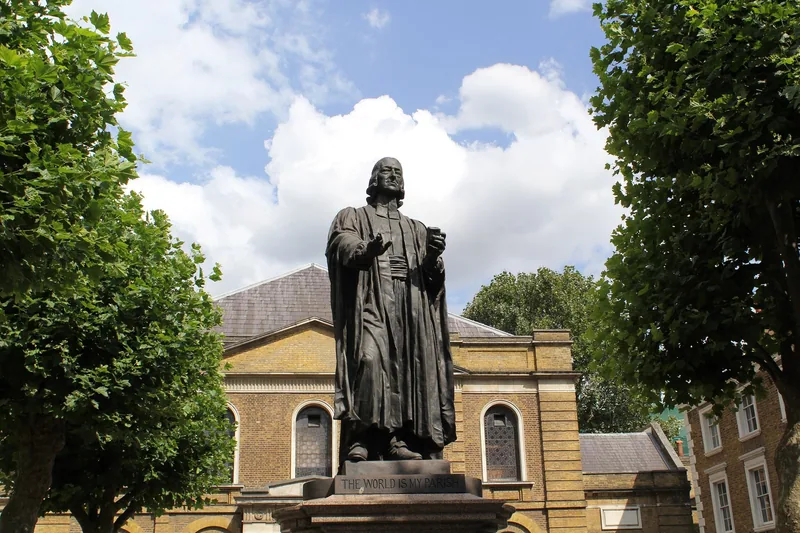
Photo: Harry Mitchell · CC BY 4.0 · Wikimedia Commons · resized
The chapel, as the Grade I listing describes it
Wesley's Chapel has been listed at Grade I since 29 December 1950, and its list entry calls it "the Mother Church of World Methodism". The entry is detailed enough to use as a checklist while you stand in the nave.
The main body is of 1777 and 1778, in brown brick laid in Flemish bond with yellow brick and stone dressings and a hipped roof of Welsh slate: two storeys, five windows wide. The stone portico came later, in 1814 and 1815, with coupled Greek Doric columns and a frieze of triglyphs and small round plaques modelled with the dove of peace. The rusticated brick piers, the chamfered quoins and the stone surrounds to the upper windows are an 1891 alteration by the architect Elijah Hoole, and the single-storey wings on either side are probably his too, from about 1899.
No architect is named in the list entry for the original building of 1777. The traditional attribution is to George Dance the Younger, then surveyor to the City of London, but Historic England does not say so, and we would rather tell you that than pretend the question is settled.
Inside, the ceiling is worth a minute's attention for a sad reason. Its decorative plasterwork, with a circular central panel and borders of anthemion and acanthus, is a replica: the original was destroyed in a fire in 1879.
The jasper columns, and the wooden ones they replaced
The galleries run round three sides of the chapel and are carried on Roman Doric columns of jasper that date from 1899. That is the detail everybody photographs. The better detail is what happened to the columns they replaced.
Some of the original wooden columns still stand, ranged along the west wall of the chapel, which the list entry records plainly. They are usually said to have been ships' masts given by George III; the chapel tells that story, and the listing does not, so treat the masts as the chapel's own tradition and the timber as a fact you can see.
Two more things survive from Wesley's own fittings. The mahogany pulpit, panelled and set on an arcaded base with fluted columns at its corners, is the top stage of the original three-decker pulpit, cut down. And the small chapel at the west end, which the congregation calls the Foundery Chapel and the list entry calls the Founder's Chapel, holds Charles Wesley's organ. The westernmost bay of the main space was glazed off from the rest in about 1975.
The Victorian and twentieth-century glass is better than it has any right to be. The list entry names Frank O. Salisbury for three windows of 1930, 1932 and 1934, Henry Holiday for a St John of 1900 in the north gallery, James Powell and Sons for the Wesleys' conversion of 1924, and Osborne and Philips for a John Wesley preaching of 1947.
John Wesley's House, and the closet on the first floor
The house is also Grade I, listed on the same day in 1950. Its statutory address is 47 City Road, which is one of those small discrepancies worth flagging: the museum gives 49 City Road as the address for the whole site, and Historic England numbers the house 47. Both are correct in their own systems.
It was built in 1779 and heavily reconstructed in the 1890s when it became a museum, and it is four storeys over a basement, three windows wide, in yellow brick with dressings of stucco, stone and Coade stone. The frieze of Vitruvian scrolls above the ground floor is Coade stone as well, and there is a London County Council plaque between the two ground-floor windows.
Inside, the ground, first and second floors all keep their original door architraves, panelled dados, window shutters and cornices, with fine cast-iron grates in two of the front rooms. The room to look for is on the first floor: a small closet for private prayer, with its own panelled dado, fitted cupboard and cast-iron grate. Methodists worldwide call it the Power House of Methodism. It is roughly the size of a large wardrobe.
The house also holds Wesley's own furniture and belongings, among them his study chair and his electrical machine. The wider collection on the site runs to more than 15,000 objects, and the burial register for 1779 to 1854 has been put online.
Nine listed structures on one small plot
This is the fact that gives the site away as more than a chapel. Historic England's list contains nine separate entries within the City Road complex, which is an extraordinary density for a plot you can walk across in ninety seconds.
| Structure | Grade | First listed |
|---|---|---|
| Wesley's Chapel | I | 29 December 1950 |
| John Wesley's House and attached railings | I | 29 December 1950 |
| Gates to John Wesley's House | II | 29 December 1950 |
| Tomb of John Wesley in the burial ground | II* | 29 September 1972 |
| Statue of John Wesley in the forecourt | II | 29 September 1972 |
| Memorial to Susannah Wesley in the forecourt | II | 29 September 1972 |
| Chapel keeper's house | II | 29 September 1972 |
| Benson Building, abutting the chapel | II | 29 September 1972 |
| Entrance gates to the chapel | II | 29 September 1972 |
The tomb at Grade II* is the one people miss. It is in the small burial ground behind the chapel, not in Bunhill Fields, and it is separately listed a grade above most of the rest. Wesley's mother's memorial, in the forecourt at the front, is the counterpart across the road: she herself is buried in Bunhill Fields. Historic England spells her Susannah; other sources drop the second h.
Access, and the floor you cannot reach
The honest picture, from the site's own visitor page. There is ramp access into the chapel. The Museum of Methodism in the crypt and the accessible toilet are reached by lift. Access to John Wesley's House is to the ground floor only, which means that the prayer room, the study and the upper rooms, which are the reason to pay the £10, are out of reach if you cannot manage stairs. Say so at the desk before you buy a ticket.
For visitors with autism, or anyone who wants to know exactly what a building looks and sounds like before going in, the site publishes a visual story as a PDF. That is more than most small London museums manage; our guide for autistic and sensory-sensitive visitors lists the others that do, and our accessible London guide covers the wider picture.
Getting there is easy. Old Street, on the City branch of the Northern line, is the closest station, with Moorgate a slightly longer walk from the other direction. Buses 21, 43, 55, 76, 141, 205, 214, 243 and 271 all pass the door, which for once makes the bus the sensible choice rather than the scenic one.
Nonconformist London beyond City Road
Nonconformists were Protestants outside the Church of England: Methodists, Baptists, Congregationalists, Quakers, Presbyterians. Barred from the older universities and from public office for much of two centuries, they built instead, and their buildings are scattered across inner London in places nobody puts on a route. Four are worth the detour, and all four are working churches, so opening depends on services rather than on published visitor hours. Check before you travel.
- Bunhill Fields, City Road. The nonconformist burial ground opposite the chapel, on Historic England's register of parks and gardens at Grade I since 5 May 2010, covering 1.64 hectares. Its boundary walls, gates and railings are separately listed at Grade II, on the same day in 1951 as the chapel.
- Union Chapel, Islington. Listed Grade I on 29 September 1972, which puts a Victorian Congregational chapel in the same bracket as the chapel on City Road. Its former Sunday school, lecture hall and vestry block were added at Grade II* in November 2011. It doubles as a concert hall; our guide to live music venues in London covers that side of it, and Islington is the wider walk.
- Metropolitan Tabernacle, Elephant and Castle. The Baptist church built for Charles Haddon Spurgeon, listed Grade II on 27 September 1972. The great classical portico on Newington Causeway is the part to look at, and it is far older than what stands behind it.
- The City Temple, Holborn Viaduct. The great Congregational church of the City, listed Grade II on 10 November 1977, rebuilt after wartime destruction. Ten minutes' walk from Dr Johnson's House.
Ninety minutes, and what sits around it
Allow an hour for the chapel and the crypt museum, and ninety minutes if you pay for the house. It is not a half-day, and it should not be treated as one.
The obvious pairing is Bunhill Fields, thirty seconds away across City Road, which is free and takes another half hour. After that you are ten minutes from the Barbican and fifteen from Clerkenwell, where the Charterhouse and the Museum of the Order of St John make the other half of a day about small institutions that almost nobody visits.
If you would rather hear these buildings than look at them, choral evensong in London explains how to walk into a service for nothing.
Frequently asked questions
Is Wesley's Chapel free to visit?
Yes. The chapel, the Museum of Methodism in the crypt and the grounds are all free, with donations invited. The only charge on the site is for John Wesley's House next door, at £10 for an adult and £6 concession, with children under 18 admitted free. There is no advance booking for individuals.
What days is Wesley's Chapel open to visitors?
Tuesday to Saturday, 10.30am to 4pm, plus whatever services and events are advertised. It is closed to heritage visitors on Sundays and Mondays, because Sunday is the working day of a busy congregation. The last entry to John Wesley's House is 2.45pm, earlier than the site's closing time.
Is John Wesley's House worth paying for?
If you can manage stairs, yes: it is one of very few small Georgian townhouses in London still arranged as somewhere people lived, and the first-floor prayer closet is genuinely affecting. Access is to the ground floor only for anyone who cannot use the staircase, which removes most of what the ticket buys.
Where is John Wesley buried?
In the small burial ground behind the chapel on City Road, not in Bunhill Fields across the road. His tomb is listed in its own right at Grade II*, a grade above most of the other structures on the site. His mother Susannah is buried in Bunhill Fields, with a memorial in the chapel forecourt.
Which station is nearest to Wesley's Chapel?
Old Street, on the City branch of the Northern line, is closest, with Moorgate a slightly longer walk. Nine bus routes pass the door: 21, 43, 55, 76, 141, 205, 214, 243 and 271. The chapel has ramp access and the crypt museum has a lift.
Sources
- The Museum of Methodism and John Wesley's House - Visiting us (checked September 2026)
- The Museum of Methodism and John Wesley's House - John Wesley's House (checked September 2026)
- Historic England - Wesley's Chapel, list entry 1195538 (checked September 2026)
- Historic England - John Wesley's House and attached railings, list entry 1195533 (checked September 2026)
- Historic England - Tomb of John Wesley, list entry 1207627 (checked September 2026)
- Historic England - Union Chapel, Islington, list entry 1208365 (checked September 2026)
- Historic England - Metropolitan Tabernacle, list entry 1385730 (checked September 2026)
- Historic England - Bunhill Fields Burial Ground, registered park and garden 1001713 (checked September 2026)