
The Barbican Conservatory is free, and that is the easy part. It opens on about one day a week, almost always a Sunday, usually from noon to 5pm, with a timed ticket you have to book. When we checked the Barbican's booking system in late September 2026, the last published opening date was Sunday 27 September and nothing beyond it had been released.
It is a glasshouse on Level 3 of the Barbican Centre, wrapped around the fly tower of the theatre, with around 1,500 species of plants growing under 23,000 square feet of steel and glass. The Barbican calls it the second biggest conservatory in London, after the glasshouses at Kew. Nobody who walks past the building would guess it is there.
Our guide to the Barbican Centre covers the rest of the building, the galleries, the architecture tour and what else is free. This page is only about getting into the Conservatory, and about what is actually growing in it.
Barbican Conservatory: how it works
- Cost
- Free, with a timed ticket. Donations invited
- Where
- Level 3, Barbican Centre, Silk Street, London EC2Y 8DS. Entrance with ticket and bag checks on Level 3
- When
- Selected dates only, mostly Sundays, with some Saturdays and Friday evenings. Closed on any date not listed
- Typical hours
- Weekend slots from noon to 5pm; Friday evening slots from 6.30pm to 9.30pm
- Tickets
- Released online one month ahead, plus a limited batch from 9.30am on each open day
- Not allowed inside
- Large bags, luggage, prams and buggies; dogs except assistance dogs
- Wheelchair access
- Limited: a 1:12 ramp and wide doors to get in, but steps in parts of the interior
- Time needed
- Entry is within an allocated hour, and an hour is about right
The real opening calendar, and what the pattern tells you
The Barbican does not publish a schedule in words; it publishes a list of bookable dates. Reading the whole of 2026 out of its booking system gives a clearer picture than the website does. Over the year there were 56 open days, and they fell like this:
| Type of opening | Days in 2026 | Time slots |
|---|---|---|
| Sundays | 27 | Noon to 5pm, half-hourly |
| Saturdays | 12 | Noon to 5pm, half-hourly |
| Friday evenings | 11 | 6.30pm to 9.30pm, half-hourly |
| A run of weekdays in late August | 6 | Noon to 4pm |
Three things follow. First, a Sunday is much the likeliest day to get in, and roughly two Sundays in three were open across the year. Second, the Friday evening openings are the ones almost nobody knows about: a tropical glasshouse in the dark, with the City outside the glass, and fewer people competing for tickets. Third, if you are in London in late August you may find it open several days in a row, because the Barbican has used the quiet fortnight at the end of the summer for a longer run.
January was different again, with slots running to 7pm rather than 5pm. And the autumn and winter dates simply had not appeared yet when we looked in late September, which is the ordinary state of affairs rather than a problem: dates go on sale a month ahead.
Two releases, and the second one is the useful one. Tickets appear online a month before each open day and go quickly. A further limited batch is released at 9.30am on the morning of every open day. If the date you want shows as sold out, set an alarm for 9.30am rather than giving up, and join the Barbican's Conservatory waiting list, because free tickets get returned. Returning yours if you cannot come takes a minute in your account and frees it for somebody else.
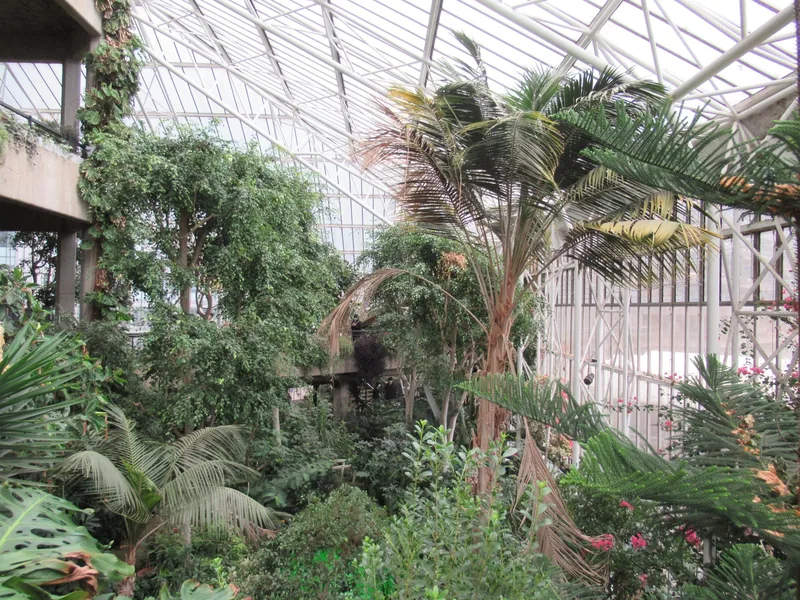
The building under the glass
The Conservatory was designed by Chamberlin, Powell and Bon, the architects of the whole Barbican estate, and it exists because of a technical problem rather than a horticultural ambition. The theatre below needs a fly tower, the tall box from which scenery is lowered onto a stage six storeys down, and a fly tower is an ugly thing to leave on a roof. So they built a glasshouse around it.
That is why the space feels the way it does: paths at different levels winding round a blank concrete mass, with planting spilling over the edges. The roof covers 23,000 square feet, and under it sits more than 1,600 cubic metres of soil, all of it mixed by hand to a specification. Planting began in 1980 and the Conservatory opened in 1984.
If concrete is the reason you are here at all, our guide to brutalist London covers the estate and the rest of the city's concrete, and the Barbican and Moorgate covers the neighbourhood.
What is growing in it
Around 1,500 species, and the collection is not a rainforest. It is a mix of temperate and arid plants from places as different as the rocky deserts and bushland of South Africa and the coast of Brazil, which means you get tree ferns and a date palm in the same building as cacti and succulents. Some of the species are rare or endangered where they come from.
The plants people photograph are the tree ferns, the date palm and the Swiss cheese plant, which is a houseplant everywhere else and a structural feature here. The two worth finding because they are unexpected are the coffee and the ginger, both grown to maturity indoors in the middle of the City of London.
An hour is the right length of visit and is also what your ticket effectively buys, since entry is within an allocated hour. Ten minutes of that should go on the Sculpture Court immediately outside, which is reached either by steps or by a ramp, costs nothing extra and is walked past by almost everybody.
Getting in, which catches people out
The Barbican's level numbering defeats first-time visitors, and the Conservatory is on Level 3, the gallery floor, reached by the main lifts. Coming from Barbican Underground station, look for a flight of steps with "Art Gallery" above them: they lead up to the Sculpture Court, where the Conservatory is signed. From the estate's raised highwalks, follow signs to the Barbican Centre and then go up.
There is a ticket and bag check at the entrance, and the restrictions are stricter than most London gardens. Large bags, luggage, prams and buggies are not allowed inside, and there is no dog access except for assistance dogs. Nothing on the Barbican's page suggests a buggy park, so if you are visiting with a baby, plan for a sling.
Wheelchair access is described by the Barbican itself as limited. Getting to the door is fine: automatic glass doors 120cm wide open onto a 1:12 ramp, and the Conservatory's own double doors are 135cm. Inside, there are steps in some areas, so a wheelchair user or anyone with restricted mobility will see part of the space rather than all of it. Contact the box office in advance if that matters, and note that assistance dogs are welcome throughout.
The other ways in
If the general opening dates do not fit your trip, the Conservatory also hosts its own small programme of ticketed events, which sometimes have availability when the free slots do not.
The most useful of these for some visitors is the Conservatory Sensory Tour, an 11am tour run exclusively for neurodivergent visitors and anyone who benefits from a relaxed environment; two were scheduled for 8 and 23 November 2026. Our guide to London for autistic and sensory-sensitive visitors covers the wider picture of relaxed openings in the city.
Beyond that the space is used for concerts, talks, yoga sessions for Barbican members and occasional artist commissions. The Conservatory and its terrace are also hired out for private events, which is one reason the public dates are as thin as they are.
Whether it is worth planning around
Honestly: yes if you are in London for more than three days and can be flexible about which Sunday; no if you have a fixed two-day trip, because the odds of the right date being open and available are poor. It is a lovely hour and not a substitute for a botanic garden.
The good news is that it is not the only free high-level garden in the City. Our round-up of roof gardens and free terraces covers The Garden at 120, which needs no booking at all, and the roof garden above Canary Wharf; Sky Garden releases its free tickets weekly rather than monthly. For enclosed gardens at ground level, see London's secret gardens.
And if the Conservatory is closed on the day you are free, the Barbican building itself is open seven days a week for nothing, which puts it on our list of free things to do in London and among the better options in our guide to a rainy day in London.
Frequently asked questions
Is the Barbican Conservatory free?
Yes, admission is free, but it is ticketed and timed and it only opens on listed dates. Tickets are released online a month in advance and a limited batch goes live at 9.30am on each open day. Donations are invited but not required.
When is the Barbican Conservatory open?
On selected dates, mostly Sundays, with some Saturdays and a number of Friday evenings. In 2026 it opened on 56 days: weekend slots ran from noon to 5pm and Friday evening slots from 6.30pm to 9.30pm. It is closed on any date not listed in its booking system.
How do I get a ticket for the Barbican Conservatory?
Book through the Conservatory's page on the Barbican's own site. Dates appear a month ahead, and a second batch of day tickets is released at 9.30am on the morning of each open day. There is a waiting list, and because the tickets are free people return them, so checking again is worth it.
Can you take a pushchair into the Barbican Conservatory?
No. Prams and buggies are not allowed inside, along with large bags and luggage. Dogs other than assistance dogs are also not admitted. Plan on carrying a small child rather than pushing one.
How long does a visit to the Barbican Conservatory take?
About an hour, which matches the way the ticketing works: you may enter at any point within your allocated hour. Add ten minutes for the Sculpture Court immediately outside it, and longer if you are going to eat in the building afterwards.
Sources
- Barbican Centre - Visit the Conservatory: ticketing, facts, access and location (checked September 2026)
- Barbican Centre - Conservatory opening dates and time slots for 2026, from the Centre's own booking data (checked September 2026)
- Barbican Centre - Opening hours (checked September 2026)
- Barbican Centre - Free things to do (checked September 2026)