
Lee Valley Regional Park is 26 miles long and 10,000 acres, running from the Thames at Canning Town up through Stratford and Tottenham into Essex and Hertfordshire. Most of it is free. The one rule that matters everywhere in it: entering the water is banned under the park's own byelaws, in every lake, river and channel, however inviting it looks on a hot day.
It is not a park in the ordinary sense. It was created by a specific Act of Parliament as a green lung for London, Essex and Hertfordshire, and it is run by its own public authority rather than by a borough. What that produced is a chain of reservoirs, marshes, gravel pits, towpaths, nature reserves, sports venues and campsites strung along one river for 26 miles, with no single entrance and no obvious middle.
Which means the useful question is not what the Lee Valley is but which bit to go to. This page answers that. The Queen Elizabeth Olympic Park at the southern end and Walthamstow Wetlands have their own guides; this is the map around them.
Lee Valley Regional Park: the frame
- Length and size
- 26 miles, 10,000 acres, across London, Essex and Hertfordshire
- Run by
- Lee Valley Regional Park Authority, a statutory body created by Act of Parliament
- Cost
- The open spaces are free. The sports venues, the campsites and most car parks charge
- Swimming
- Prohibited throughout, under the Authority's byelaws
- Southern end
- East India Dock Basin and Bow Creek Ecology Park, by Canning Town
- Northern end
- Ware and Hertford, in Hertfordshire
- Biggest single chunk
- River Lee Country Park, 1,000 acres around Waltham Abbey and Broxbourne
- Car parking
- Pay per hour by ANPR at most sites; an £85 annual permit covers ten car parks in and around River Lee Country Park
You cannot swim anywhere in it, and that is the point to start with
The Authority is unusually blunt about this. Its own visitor pages state that entering water in the park is not allowed, that it is dangerous and that it is against the byelaws. That covers the reservoirs, the gravel-pit lakes, the River Lee Navigation and the side channels.
The reason is the reason everywhere in the Lee Valley: these are working water bodies. Many of the lakes are flooded gravel pits with shelving sides and cold deep water a metre from the bank, the navigation carries boats, and some of the reservoirs supply drinking water. There are no lifeguards anywhere in the park.
If open water is what you want, the nearest legal options are the swimming lake at Beckenham Place Park in the other direction, and the reservoir at West Reservoir in Hackney; our guide to London's swimming ponds and lidos has the complete list. What you can do on the water here is paddle a boat: the Authority runs marinas and watersports centres, and there is a white-water course.
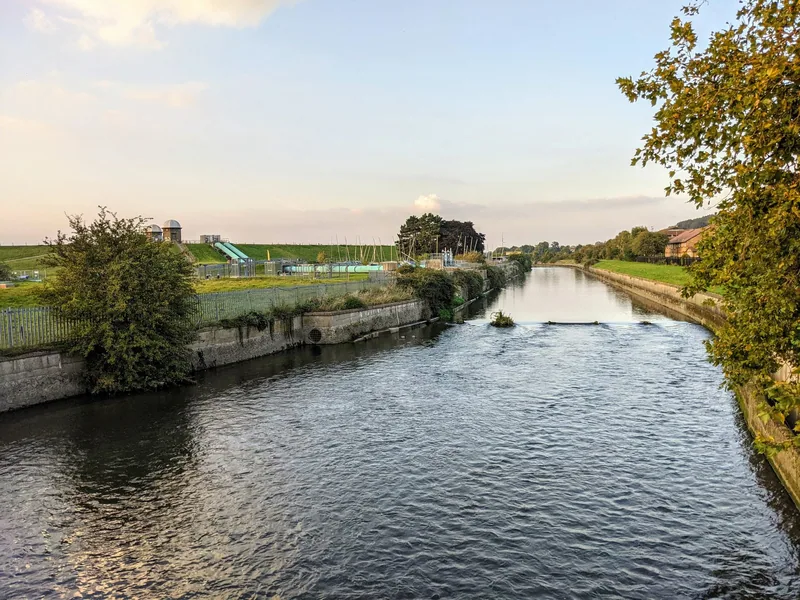
Photo: The wub · CC BY-SA 4.0 · Wikimedia Commons · resized
The bits worth a day, south to north
Seen as a whole the park is unmanageable. Seen as five or six destinations it makes sense.
| Where | What it is | Nearest station |
|---|---|---|
| East India Dock Basin | The park's southernmost point, with views over the Thames to The O2 | Canning Town |
| Bow Creek Ecology Park | A green island in a river meander, a short walk from the station | Canning Town |
| Queen Elizabeth Olympic Park | The 2012 site, the VeloPark and the East Bank museums | Stratford |
| Walthamstow Marshes | Unimproved grazing marsh, rare in London, with the wetlands beside it | Clapton or Lea Bridge |
| River Lee Country Park | 1,000 acres of lakes and woodland, the Wildlife Discovery Centre and Fishers Green | Cheshunt or Waltham Cross |
| Myddelton House Gardens | Eight acres of botanical garden, free entry, open daily 10am to 4pm | Turkey Street, about 14 minutes on foot |
| Amwell and Rye Meads | Nature reserves on old gravel pits at the Hertfordshire end | Rye House |
If you have one afternoon and are staying in central London, the answer is the Olympic Park and the walk north along the navigation into Hackney Wick. If you have a whole day and want countryside, take the train to Cheshunt and walk River Lee Country Park. If you want birds, the Wildlife Discovery Centre is a purpose-built hide with a viewing tower over Seventy Acres Lake.
Myddelton House Gardens, the underrated one
Eight acres of botanical garden at Bulls Cross in Enfield, free to walk into, open daily from 10am to 4pm. It was the lifelong home of E. A. Bowles, one of the significant British gardeners of the early twentieth century, and the planting still reflects his interests rather than a municipal plan.
The New River runs through it, which is the other reason to come: the artificial channel that Sir Hugh Myddelton built to bring drinking water from Ware in Hertfordshire to London, and which still functions. Wheelchairs are available on a first-come basis from a shed in the car park.
Two practical notes. Car parking is £3 for a car, and the site is inside the Ultra Low Emission Zone, so a non-compliant vehicle pays the ULEZ charge to get there. The gardens close at 4pm all year, which is early, so treat it as a morning.
Lee or Lea? Both, and it is not a mistake. The river appears on maps, signs and station names in both spellings. The park authority calls itself Lee Valley and names its biggest section River Lee Country Park, while the marshes at Walthamstow and the older place names use Lea. Searching for either will find the same places, and nobody local will correct you.
The sports venues, and what they cost
This is where the park stops being free. The 2012 Olympics left the Authority with world-class facilities and a duty to make them pay, so almost everything with a roof has a price on it.
- Lee Valley White Water Centre at Waltham Cross, the 2012 canoe slalom venue, run by Better for the Authority. White-water rafting starts at £58 a person. A paddling membership is £15 a month and opens a 45-day advance booking window.
- Lee Valley VeloPark in the Olympic Park: the velodrome, BMX track, road circuit and mountain bike trails, all bookable. Our VeloPark guide has the sessions and prices.
- Lee Valley Ice Centre on Lea Bridge Road in Leyton, opened in 2023, with two Olympic-sized rinks, an 80-station gym and a cafe, operated by GLL. Session prices are in our guide to ice skating in London.
- Lee Valley Athletics Centre at Pickett's Lock, Hockey and Tennis Centre in the Olympic Park, an 18-hole golf course and a riding centre.
- Camping: four sites, from the Almost Wild Campsite at Sewardstone to caravan parks at Dobbs Weir and Edmonton.
The Authority also runs a Community Access Fund that pays for free access or travel to its venues for groups who could not otherwise afford them, and a grant scheme for longer projects. Neither is aimed at visitors, but they are worth knowing about if you are here with a youth or community group.
Walking and cycling the length of it
The towpath of the River Lee Navigation is the spine, and it runs almost unbroken from the Thames to Hertfordshire, flat, surfaced in most places and shared between walkers and cyclists. You can ride the whole 26 miles in a day if you are fit, or walk any section of it.
The Authority publishes a set of waymarked routes from two to twelve miles, filterable by whether they have parking, public transport, lavatories, refreshments or accessible surfaces, and by location from Bromley-by-Bow up to Stanstead Abbotts. The short ones worth knowing: Grebes and Gravel, two miles from the White Water Centre; the Farm and Wetland Trail, three miles from Fishers Green; and the Golden Circle, 5.5 miles from the VeloPark. The long one is Fishers Green Foray at twelve miles.
Our guide to London's long walking routes covers how the towpath links to the wider network, and cycling in London explains hiring a bike. The practical advantage of the Lee Valley over most long London walks is that the railway follows the river for almost its whole length, out of Liverpool Street towards Cheshunt, Broxbourne and Hertford, so you can walk as far as you feel like and get a train back from wherever you stop.
The car parks are run on camera recognition, so do not overstay. Most Lee Valley car parks use automatic number plate recognition rather than tickets on windscreens. The £85 annual permit covers ten car parks in and around River Lee Country Park but is not valid at the White Water Centre or at Broxbourne Riverside, which charge separately. Changing the registration on a permit costs £10, free for blue badge holders. Coming by train avoids all of it.
What is here that is not anywhere else in London
Three things. Walthamstow Marshes is grazing marsh that was never drained or improved, a habitat that has almost vanished from the London area, and it reads as countryside rather than as a landscaped park. Gunpowder Park near Waltham Abbey is a former Ministry of Defence site turned into open space with paved routes, which makes it one of the more accessible pieces of countryside in the region. And Clayton Hill in the country park is a genuine viewpoint over the whole valley, which is not something a flat river corridor usually offers.
For contrast, Epping Forest lies immediately east of the valley's middle section and is ancient woodland rather than water, and the two together make a proper weekend on the north-eastern edge of London. Closer in, Victoria Park is the conventional park the Lee Valley is not.
Frequently asked questions
Can you swim in the Lee Valley?
No. The Lee Valley Regional Park Authority states that entering the water anywhere in the park is dangerous and against its byelaws, and that includes the lakes, the reservoirs and the River Lee Navigation. There are no lifeguarded swimming areas. Paddling a boat, canoe or board at the managed watersports sites is allowed.
How long is the Lee Valley park and where does it start?
Twenty-six miles, covering 10,000 acres. The southern end is at East India Dock Basin on the Thames, by Canning Town, and the northern end is in Hertfordshire at Ware and Hertford. It runs through London, Essex and Hertfordshire and is managed by its own statutory authority.
Which part of the Lee Valley is best for a day out from central London?
For half a day, the Olympic Park at Stratford and the towpath north from it. For a full day in something that feels like countryside, take a train to Cheshunt or Broxbourne and walk River Lee Country Park, which covers 1,000 acres and has the Wildlife Discovery Centre and its viewing tower.
Is Myddelton House Gardens free?
Yes, entry is free and donations are invited towards the rock garden project. It opens daily from 10am to 4pm. Car parking costs £3, and the site is inside the Ultra Low Emission Zone, so a non-compliant vehicle will also pay that charge.
Do I need to pay to park in the Lee Valley?
At most sites, yes, and the car parks use number plate recognition. An £85 annual permit covers ten car parks in and around River Lee Country Park but not the White Water Centre or Broxbourne Riverside. Blue badge holders get a free annual parking pass at Myddelton House Gardens.
Sources
- Lee Valley Regional Park Authority - About the Authority and the 26-mile, 10,000-acre park (checked September 2026)
- Lee Valley Regional Park - Visitor home page, including the byelaw on entering water (checked September 2026)
- Lee Valley Regional Park - Green spaces and gardens (checked September 2026)
- Lee Valley Regional Park - Walking and running routes (checked September 2026)
- Lee Valley Regional Park - Myddelton House Gardens: opening, prices and parking (checked September 2026)
- Lee Valley Regional Park - White Water Centre: rafting prices and memberships (checked September 2026)
- Lee Valley Regional Park - Lee Valley Ice Centre (checked September 2026)
- Lee Valley Regional Park - Parking in the park and annual permits (checked September 2026)