
London has a handful of gardens and terraces high above street level that cost nothing to enter. The best are the Barbican Conservatory, The Garden at 120 in the City, and the roof garden above Canary Wharf's Elizabeth line station. Some need a free ticket booked in advance; others you simply walk into.
A roof garden is not the same thing as a viewing gallery. A viewing gallery sells you the skyline. A roof garden gives you somewhere to sit among plants, usually lower down, often with a bench, a hedge and a bit of shelter from the wind. Both are worth your time, but you choose between them for different reasons.
If what you want is a serious garden, the glasshouses and gardens at Kew are in another league and our guide covers them in full. This page is about the smaller, free, high-up spaces scattered around central and east London: which ones are genuinely gardens, how the ticketing works, and what tends to go wrong.
Free gardens and terraces above the street
- The Garden at 120
- Fen Court, 120 Fenchurch Street EC3M 5BA, fifteen storeys up. No booking. Closed on bank holidays
- Barbican Conservatory
- Free timed ticket, released a month ahead. Entrance on Level 3, Silk Street EC2Y 8DS
- Crossrail Place Roof Garden
- Above the Elizabeth line station at Canary Wharf. Free; check current hours before you go
- Sky Garden
- Free ticket released weekly. Open Mon-Thu and Sun 8am to midnight, Fri and Sat 8am to 1am
- Horizon 22
- Level 58 of 22 Bishopsgate. A viewing gallery, not a garden. Free timed ticket
- Best months
- Late April to early June for planting, September for light and fewer people
Garden, glasshouse or viewing floor: knowing what you are booking
Visitors often book one thing expecting another. It helps to sort them into three groups before you plan a day.
Outdoor roof gardens are planted terraces open to the sky. The Garden at 120 and Crossrail Place are the two obvious ones. They are pleasant in dry weather and miserable in a downpour, and both close or become unpleasant when it is windy.
Glasshouses at height means, in practice, two places: the Barbican Conservatory on the roof of a concrete theatre, and Sky Garden under its curved glass shell. Both work in any weather, which is why they are the ones to keep in reserve for a grey day.
Viewing floors have a few planters and a great deal of glass. Horizon 22 is the clearest example. If the view is the point, our guide to the free viewpoints across the city compares them properly, with opening hours and bag limits.
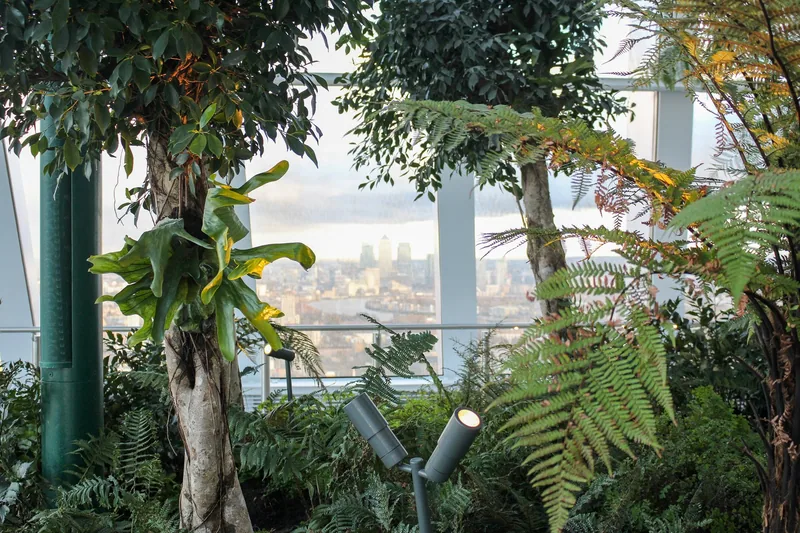
Photo: The wub · CC BY-SA 4.0 · Wikimedia Commons · resized
The Barbican Conservatory: the one worth planning around
This is the find. Hidden on the roof of the Barbican Theatre is a large tropical glasshouse, which the centre describes as the second biggest conservatory in London: fig trees pushing against the glass, cacti in a separate arid house, ponds with carp and terrapins, and walkways running between the upper branches. Concrete walls on one side, palms on the other.
Admission is free, but it is ticketed and it is not open every day. The rules, as the Barbican's own Conservatory page sets them out, are worth reading carefully:
- Tickets are released online one month in advance, for the dates the Conservatory will be open.
- A limited number of extra day tickets go online at 9.30am on each open day.
- Entry is by timed slot; you can arrive at any point within your allocated hour.
- It is closed to the public on any date not listed, so never turn up on spec.
- There is a waiting list you can join by email for newly released tickets.
The Conservatory entrance is on Level 3, not at the main doors. Bag and ticket checks happen there, and large bags, luggage, prams and buggies are not allowed inside. Only guide dogs may come in. Leave everything you can at your hotel, or use the options in our guide to left luggage around the main stations.
Allow an hour in total including the walk in, because the Barbican estate itself is confusing on a first visit. The raised walkways, ponds and terraces outside the centre are free to wander at any time, and they are a proper piece of 1970s architecture rather than an afterthought.
Crossrail Place: a garden with a roof over it
Above the Elizabeth line station at Canary Wharf sits a long, narrow garden under a lattice roof of timber and inflated plastic panels. It is open to the air at each end but covered overhead, which means light rain does not end your visit. It is free.
Getting there is the easy part: Canary Wharf is on the Elizabeth line, about six minutes from Liverpool Street, and the garden is signed from inside the station. The estate's website was unreadable to our research tools in September 2026, so confirm the current opening times on canarywharf.com before you make a special trip; the garden closes in the evening and can shut for events.
It suits a particular kind of visit: an hour between trains, a sandwich, somewhere quiet after the crowds at the Tower. Combine it with a walk around the docks in our guide to Canary Wharf, which is mostly water and glass and looks nothing like the rest of London.
The two City gardens everyone means when they say "roof garden"
Sky Garden, high up inside the curved tower at 20 Fenchurch Street, is the famous one: free, but tickets go on a weekly release cycle and the good slots disappear within minutes. Our step-by-step guide to getting a Sky Garden ticket explains the release times and what to do when they have gone.
Four minutes' walk away on Fenchurch Street the arrangement is the opposite: no ticket, no booking, just a security check and a lift. It is the one to fall back on when nothing else is available, and the entry details are in the free viewpoints guide linked above.
Both City gardens sit in a wind tunnel of their own making. Tall towers accelerate wind at their bases and around their edges, and an open roof terrace fifteen storeys up feels a good deal colder than the pavement below. Take a jacket even in July, tie back long hair, and do not expect to sit outside comfortably on a blustery day.
Terraces that ask nothing at the door
Several cultural buildings have terraces open to anyone, ticket or no ticket. They are not gardens, but they give you air, a seat and a view for nothing.
At Tate Modern the top floor of the Natalie Bell Building holds a restaurant and bar facing the river and the dome of St Paul's, while the Terrace Café on Level 1 of the Blavatnik Building opens onto a flat outdoor terrace. You will have to buy a coffee to sit in the café itself, but the museum is free to enter and the upper levels are worth the lift ride on their own.
Along the river, the concrete walkways and stepped levels of the Southbank Centre are public space, as are the terraces in front of the Royal Festival Hall. Further east, our guide to rooftop bars covers the ones where you pay for the view in the price of a drink, including the seasonal car-park rooftops in Peckham that only open in summer.
Gardens at ground level that do the same job better
If what you actually want is a quiet, enclosed green space rather than height, London has better answers. The ruined church garden at St Dunstan in the East is five minutes from Sky Garden and free, with climbing plants growing through the shell of a bombed church. West of the centre, the Chelsea Physic Garden is a walled botanic garden that has been growing medicinal plants since the seventeenth century.
And if you want real height, real air and a proper walk, take a train out of town instead. Our guide to Box Hill and the Surrey Hills covers a chalk escarpment under an hour from central London, and the cathedral city of St Albans has a hundred acres of Roman parkland twenty minutes from St Pancras.
Step-free access, children and the rules that catch people out
Every roof garden in this guide is reached by lift, so the vertical part is usually fine. The problems are elsewhere. Security checks at the City towers are airport-style, which slows a group down. Bag size limits are enforced. Tripods and selfie sticks are refused in most of these buildings.
Children are welcome at all of them, but under-18s generally need to be with an adult, and the Barbican Conservatory's ban on prams and buggies is a real obstacle with a baby. Our page on getting around London with a pushchair has the workarounds, and our accessibility guide covers step-free routes in more detail.
A half-day that links three of them
Start at Fenchurch Street or Monument around 10am. Do The Garden at 120 first, when it has just opened and is close to empty. Walk ten minutes west through the City to St Dunstan in the East, then north past the Roman remains towards the Barbican for a midday Conservatory slot if you have one.
From the Barbican, Moorgate or Liverpool Street puts you on the Elizabeth line for Canary Wharf in a few minutes, which makes Crossrail Place an easy late-afternoon stop. That is four green spaces, none of them charged for, in about five hours. Our round-up of things that cost nothing in the capital has more in the same spirit, and the City of London guide explains why the whole district empties out at weekends.
When to go, and when not to bother
Plants at height have a short season. Late April through early June is when the climbers and roses on London's roof terraces actually look like a garden. July and August are hot and glary, and the glass buildings hold the heat. September gives you the best light of the year with far fewer people than midsummer.
From November to February the outdoor gardens are bare and often shut early, and this is when the Barbican Conservatory and Sky Garden earn their place. Check the forecast the same morning: low cloud sits on the tops of the tall towers more often than visitors expect, and our guide to London's weather month by month explains what each season really feels like.
Frequently asked questions
Are London's roof gardens really free?
The four main ones are free to enter: The Garden at 120, the Barbican Conservatory, Crossrail Place Roof Garden and Sky Garden. The Conservatory and Sky Garden need a free ticket booked in advance, and both release a small number of extra tickets closer to the day. You pay only if you order food or drink.
How do I get a Barbican Conservatory ticket?
Book online on the Barbican website. Tickets for each open date are released a month in advance, and a limited number of day tickets go on sale at 9.30am on each day the Conservatory is open. Entry is by timed hourly slot and the entrance is on Level 3 of the centre.
Which London roof garden is best in the rain?
The Barbican Conservatory, because it is a glasshouse. Sky Garden also works, although low cloud can wipe out the view completely. Crossrail Place has a roof over most of its length, so light rain is manageable there. The Garden at 120 is fully open to the sky.
Can I take a suitcase to a roof garden?
No. Every building in this guide checks bags, and large bags, luggage and buggies are refused at the Barbican Conservatory outright. The City towers limit you to a small day bag and none of them has lockers, so plan to leave your luggage elsewhere.
When do London roof gardens look their best?
Between late April and early June, when the wisteria, roses and climbing plants are in flower. September is the best month for clear air and low evening light with smaller crowds. From November to March the outdoor gardens are bare and the indoor glasshouses are the better choice.
Sources
- Barbican Centre - Visit the Conservatory (checked September 2026)
- Fen Court - The Garden at 120, opening hours and access (checked September 2026)
- Sky Garden - Opening hours and free tickets (checked September 2026)
- Horizon 22 - Viewing gallery, Level 58 (checked September 2026)
- Tate - Visiting Tate Modern (checked September 2026)