
Chelsea Physic Garden is London's oldest botanic garden: four walled acres beside the Thames, founded in 1673 to teach apothecaries which plants cure and which ones do not. Adult entry is £15 including the voluntary donation, or £13.50 without (September 2026), and it opens Sunday to Friday from 11am to 5pm. It is shut every Saturday, and that trips up more visitors than anything else about the place.
It is small. You can walk the whole garden in twenty minutes, and if you treat it as a sight to tick off you will feel short-changed. Treat it instead as a place to spend an unhurried hour and a half, reading labels, and it becomes one of the most interesting things in Chelsea. Almost every bed here exists to make a point about what a plant is for.
The garden holds around 4,000 different plants, according to its own plant collections page, though the home page says over 4,500. Either way, more than a hundred species of tree grow inside four acres, many of them rare in Britain, because the walls and the river create a microclimate warmer than the rest of the city.
Chelsea Physic Garden at a glance
- Founded
- 1673, by the city's Worshipful Society of Apothecaries
- Opening
- Sunday to Friday, 11am to 5pm. Closed on Saturdays
- Adult ticket
- £15 with the voluntary donation, £13.50 without
- Ages 5 to 25
- £6.50 with donation, £5 without. Under-5s free
- Size
- Four acres, walled
- Address
- 66 Royal Hospital Road, London SW3 4HS
Tickets, opening days and the Saturday trap
The garden is open six days a week and closed all day Saturday. That is unusual enough that it is worth repeating: if your London weekend is Saturday and Sunday, the only day you can come is Sunday.
| Ticket (September 2026) | With voluntary donation | Without |
|---|---|---|
| Adult | £15 | £13.50 |
| Adult plus free carer or companion | £15 | £13.50 |
| Students and young people aged 5 to 25 | £6.50 | £5 |
| Universal Credit, Pension Credit or refugee status | £6.50 | £5 |
| Flexible ticket, valid for one visit within three months | £16 | £16 |
| Children under 5 | Free | Free |
| Historic Houses members | Free | Free |
You can book online or simply walk up. Concession tickets need proof of eligibility at the door. The garden also takes part in the two-for-one schemes run with National Rail's Days Out offer and BBC Gardeners' World, so if you are arriving in London by train on the same day, bring your ticket and select the two-for-one admission when booking. Our guide to buying UK train tickets explains how those rail offers work.
Two adults can get in for the price of one with a train ticket. The National Rail two-for-one offer applies here, and on a £15 adult ticket that is a saving worth the two minutes it takes to print the voucher. Bring proof of the offer with you; the kiosk will not take your word for it.
A garden built to train apothecaries
The Worshipful Society of Apothecaries of London founded the garden in 1673 so that trainee apothecaries could learn to identify the plants they would be dispensing. Getting it wrong could kill a patient, and several of the plants grown here to cure are lethal in the wrong dose or the wrong preparation. That is the whole reason the place exists.
Throughout the 1700s it became the world's leading centre for exchanging and distributing plants, under head gardeners including Philip Miller. Seeds and cuttings went out from these four acres across Europe and far beyond it.
The garden does not present this as an unbroken success story. Its own interpretation is direct about the fact that figures such as Miller and Joseph Banks were central to what it calls the horticultural colonialism of the British Empire, and that plants such as rubber, cocoa and coffee were exploited economically at the expense of enslaved and indigenous people. That honesty is unusual among British botanic institutions and is one of the more thought-provoking things about a visit.
The Garden of Medicinal Plants
This is the heart of the place, and it is laid out as a series of themed rooms rather than as a single bed.
- World Medicine Collection: beds for each region of the world, planted with species used by healers and herbalists over the past 5,000 years.
- Dioscorides Bed: plants first listed by the first-century Greek physician and pharmacologist Dioscorides in his book of medicinal plants.
- Officinalis Beds: early pharmacies were called officinas, and this bed holds the plants they sold. It explains why so many plant names end in officinalis.
- Traditional Medicine of the British Isles: plants the Apothecaries themselves grew here between the 17th and 19th centuries.
- Pharmaceutical Plants: around 60 plants underpinning modern medicine, arranged by medical discipline including oncology and dermatology. Plants are the basis of roughly a quarter of all modern Western medicines.
- Herbal Remedies: the garden notes plainly that over 80% of the world's population relies on herbal preparations, and that most have little scientific evidence behind them.
If you have half an hour and want one thing to look at properly, make it the Pharmaceutical Plants beds. Finding the shrub behind a drug you have taken is a genuinely strange experience.
The microclimate: an olive tree and a grapefruit
High brick walls, a south-facing aspect and the river make this warmer than the rest of London, and the planting exploits it. The garden claims the largest outdoor fruiting olive tree in Britain and the world's most northerly outdoor grapefruit tree, along with pomegranates, ginkgos, mulberries and eucalyptus.
Along the warmest wall is the Atlantic Islands Border, planted with rare and endangered species from the Canaries, Madeira and Crete, including Echium pininana with flower spikes around eight feet tall and the rare Echium wildpretii from the slopes of Mount Teide in Tenerife. Very few of these would survive a normal London winter outside these walls.
The microclimate has also become a problem. The Pond Rockery was built for alpine plants, and the garden says it is now too hot for them and grows Mediterranean species there instead. It publishes this openly under the heading of a microclimate emergency, which makes the garden an unexpectedly direct place to see climate change written into a planting scheme.
The Pond Rockery, made of Iceland and the Tower of London
The rockery has stood in the middle of the garden since 1773, is listed Grade II and is thought to be the oldest rock garden in Europe. What it is built from is the good part.
There is basalt that Joseph Banks carried as ballast on the ship St Lawrence when he sailed to Iceland looking for plants. There are fused bricks from a brick kiln in Chelsea, clam shells brought back from Tahiti on a voyage with Captain Cook, and pieces of masonry from the Tower of London. A bust of Banks looks out over the lot. On the island in the pond are carnivorous pitcher plants of the genus Sarracenia.
The Order Beds, the Historical Walk and the glasshouses
The Dicotyledon Order Beds were laid out in 1902 and hold more than 800 plants arranged by family, following the sequence established by the botanists George Bentham and Joseph Dalton Hooker. The garden points out that DNA sequencing is now rewriting this classification, so the beds are a snapshot of a system in the process of being replaced.
The Historical Walk, planted along the western side in the 1980s, traces the people associated with the garden over three centuries through the plants they introduced or first named. The Garden of Edible Plants, created in 2012, arranges fruit, vegetables and herbs by vitamin content in its central beds, with unusual herbs, spices and plants used for edible oils around them. The Garden of Useful Plants shows over 200 species used for housing, dyes and fabrics, with a bee forage bed at its centre. The World Woodland Garden holds 150 species from forests in North America, Europe and East Asia.
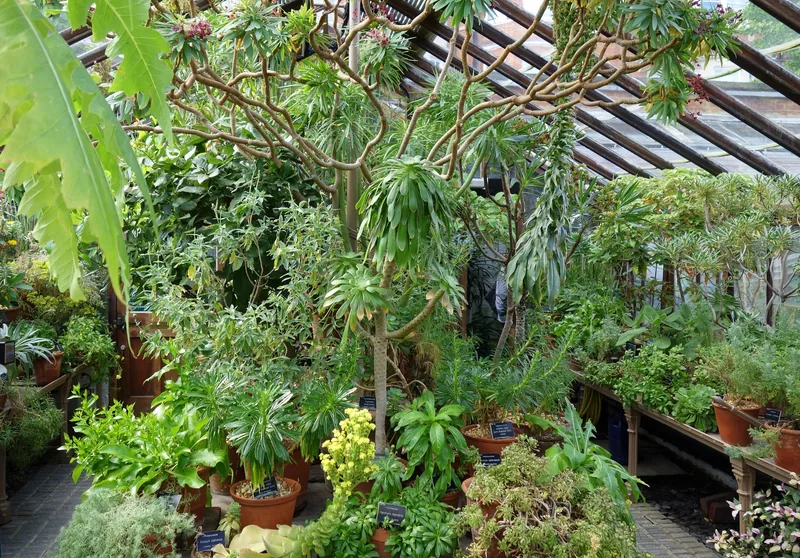
The Foster and Pearson glasshouses are over a hundred years old and hold tropical and subtropical species, with a Victorian Cool Fernery alongside. They are the part of the garden to head for if it starts raining.
Getting there, access and the café
The public entrance is at 66 Royal Hospital Road, SW3 4HS. It is a plain door in a wall and easy to walk past.
- On foot: roughly 15 minutes from Sloane Square, on the District and Circle, and about the same from South Kensington, which adds the Piccadilly line.
- By bus: the 170 from Victoria stops on Royal Hospital Road a few metres from the entrance. See our guide to London buses if you have not used them.
- Parking: one accessible space outside on Royal Hospital Road, and metered parking in the surrounding streets.
Inside, the garden is on one level, with flat paths laid with small stone shingle. A limited number of wheelchairs can be borrowed; ask at the kiosk on arrival. There is ramp access to the café and the education space, but the gallery used for talks is up stairs with no lift, so contact the garden in advance if you are booking an event. Wheelchair-accessible toilets and baby-changing facilities are in the main building and the café. Guide and assistance dogs are welcome. There is no cloakroom or bag storage at all, so you carry your luggage round with you. More on this in our guide to accessible London.
The Physic Garden Café serves seasonal food and is a pleasant place to sit. The garden also runs a programme of workshops and events, with a yearly theme, and a large Christmas Fair with more than 100 stalls.
How long to allow, and what to combine it with
Allow 90 minutes, longer if you like reading labels. Combined with lunch, it makes half a day.
The obvious pairing is a walk along the Chelsea Embankment and then up the King's Road, or across the river to Battersea Park. The Royal Hospital Chelsea, in whose gardens the RHS Chelsea Flower Show is staged each May, stands next door, and South Kensington with the Natural History Museum is fifteen minutes' walk west.
If this kind of garden appeals, Kew Gardens is the same idea at 300 times the size, and the Kyoto Garden in Holland Park is the other small, designed garden worth crossing London for. Our round-up of London's best small museums collects other places that reward an hour rather than a day.
Frequently asked questions
How much does Chelsea Physic Garden cost?
An adult ticket was £15 including the voluntary donation or £13.50 without in September 2026. Students and young people aged 5 to 25 pay £6.50 or £5, under-5s go free, and a flexible ticket valid for one visit within three months costs £16. Check current prices on the garden's own website.
Is Chelsea Physic Garden open on Saturdays?
No. It opens Sunday to Friday from 11am to 5pm and is closed all day Saturday. Friends of the garden can enter an hour earlier, at 10am. This is the most common planning mistake visitors make.
How long do you need at Chelsea Physic Garden?
About 90 minutes. The garden is only four acres, so you can walk it in twenty minutes, but the point of the place is the labelling and the arrangement of the beds, and rushing it wastes the ticket. Add time for the café.
What is the oldest thing in Chelsea Physic Garden?
The garden itself dates from 1673. The Pond Rockery has stood in the centre since 1773, is listed Grade II and is thought to be the oldest rock garden in Europe. It incorporates Icelandic basalt brought back by Joseph Banks and masonry from the Tower of London.
Is Chelsea Physic Garden suitable for children?
Under-5s go free and 5- to 25-year-olds pay £6.50 or less, so it is cheap for a family, but there is no playground and nothing to climb on. It works best for children who are already interested in plants, food or medicine. The garden runs family activities through the year.
Sources
- Chelsea Physic Garden - Opening times and tickets (checked September 2026)
- Chelsea Physic Garden - Plant collections (checked September 2026)
- Chelsea Physic Garden - Accessibility and directions (checked September 2026)
- Chelsea Physic Garden - Getting here (checked September 2026)