
London has the best collection of post-war concrete architecture in Britain, and almost all of it is free to walk through. The Barbican is the place to start, the South Bank is the obvious second stop, and the famous towers in west and east London are people's homes, which changes how you should behave when you get there.
Brutalism is a style of building from roughly 1950 to 1980. The name comes from béton brut, French for raw concrete: a building should show what it is made of rather than hide it behind stone or brick. In practice that means big grey shapes, surfaces roughened on purpose, deep window recesses, and walkways in the air instead of pavements.
Londoners have argued about these buildings for fifty years. Some are magnificent and some are genuinely grim. This page gives you a route you can walk in half a day and is honest about the ones we would not send you to.
| Building | Where | Can you go in? |
|---|---|---|
| Barbican Estate and Centre | City of London | Yes, free. Highwalks, gardens and foyers are open |
| Golden Lane Estate | Just north of the Barbican | Public paths only; the flats are homes |
| Hayward Gallery and Queen Elizabeth Hall | South Bank | Foyers free; gallery exhibitions ticketed |
| National Theatre | South Bank | Foyers and terraces free; tours ticketed |
| Brunswick Centre | Bloomsbury | Yes, it is a shopping street with flats above |
| Trellick Tower | North Kensington | No. Look from the street |
| Balfron Tower | Poplar, east London | No. Look from the street |
| Alexandra Road Estate | South Hampstead | Public footpath through it; the flats are homes |
| A section of Robin Hood Gardens | V&A East Storehouse, Stratford | Yes, free, indoors |
The Barbican, and why it is the one to start with
The Barbican is not a building. It is a small district, raised a storey above the streets of the northern City of London, built on ground that the Blitz had flattened. Its architects, Chamberlin, Powell and Bon, put around 2,000 flats and some 4,000 residents around an artificial lake, a church, a school, a library and a complete arts centre, with towers of forty storeys at the corners. The whole complex was given Grade II listed status in 2001.
What matters for a visitor is that the Barbican expects you. The highwalks, the estate gardens and the public levels of the arts centre are open and free, and the Barbican says so itself. You can spend an hour walking the raised walkways, looking down at the water and the church tower, without buying anything.
The 90-minute guided Architecture Tour is the paid option, at £19.50 including the booking fee in September 2026, and it is the only way to get the reasoning behind what you are looking at. Our page on the Barbican Centre has the full price list, the concession rates and the trick for anyone aged 16 to 29, and our page on the Barbican Conservatory covers the glasshouse, which opens on selected days only and needs a free timed ticket.
Come into the Barbican from Silk Street, not from the Tube. The estate's own signs are famously poor and the level numbering confuses people who live there. If you arrive at Barbican station and walk east along Beech Street you end up underneath everything. Silk Street puts you at the Centre's main entrance on Level G, which is where the tours meet and where the lifts make sense.
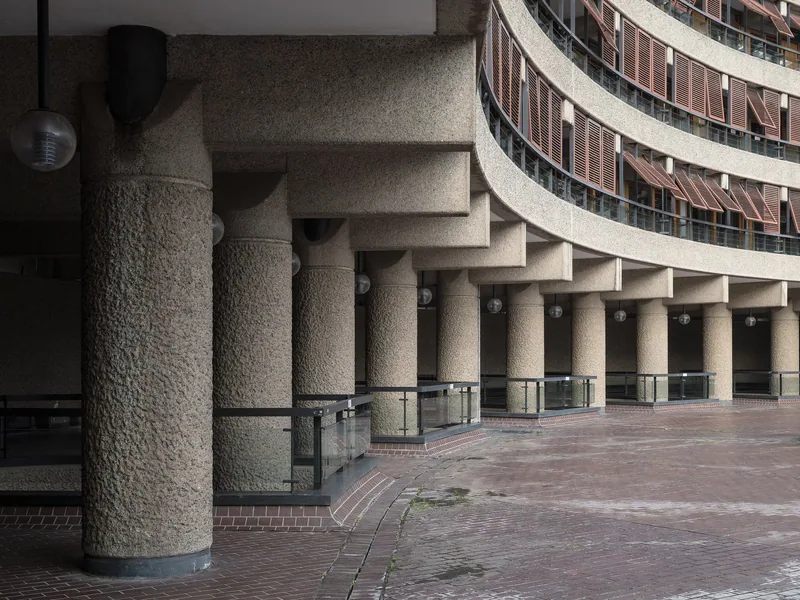
Photo: Julian Herzog (Website) · CC BY 4.0 · Wikimedia Commons · resized
Golden Lane, five minutes north
Before the Barbican, the same architects built the Golden Lane Estate immediately to the north, in the 1950s. It is smaller, lower, brighter and much easier to like: coloured panels, a ball court, a small swimming pool and leisure centre, and a long block called Crescent House running along Goswell Road with a shopping arcade underneath.
Golden Lane is the best answer to anyone who says post-war concrete housing was always inhuman. It is also entirely residential, so keep to the public paths and treat it as somebody's front garden. Our guide to the Barbican and Moorgate covers the area around both estates.
The South Bank: three buildings, one terrace
The second cluster is on the river, a twenty-minute walk from St Paul's across the Millennium Bridge.
The Hayward Gallery and the Queen Elizabeth Hall, from the late 1960s, are the hardest-edged concrete in central London: layered terraces, external stairs, and the pyramid roof lights on top of the gallery. The Royal Festival Hall next door is older and smoother and does not belong in this group. Our pages on the Southbank Centre and on the Hayward Gallery and the ICA cover what is on and what it costs.
Along the river to the east is the National Theatre, designed by Denys Lasdun and opened in the mid-1970s: horizontal concrete strata stepping back from the water, with two fly towers rising out of them. The foyers and river terraces are open to anyone, with free early-evening music in the foyer most of the week, and this is the most comfortable place in London to sit inside a brutalist building without paying for anything. The theatre also runs backstage and architecture tours; prices and times change with the repertoire, so check the National Theatre's own website rather than a listings site.
A half-day route you can actually walk
Start at Old Street or Barbican station and work south. Golden Lane Estate first, because it is small and it sets up everything that follows. Cross Beech Street into the Barbican Estate and spend forty minutes on the highwalks, ending at the lake terrace. Leave on the west side, walk past St Paul's, and cross the Millennium Bridge.
On the south side turn right and follow the river past Tate Modern and the Oxo Tower to the Southbank Centre. Finish on the National Theatre terrace. That is around three miles with plenty of stopping, and it costs nothing unless you book the Barbican tour. It works as a wet-weather day too, because both ends have large indoor public spaces; our list of free things to do in London has more in the same vein.
Brunswick Centre: the one that quietly works
North of the British Museum, in Bloomsbury, the Brunswick Centre is a stepped ziggurat of flats above a wide pedestrian street of shops, designed by Patrick Hodgkinson and finished in the early 1970s. It was unloved for decades and refurbished in the 2000s, and it now contains a supermarket, a cinema, cafes and a pharmacy.
Go and look at it because it answers the practical objection to the style. People live above the shops, the flats step back so every one gets light, and the street below is busy all day. It is five minutes from Russell Square station.
Trellick, Balfron and the towers that are somebody's flat
The two towers people come to London to photograph were both designed by Ernő Goldfinger, and they are almost the same building twice.
Balfron Tower came first, in Poplar, in the late 1960s. Trellick Tower followed in north Kensington in the early 1970s. Both put the lifts, stairs and rubbish chutes in a separate slim tower joined to the flats by short bridges every third floor, which is why they look like two buildings holding hands. Balfron is nearest Langdon Park or All Saints on the DLR; Trellick is about ten minutes from Westbourne Park station, above the north end of the Portobello Road market strip at Golborne Road.
Both are private housing. There is no lobby to walk into, no viewing platform and nothing to buy. Photograph them from the pavement or from the Grand Union Canal towpath below Trellick, and do not go into the entrance halls.
A tower block is not an attraction, and the people inside did not agree to be photographed. Trellick and Balfron get a steady stream of visitors with cameras, which residents find wearing. Stay on the public pavement, keep the lens off the windows and balconies, and do not follow anyone through a door.
Alexandra Road: low, white and almost hidden
The Alexandra Road Estate, in South Hampstead, is the counter-argument to the tower. Neave Brown designed it as long stepped terraces of white concrete, finished in the late 1970s, curving along a cutting beside the main railway line out of Euston. Nothing is more than eight storeys, every home has its own outdoor space, and a pedestrian street called Rowley Way runs the length of it with no cars at all.
It is a ten-minute walk from South Hampstead station and about fifteen from Swiss Cottage, and it combines well with an afternoon in Hampstead. Again: homes, public footpath, quiet feet.
The piece of Robin Hood Gardens you can still walk up to
The building that caused the loudest argument of all was Robin Hood Gardens in Poplar, designed by Alison and Peter Smithson and built between 1970 and 1972. It had the "streets in the sky" that the style is mocked for. It was not listed, the campaign to save it failed, and it was demolished.
The V&A bought a piece of it. A multi-storey section of the building is in the museum's collection and is on display at V&A East Storehouse in the Olympic Park, together with the Smithsons' original 1970 architectural model and a video piece filmed in the flats in 2018. Entry to the Storehouse is free and it opens daily, with late hours on Thursdays and Saturdays. It is the only place in London where you can stand next to a brutalist façade indoors, at close range, and see how the concrete was actually made.
The honest part: what deserves the criticism
Three complaints about these buildings are fair, and you will notice all three on the route above.
- Wayfinding. Raised walkways were supposed to separate people from traffic. What they actually do is make it impossible to see where you are going. The Barbican is the worst offender in London and knows it.
- Dead at night. A walkway with no shops on it and no windows overlooking it feels unpleasant after dark, and that is a design fault, not a failure of nerve on your part. Use the street-level routes in the evening.
- Weathering. Concrete streaks. Buildings photographed crisp and white in 1972 now have grey runs under every sill unless somebody pays to clean them, and most owners have not.
What the style got right is space and light inside. The flats are generous and the good estates give everyone a garden or a terrace. If you only ever see this architecture from outside in the rain you will hate it, which is the argument for going on a tour or into a foyer at least once.
What it costs
Almost nothing. The Barbican highwalks, the Southbank Centre foyers, the National Theatre terraces and V&A East Storehouse are all free to enter. The only fixed costs are the Barbican's Architecture Tour and any ticketed exhibition at the Hayward.
None of this is on a sightseeing pass, which is worth knowing if you were planning to buy one: our assessment of whether the London Pass is worth it lists what the pass does and does not cover. For one weekend each September, buildings that never normally open let people in through the Open House Festival, and post-war housing estates are usually well represented. If you want the opposite aesthetic afterwards, our guide to art deco London covers the 1930s, and the BT Tower is the other great concrete object of the same decades.
Frequently asked questions
What is the best brutalist building to visit in London?
The Barbican, without much competition. It is the largest, the most complete and the only one where the public levels, the gardens and an arts centre are all open for free, and it runs a guided architecture tour if you want the reasoning explained. Allow an hour for the walkways alone.
Can you go inside Trellick Tower or Balfron Tower?
No. Both are private residential buildings with no public access, no viewing floor and no cafe. Look at them from the street or, in Trellick's case, from the canal towpath. Residents get a lot of camera traffic, so keep to public ground and do not photograph into flats.
Is the Barbican free to walk around?
Yes. The estate highwalks, the gardens, the lake terrace and the public areas of the arts centre cost nothing and you do not need a ticket or a booking. You pay only for performances, gallery exhibitions, the Architecture Tour and the Conservatory's timed slots, which are free but limited.
Why do people dislike brutalist architecture?
Because raw concrete stains badly in a wet climate, because raised walkways are confusing and feel unsafe at night, and because the style was used for a great deal of cheap public building that was then poorly maintained. The best examples answer none of those objections from outside and all of them from inside.
Where can I see part of Robin Hood Gardens?
At V&A East Storehouse in the Queen Elizabeth Olympic Park. The V&A acquired a section of the demolished Poplar estate and displays it there, along with the architects' own model from 1970. Entry is free, the nearest station is Hackney Wick, and the Storehouse opens daily with late evenings on Thursday and Saturday.
Sources
- Barbican Centre - Our building (architecture) (checked September 2026)
- Victoria and Albert Museum - Robin Hood Gardens, Poplar, London, by Alison and Peter Smithson (collection record) (checked September 2026)
- V&A East Storehouse - Visit (checked September 2026)
- Barbican Centre - Visit the Conservatory (checked September 2026)