
The Barbican is a housing estate with an arts centre in it, not the other way round. It holds more than 2,000 flats and over 4,000 residents on a site the Luftwaffe cleared, arranged around a lake, a church, a school and a network of walkways one storey above the street. It is free to walk through at any hour, and the way in that works is Silk Street.
Moorgate, its neighbour to the east, is a station with a district attached. The two belong together because they are the only part of the City of London where people actually live, and because the Barbican's walkways are the reason visitors get lost there.
Almost nobody comes to this corner on purpose. People arrive for a concert, or because they are staying nearby, or because they took a wrong turn out of Moorgate. All three are good reasons, and the estate is one of the most interesting things to look at in London for nothing. Our guide to the Barbican Centre covers the arts complex, its hours and its tours. This page is about the place around it.
The Barbican and Moorgate at a glance
- Where
- The north-west corner of the City of London, EC2Y and EC2M, Zone 1
- Stations
- Barbican (Circle, Hammersmith & City, Metropolitan); Moorgate (those three plus Northern, Elizabeth line and Great Northern trains)
- The way in
- Silk Street, EC2Y 8DS, for the arts centre and for everything else
- Fare to Oxford Circus
- £3.10 peak, £3.00 off-peak; about 15 minutes with one change
- Best free thing
- The highwalks and the lake terrace, at any hour
- After dark
- Quiet, well lit, residential. The City around it empties completely
The numbers, and what they were for
The site was flattened by bombing in December 1940, and for twenty years it was a wilderness of cellars in the middle of the City. The Corporation decided to put housing back rather than offices, which was a remarkable decision at the time, and commissioned Chamberlin, Powell and Bon.
Construction ran from 1963 to 1976. The estate opened officially in July 1969, with the first tenants moving into Andrewes House, and when finished it held over 2,000 flats of 140 different types and sizes and more than 4,000 residents. Its three towers, at 126 metres, were the tallest residential towers in Europe when they went up; the 42-storey Shakespeare Tower was completed last, in 1976. The arts centre was approved in 1971 and opened in March 1982.
The estate is listed Grade II and sits in a conservation area with Golden Lane. That matters to a visitor because it explains why nothing has been tidied up: the concrete is pick-hammered by hand and the window frames are the original teak.
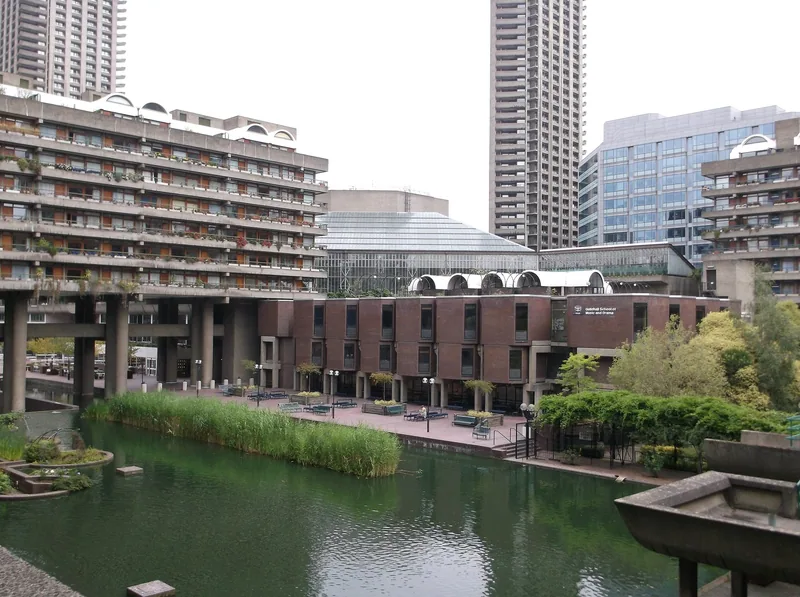
Photo: Harry Mitchell · CC BY 4.0 · Wikimedia Commons · resized
Finding your way in, and why it is hard
The estate was built on the principle that pedestrians and traffic should be separated, so the pavements you want are one level above the road. The result is that the ground floor is often not the entrance, the lifts are not where you expect them, and the signed route from a station can feel like it is taking you the wrong way.
Three things make it manageable.
- Aim for Silk Street. Every signed route from every station leads there, and it is the only address worth remembering.
- Follow the yellow-painted route markings and the signs, not your instincts. The estate is signposted for exactly this problem, and the signage is better than the map on your phone, which does not understand that two paths crossing are on different levels.
- Once inside, work from Level G. The Centre's floors run from -2 up through Level G to Level 3, and the information desk is on Level G.
From Barbican station it is about four minutes, from Moorgate seven and from Farringdon eight. Moorgate is the one to use if you need a lift: TfL's own station data records four lifts there against two at Barbican, although lifts and step-free access are not the same thing and the route that matters depends on which line you arrive on; our guide to step-free travel in London explains how to check.
Walk the highwalks once, at dusk, without trying to get anywhere. The raised walkways link the whole estate to the arts centre, the church and the gardens, and they are public. At about half past seven on a weekday the offices have emptied, the residents' windows are lit, and you have a concrete city of 4,000 people almost to yourself. It costs nothing, it takes twenty minutes, and it is the single best thing to do here.
What to look at
The lake and the Lakeside Terrace. An artificial lake with fountains runs along the front of the arts centre, with a terrace beside it that anybody may sit on. It is the estate's front garden and the part almost every visitor finds.
St Giles' Cripplegate. The medieval parish church stands in the middle of the estate, gutted by the 1940 bombing and rebuilt in the 1950s. John Milton is buried here. It is a working church, so opening depends on services; check before making a special journey.
The Roman and medieval wall. A substantial stretch of the old City wall survives along the estate's western edge, by the lake and behind the church, with a medieval bastion in the middle of it, reached from the highwalks; our page on Roman London and what survives puts it in order with the rest.
The Conservatory. A glasshouse of about 1,500 plant species wrapped around the theatre's fly tower, free but open only on listed dates and with a timed ticket. It has its own page: the Barbican Conservatory. If the architecture is why you came, our guide to brutalist London lists the other buildings worth the journey.
Golden Lane, next door and older
Immediately north-west, across Beech Street, is the Golden Lane Estate: the same architects' earlier work, built between 1953 and 1962 for the City Corporation as social housing. It has more than 500 flats, a community centre, and a leisure centre with a swimming pool anybody can use. The whole estate was listed in 1997 at Grade II, with Crescent House separately listed at Grade II*.
It is smaller, lower and gentler than the Barbican, with coloured panels and a sunken garden, and a great many architects prefer it. Walk through it on the way to Whitecross Street.
Moorgate: a station with five different railways in it
Moorgate is one of the most useful and least understood stations in London. Underneath it are the Circle, Hammersmith and City, Metropolitan and Northern lines. Beside it are the Elizabeth line platforms, which are shared with Liverpool Street and reached by a long passage, so a journey described as "Liverpool Street" may put you out at Moorgate. And above ground are Great Northern trains on their own tracks to Hertfordshire.
Two things follow for a visitor. First, Moorgate is the fastest way from this corner of the City to almost anywhere: Oxford Circus is about fifteen minutes with one change, at £3.10 peak or £3.00 off-peak with contactless or Oyster. Our guide to the Elizabeth line explains how the shared station works.
Second, Liverpool Street is a five-minute walk from the Moorgate exits, which is often faster than any train between the two; our page on getting between London's main stations has the other awkward pairs, and eating near Liverpool Street is where to go for dinner, because the City side of Bishopsgate closes at the weekend and the Spitalfields side does not. And the Great Northern trains from the surface platforms reach Palmers Green in about 27 minutes, roughly twice an hour, which is the quickest route to the Cypriot restaurants and bakeries in our guide to Greek and Cypriot food in London.
Finsbury Circus, London's first public park
Two minutes east of Moorgate is an oval garden that was laid out in 1606 as London's first public park, has belonged to the City Corporation since 1812, and is the largest open green space in the Square Mile. It is Grade II listed.
Most of it was fenced off for a decade while Crossrail dug a tunnel underneath, and it reopened in May 2025 after a redesign: a larger central lawn, better seating and accessibility, twelve additional tree species, more than 13,000 plants and over 6,000 bulbs. It is now the best place within five minutes of Moorgate to sit down with something bought elsewhere, and at lunchtime on a weekday it fills with office workers doing exactly that.
For more City green space, Bunhill Fields is eight minutes north up Moorgate and Finsbury Pavement, with the graves of Bunyan, Defoe and Blake and a lawn to sit on.
Where to eat, and the street the City actually uses
The estate itself has cafes and bars inside the arts centre, open to anybody without a ticket. Outside it, three streets matter.
Whitecross Street, five minutes north, is a weekday lunch market run by Islington Council, trading roughly 11:00 to 14:00 from Monday to Thursday and 09:00 to 18:00 on Friday, with street food from all over the world and a run of small shops behind the stalls. A salad and hot food counter at number 126 was rated 5 for hygiene in January 2026. Our guide to eating cheaply in London covers it alongside Leather Lane.
Chiswell Street, on the estate's eastern edge, is the old Whitbread brewery street and holds the nearest good pub: a large pub and dining room at number 49, rated 5 in February 2026, which is busy with City workers until about 21:00 and then empty.
Long Lane and Great Sutton Street, ten minutes west towards Smithfield, have two more pubs: 71 to 72 Long Lane, rated 5 in January 2026, and 16 Great Sutton Street, rated 4 in November 2025. Both are on the way into Clerkenwell, which has far more choice than anywhere in the City.
The City closes at the weekend, and this is where you notice it. On a Saturday or Sunday the Barbican's own cafes are open and almost nothing else within five minutes is: Whitecross Street market does not trade, the Chiswell Street trade evaporates and several sandwich shops shut entirely. Plan to eat inside the Centre, walk to Clerkenwell or Smithfield, or build a picnic for Finsbury Circus using our guide to picnic supplies and self-catering.
What is being built
The biggest change nearby is at West Smithfield, ten minutes west, where the London Museum is moving into the General Market buildings. Its new site opens on 28 November 2026, with free galleries; the old London Wall site five minutes from the Barbican closed in December 2022 and its round entrance pavilion still stands empty.
Beech Street, the tunnel road under the estate, has been the subject of repeated traffic proposals and remains open to vehicles. Expect building work along London Wall and Moorgate indefinitely: this part of the City has been rebuilding continuously since 1945.
Staying here, and what the evening is like
Hotels here are mostly around Moorgate and Old Street, aimed at business travellers, which means they are cheaper at weekends than in midweek, the opposite of most of London. The trade-off is honest: you are two stops from everywhere and in a district with no shops and very little street life after 20:00.
What it does have is quiet. The walk back from a performance to Moorgate takes seven minutes on a highwalk with nobody else on it. For what is on, see classical music in London; for the rest of the Square Mile, the City of London.
Frequently asked questions
Can you walk around the Barbican Estate if you do not live there?
Yes. The highwalks, the lake terrace, the estate gardens and the arts centre foyers are all public, free and open every day. The flats and their private gardens are not. Nobody will stop you walking through, and the estate is signposted for visitors because so many people get lost in it.
Why is the Barbican so hard to find your way around?
Because it was designed to keep pedestrians away from traffic, so the main walking level is one storey above the road. The entrance you want is often not at ground level, and mapping apps do not understand that two crossing paths are on different levels. Follow the signs to Silk Street and work from there.
Which station is best for the Barbican?
Barbican station, about four minutes away on the Circle, Hammersmith and City and Metropolitan lines. Moorgate is seven minutes and adds the Northern line, the Elizabeth line and trains to Hertfordshire, and TfL's station data records four lifts there against two at Barbican.
Is there anything to eat near the Barbican at the weekend?
Inside the arts centre, yes. Outside it, very little: Whitecross Street's market trades on weekdays only and the City's lunch trade closes from Friday evening. Walk ten minutes to Clerkenwell or Smithfield, or buy food and sit in Finsbury Circus Gardens.
Is the Barbican worth visiting if you are not going to a concert?
Yes, for an hour. The highwalks, the lake, the medieval church, the surviving stretch of Roman and medieval city wall and the Golden Lane Estate next door are all free, and together they make the most coherent piece of post-war planning in Britain. Add the Conservatory if you can get a ticket for an open day.
Sources
- City of London Corporation - Barbican Estate celebrates 50th anniversary, 1 July 2019 (flats, residents, towers, dates, listing) (checked September 2026)
- City of London Corporation - Golden Lane Estate (checked September 2026)
- City of London Corporation - Golden Lane Estate listed building management guidelines (1997 listing, Crescent House Grade II*) (checked September 2026)
- City of London Corporation - Finsbury Circus Gardens reopens after transformation, 29 May 2025 (checked September 2026)
- City of London Corporation - Finsbury Circus Gardens (checked September 2026)
- Barbican Centre - Getting here, entrances and step-free routes (checked September 2026)
- Transport for London - detailed station data (lifts, platforms and fare zones for Barbican and Moorgate) (checked September 2026)
- Transport for London - Single Fare Finder (checked September 2026)