
Kew Gardens, officially the Royal Botanic Gardens, Kew, is a huge botanic garden in south-west London with famous Victorian glasshouses, a treetop walkway 18 metres above the ground and living plants from almost every corner of the world. An adult ticket costs £25 online in September and October 2026, and you need most of a day to see it properly.
Kew is not a park in the usual sense. It is a scientific institution and a UNESCO World Heritage Site, and its gardens are a living collection of plants from almost every part of the world, labelled and arranged for study as well as for pleasure. For a visitor, that means great variety: tropical rainforest under glass, a Japanese garden, a Chinese-style pagoda, woodland, lakes and wide lawns, all inside one fence.
Unlike the Royal Parks in central London, Kew charges for entry, and the price changes with the season. The gardens are a Tube ride from the centre, beside the Thames between Richmond and Chiswick. This guide explains what to see, what tickets cost, the autumn 2026 changes and how to get there.
Kew Gardens: the practical details
- Adult ticket, 2 September to 31 October 2026
- £25 online (£27.50 with donation); £28 at the gate
- Adult ticket, 1 November to 31 January
- £17 online (£19 with donation); £20 at the gate
- Child (4-15)
- £2 online; £4 at the gate
- Opening hours, September 2026
- 10am to 7pm, last entry 6pm; glasshouses 10am to 5pm
- Nearest station
- Kew Gardens (District line and London Overground), about 500 metres from Victoria Gate; Zones 3 and 4
- Time needed
- At least half a day; a full day to see the main glasshouses and the walkway without rushing
What Kew is and why it matters
Kew grew from a royal garden, and Kew itself names Princess Augusta, mother of George III, as the founder of the Gardens in the 18th century. Today its scientists study and protect plants from around the world, and the collections in the gardens are part of that work. Many of the plants you pass are rare or endangered in the wild.
The gardens stretch along the Thames. Most visitors arrive at Victoria Gate, the entrance closest to Kew Gardens station. The Temperate House and the Great Pagoda are towards Lion Gate in the south. Pick up a map at the gate or download it before you go; distances are bigger than they look.
The Palm House: a Victorian rainforest under glass
The Palm House is the building on most photographs of Kew. It was built in 1844 by Richard Turner to designs by Decimus Burton, and was the first glasshouse of its kind built on such a scale. The builders borrowed techniques from shipbuilding, which is why it looks a little like an upturned ship's hull.
Inside, the air is hot and heavy. It holds a tropical rainforest collection, with plants such as the rubber tree, the African oil palm and the cocoa tree, and what Kew describes as the oldest pot plant in the world. Many of the species are endangered in the wild, and Kew's scientists use the collection for research into medicines and sustainable crops.
Glasshouses keep shorter hours than the gardens: from 10am to 5pm. If you arrive in the afternoon, see the Palm House and the other glasshouses first and leave the outdoor gardens until later.
The glasshouses at Kew close at 5pm, even when the gardens stay open until 7pm. In September 2026 the gardens are open until 7pm, but the Palm House, the Temperate House and the other glasshouses shut at 5pm. Plan your route so that you are inside them by mid-afternoon.
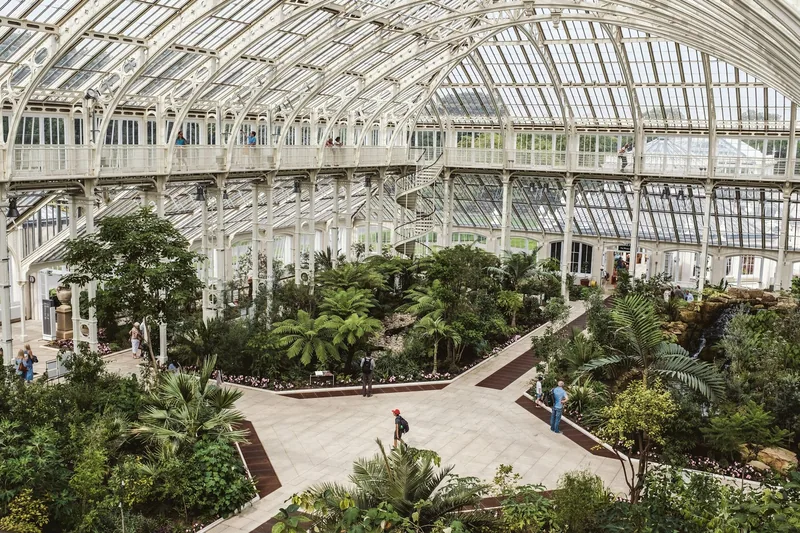
The Temperate House, the world's largest Victorian glasshouse
The Temperate House, which Kew describes as the world's largest Victorian glasshouse, reopened in 2018 after a five-year restoration and is a Grade I listed building. It holds around 1,200 species from Asia, Australasia, the Americas and Africa, most of them plants that cannot survive frost, so it is kept at a minimum of around 10 degrees Celsius in winter.
The Temperate House tells the story of plants that are rare or extinct in the wild, including island plants from St Helena, the Pitcairn Islands and the Juan Fernández Islands. In all, the house holds around 3,000 individual plants.
Step-free access is on the western side of the building. As with the other glasshouses, Kew may close it at short notice for maintenance, so check its planned closures page on the day.
The Treetop Walkway and The Hive
The Treetop Walkway lifts you 18 metres off the ground into the crowns of sweet chestnut, beech, horse chestnut and oak trees. It is made from more than 400 tonnes of weathered steel, rusty in colour so that it blends in with the woodland, and it is designed to flex slightly in the wind. At the top you are among the uppermost branches, a world of birds, insects, lichen and fungi.
There are 118 steps up, and there is also a lift. Buggies have to be left at ground level and children must be supervised. The walkway can close in bad weather or for maintenance, so if it is the one thing you want to see, check Kew's closures page before you travel.
In the middle of a wildflower meadow stands The Hive, a 17-metre-high structure of 170,000 aluminium parts and 1,000 LED lights. Created by the artist Wolfgang Buttress for the UK Pavilion at the 2015 Milan Expo, it responds in light and sound to the activity of a real beehive at Kew. Walk inside and the lights glow and fade with the bees' vibrations. The path to it is wheelchair accessible but may feel steep; mobility scooters cannot go inside.
The Princess of Wales Conservatory and the Great Pagoda
The Princess of Wales Conservatory is a winding glasshouse with ten computer-controlled climate zones, from desert to wet tropics. It is the place for cacti, orchids and carnivorous plants such as Venus flytraps and pitcher plants. In the wet tropical zone floats the giant waterlily Victoria boliviana, first identified at Kew, whose flowers open at sunset and change from white to pink. In 1985 Sir David Attenborough buried a time capsule of seeds in the foundations, to be opened in 2085.
At the southern end of the gardens is the Great Pagoda, completed in 1762 for Princess Augusta and designed by Sir William Chambers. It was restored in 2018, including the 80 gilded wooden dragons that decorate its roofs. You can climb it for one of the earliest bird's-eye views of London, but it needs its own time slot, bought as an optional extra with your Kew ticket, at the gate or at the Pagoda.
Kew Palace and the other Historic Royal Palaces sites at Kew close from 28 September 2026 until spring 2027. Kew Palace, the royal residence inside the gardens, is run by Historic Royal Palaces, not by Kew. Before you pay for a Pagoda slot, check on the Kew website that it is open on your date. Lion Gate, the southern entrance nearest the Pagoda, will open only at weekends from 2 November 2026 to 29 January 2027.
What else to see: gardens, trees and the Children's Garden
Beyond the big names there is plenty to fill a second visit. The Great Broad Walk Borders are long, richly planted flower borders that lead into the heart of Kew. The Japanese Landscape surrounds the Chokushi-Mon, a Japanese gateway, and a traditional Japanese farmhouse, the Minka House, stands in the Bamboo Garden. The Davies Alpine House grows mountain plants in cool, dry, windy conditions, and the Arboretum holds about 11,000 trees, which make autumn one of the best times to visit.
In 2026 there is also an outdoor exhibition, Henry Moore: Monumental Nature, with works by Moore placed across the gardens from 9 May 2026 to 31 January 2027. Free guided walks, "Introduction to the Gardens", start daily at 11am and 1.30pm and are included in your ticket.
Families should head for the Children's Garden, designed for children aged 2 to 12. It covers an area the size of 40 tennis courts, with a 4-metre-high canopy walk around a 200-year-old oak, bamboo tunnels, trampolines and hammocks. You do not need to book, and adults may enter only with children. Kew says it is quieter first thing in the morning and in the late afternoon. Our guide to London with children has more ideas for family days.
Tickets, prices and ways to save
Kew sells tickets online and at the gate, and online is always cheaper. Its prices follow the season: peak prices apply from September to October, and lower off-peak prices from November to January.
| Adult ticket | Online | Online with donation | At the gate | Gate with donation |
|---|---|---|---|---|
| Peak, 2 September to 31 October 2026 | £25 | £27.50 | £28 | £31 |
| Off-peak, 1 November to 31 January | £17 | £19 | £20 | £22 |
| "£10 Tuesdays", 8 September to 29 December 2026 | £10 | £11 | - | - |
Children aged 4 to 15 pay £2 online or £4 at the gate. So a family of two adults and two children visiting in October pays £54 online, against £64 at the gate. A couple pays £50 online on a normal day, but only £20 on one of the "£10 Tuesdays" that Kew is running until 29 December 2026. Check the current prices and the Tuesday offer on the official tickets page before you book.
A Tuesday visit to Kew costs £10 until 29 December 2026. Kew's "£10 Tuesdays" offer cuts the adult price from £25 to £10 during the autumn peak. If your dates are flexible, it is the easiest saving in this guide; our tips for seeing London on a budget list more like it.
Christmas at Kew, the evening light trail, is a separate event with its own tickets. In 2026 it runs on selected dates from 13 November to 3 January 2027, and Kew says December dates are already selling fast. Our guide to Christmas in London compares it with the other seasonal events.
Opening hours through the year
Closing time at Kew moves with the daylight. The glasshouses open from 10am to 5pm throughout.
- September 2026: 10am to 7pm, last entry 6pm.
- 1 to 24 October 2026: 10am to 6pm.
- 25 October to 11 November 2026: 10am to 4pm.
- 12 November 2026 to 3 January 2027: 10am to 3.15pm.
In the short winter days you have just over five hours, so arrive at opening time. Kew also works well as a rainy-day plan: the Palm House, the Temperate House and the Princess of Wales Conservatory together give you a couple of hours under glass. Our guide to the best time to visit London helps you pick a season.
Getting to Kew Gardens
The easiest way is to Kew Gardens station, which is served by the District line and the Mildmay line of the London Overground and sits in Zones 3 and 4. From there it is about 500 metres to Victoria Gate. The westbound platform is not step-free, which matters for the return journey towards Richmond. Our guides to the Underground, the London Overground and step-free travel explain the details.
The other option is Kew Bridge station, served by South Western Railway, which is about 800 metres from Elizabeth Gate. Contactless and Oyster work on both routes, and the daily cap limits what you pay; see our page on London's travel zones for how zones affect the price.
The river bus does not help here. Uber Boat by Thames Clippers runs only between Putney and Barking Riverside, so there is no commuter boat to Kew; see our guide to the river bus for what it does cover.
Combining Kew with Richmond and beyond
Kew sits one stop from Richmond on the District line and the Overground, so it is easy to add the riverside town of Richmond for dinner, or to spend the next morning among the deer in Richmond Park. Further up the Thames, Hampton Court Palace has some of the finest historic gardens in England.
Garden lovers visiting in May may also want to know about the Chelsea Flower Show, which in 2027 opens to the public from 20 to 22 May. For free green space closer to the centre, see our overview of London's parks and gardens.
Frequently asked questions
How much does it cost to visit Kew Gardens?
From 2 September to 31 October 2026, an adult ticket costs £25 online or £28 at the gate, before the optional donation. From 1 November to 31 January it drops to £17 online. Children aged 4 to 15 pay £2 online. On "£10 Tuesdays", until 29 December 2026, adults pay £10.
How long do you need at Kew Gardens?
Plan at least half a day to see the Palm House, the Temperate House and the Treetop Walkway. A full day lets you add the Princess of Wales Conservatory, the Pagoda, the Children's Garden and a proper walk through the Arboretum without rushing.
Is it cheaper to buy Kew Gardens tickets online?
Yes. Kew says online booking gives the best value. In autumn 2026 an adult ticket is £25 online and £28 at the gate, and a child ticket is £2 online and £4 at the gate, so a family of four saves £10 by booking ahead.
Which Tube station is nearest to Kew Gardens?
Kew Gardens station, on the District line and the London Overground, is about 500 metres from Victoria Gate. Kew Bridge station, on South Western Railway, is about 800 metres from Elizabeth Gate. The westbound platform at Kew Gardens station is not step-free.
Is Kew Palace open?
Not in autumn and winter 2026. Kew Palace and the other Historic Royal Palaces attractions at Kew close from Monday 28 September 2026 until spring 2027. The rest of the gardens and the glasshouses stay open as normal.
Sources
- Royal Botanic Gardens, Kew - Tickets (checked September 2026)
- Royal Botanic Gardens, Kew - Opening and closing times (checked September 2026)
- Royal Botanic Gardens, Kew - Getting here (checked September 2026)
- Royal Botanic Gardens, Kew - What's in the Gardens (checked September 2026)
- Royal Botanic Gardens, Kew - Temperate House (Internet Archive copy, 12 September 2026) (checked September 2026)
- Royal Botanic Gardens, Kew - Great Pagoda (Internet Archive copy, 29 August 2026) (checked September 2026)
- Royal Botanic Gardens, Kew - Treetop Walkway (Internet Archive copy, 8 May 2025) (checked September 2026)
- Royal Botanic Gardens, Kew - Palm House (Internet Archive copy, 18 January 2025) (checked September 2026)