
Eurostar runs direct from London St Pancras to Lille Europe in 1 hour 22 minutes, with Standard fares advertised from £39 one way. That is half an hour less than Brussels and nearly an hour less than Paris, and because the journey is so short, Lille gives you more hours on the ground than any other Eurostar destination. It is the cheapest cross-Channel day out from London, if you pick the train rather than letting the booking engine pick it for you.
Lille is a city of about 235,000 people in the far north of France, close enough to the Belgian border that its old quarter is built of Flemish brick rather than Parisian stone. It was a Flemish cloth town before it was French, and the centre still looks it: gabled houses, a seventeenth-century merchants' exchange around a courtyard, and a main square the locals call the Grand'Place whatever the maps say.
Our guide to Eurostar from London has the classes, the luggage rules and the border process, and our Paris day trip page sets out how a cross-Channel day is put together. This page is about Lille: the fare, the two stations, and what a day there is actually like.
London to Lille: the numbers
- From
- London St Pancras International, direct
- Journey time
- 1 hour 22 minutes (Eurostar, September 2026)
- Arrives at
- Lille Europe, in the centre
- Fare
- From £39 one way in Eurostar Standard, subject to availability
- Be at St Pancras
- 75 minutes before departure (Standard and Plus)
- Currency
- Euro
- Time difference
- One hour ahead of London, all year
- Walk from the station
- Five minutes to the Grand'Place, ten to Vieux Lille
- Verdict
- Worth a day, and the best value day of the three French options
Why Lille is the cheap one
All the short Eurostar routes share the same lead-in fare of £39 one way in Standard, so Lille is not cheaper per ticket than Brussels. It is cheaper as a day, for three reasons.
- You lose less of the day to the train. At 1 hour 22 minutes each way, the round trip takes under three hours of travelling. Paris takes closer to four and a half.
- The cheap fares survive longer. Lille is a smaller market than Paris or Brussels, so the lowest price bands are still available on dates where Paris has already moved up two bands.
- You do not need a transport pass. Everything a first visit wants is within a fifteen-minute walk of the station, so there is no Métro fare to add on top, which is where a Paris day quietly gains twenty euros.
Against that, the things worth seeing in Lille are fewer, and the one world-class museum is a walk away from the pretty part. If you are choosing purely on cost, compare it with the best British options in our ranking of the cheapest day trips from London, which do not carry a cross-Channel fare at all.
Eurostar Snap works better for Lille than for anywhere else. Snap is Eurostar's late-deal scheme: you pick the date, Eurostar picks the departure time, and you find out which train you are on nearer the day. On a Paris or Amsterdam day trip that is a gamble with your whole itinerary. On a Lille day it costs you an hour at worst, because there is nothing you must be anywhere for.
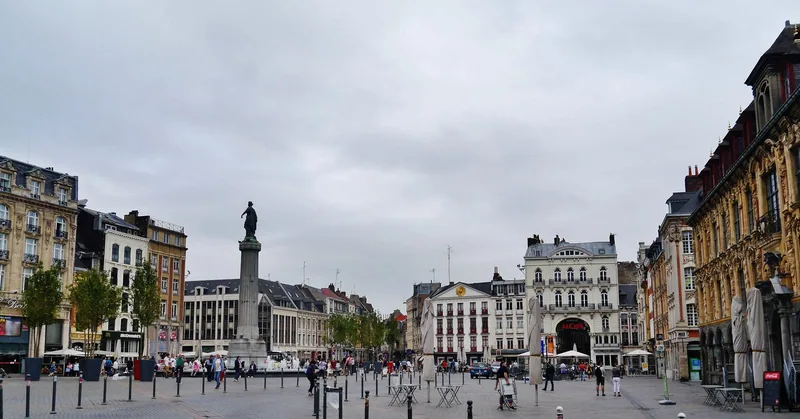
Photo: Zairon · CC BY-SA 4.0 · Wikimedia Commons · resized
Picking the train carefully
The lowest fares tend to sit on the departures that suit a day tripper least: a late-morning train out and an early-evening one back. Eurostar publishes the day's actual departure times only inside its booking calendar, not as a printed timetable, so the only way to plan this is to open the booking page for your date and read the times before you look at the prices.
Two things follow. First, search for the number of people you really are: the lowest fares are released in limited numbers per train and the system fills a booking from the cheapest band upwards. Second, check the day either side, because a midweek departure is regularly a band cheaper than a Friday or Sunday one.
There is no walk-up fare, no railcard discount and no equivalent of an Off-Peak return, so this is not a trip you can decide on at the station. Tickets can be changed, at a price, within limits that our Eurostar guide sets out. Our list of what to book before you go to London puts it in order with everything else.
Lille Europe and Lille Flandres: two stations, 500 metres apart
Eurostar arrives at Lille Europe, a glass-and-steel station built for the high-speed line in the 1990s. It is not Lille's main station. Lille Flandres, the old terminus for regional trains and services into Belgium, is about 500 metres away on the far side of a shopping centre, and the walk between the two is signposted and takes five to seven minutes.
This matters in two situations. If you are changing onto a French domestic train, check which of the two stations your onward service leaves from before you leave the platform: the TGV to Marne-la-Vallée for Disneyland Paris goes from Lille Europe, but many regional trains go from Flandres. And if you are meeting someone, name the station, because "Lille station" means different things to different people.
Because the UK and French border checks both happen in London before you board, arriving is simple: you walk off the train and out of the building. Our King's Cross and St Pancras guide covers the London end, including where the Eurostar entrance actually is, and our page on left luggage at London's stations is useful if you are travelling out on the morning you arrive in Britain.
A day in Lille on foot
Turn right out of Lille Europe and you are in the centre in five minutes. The Grand'Place, properly the Place du Général-de-Gaulle, is the hinge of the city: a broad square with the old newspaper building on one side, cafés down the other and a column in the middle.
Beside it stands the Vieille Bourse, the old stock exchange of 1653, built as a square of small houses around an inner courtyard. The courtyard is now given over to second-hand book stalls and, on some afternoons, chess players, and it is free to walk into. Ten minutes north, Vieux Lille is the Flemish quarter: narrow brick streets, tall gables, expensive small shops and the cathedral of Notre-Dame-de-la-Treille, whose modern marble west front is either the best or the worst thing in the city depending on who you ask.
The Palais des Beaux-Arts, fifteen minutes south on the Place de la République, is the serious reason to come. It is one of the largest fine-art museums in France outside Paris, strong on Flemish and Dutch painting, with a basement of eighteenth-century relief models of fortified towns that is unlike anything in London. Check its opening days and the current admission price on the museum's own site before you travel: like most French municipal museums it closes one day a week, and that day catches day trippers.
For a market rather than a museum, the Wazemmes quarter is two Métro stops or a twenty-minute walk south-west of the centre, built around a covered market hall with an open-air market spilling out across the square on its main trading days. Confirm the days locally; they are not the same all year.
Eating, money and language
Northern French food is heavier and cheaper than Parisian food, and the regional dishes are genuinely local rather than invented for visitors: carbonade flamande, a beef stew cooked in beer; potjevleesch, a cold terrine of several meats in jelly; maroilles, a strong washed-rind cheese that turns up in tarts. The traditional places to eat them are the estaminets, small Flemish-style dining rooms with tiled floors and no music.
Lille uses the euro. Card payment is normal, contactless is widely accepted, and there is no reason to change money before you leave: our page on changing money in London explains why the airport and station bureaux are the worst option if you do. Service is included in French restaurant prices, and tipping is optional and small.
English is less widely spoken in Lille than in Brussels or central Paris, and more so outside the immediate centre. A few words of French go a long way here, and shopkeepers expect a greeting before a question.
Papers, and the check that happens in London
France wants a passport; an identity card will not do, whichever direction you are going. The Schengen validity tests and the 90-day allowance are the same as for any EU trip, and both are explained once on our Eurostar guide instead of three times over on three day-trip pages.
What is worth knowing for Lille specifically is that every border formality happens before you board, in St Pancras, including the EU's Entry/Exit System. You land at Lille Europe and walk straight out. Returning, the British side wants an Electronic Travel Authorisation from most visa-free visitors, which is covered on our ETA page.
Lille, Brussels or Paris for one day
| City | Each way | Travel time round trip | What a day buys |
|---|---|---|---|
| Lille | 1 h 22 min | Under 3 hours | The whole centre on foot, one major museum, a long lunch |
| Brussels | 1 h 53 min | Under 4 hours | The Grand-Place, the arcades and the upper town |
| Paris | 2 h 16 min | About 4 h 30 min | One major sight and one neighbourhood, at a rush |
Our verdict: for a first cross-Channel day from London, Paris is the one people want and Lille is the one that works. If you have two days, Brussels is the better single city, and Amsterdam needs a night in it to be worth the fare. Our full day trips list has the domestic alternatives.
Frequently asked questions
How long is the Eurostar from London to Lille?
One hour 22 minutes, direct from London St Pancras International to Lille Europe. Eurostar asks Standard and Plus passengers to arrive at St Pancras 75 minutes before departure because the ticket, passport and security checks all happen in London, so allow about two hours and forty minutes door to platform.
Is Lille worth a day trip from London?
Yes, and it is the Eurostar day trip we would recommend to a first-timer. The journey is short, the centre is walkable from the station, and you do not need a local transport ticket. If you want more than one major museum, stay the night instead.
How much is the Eurostar to Lille?
Eurostar advertises Standard fares from £39 one way, subject to availability, so a return booked well ahead starts around £78 for an adult (September 2026). There are no railcard discounts, no walk-up fares and no Off-Peak category, and prices rise sharply close to departure.
What is the difference between Lille Europe and Lille Flandres?
Lille Europe is the high-speed station where Eurostar arrives. Lille Flandres, about 500 metres away and a five to seven minute signposted walk, is the older station used by most regional services. Check which one your onward train leaves from before you leave the platform.
Can you get to Paris from Lille by train?
Yes, and it is the standard way to reach Disneyland Paris from London: a TGV from Lille Europe runs to Marne-la-Vallée–Chessy, and Eurostar sells the whole journey as one booking. Central Paris is about an hour from Lille by TGV, but for a day trip it is quicker to take the direct Eurostar from London.
Sources
- Eurostar - London to Lille trains (checked September 2026)
- Eurostar - London to Paris trains, journey time (checked September 2026)
- Eurostar - Check-in and recommended arrival times (checked September 2026)
- GOV.UK - France travel advice: entry requirements (checked September 2026)
- European Commission - The difference between EES and ETIAS (checked September 2026)
- GOV.UK - Apply for an Electronic Travel Authorisation (checked September 2026)