
King's Cross and St Pancras International are two separate stations about fifty metres apart on Euston Road, sharing one Underground station with six lines and four street entrances. If you have arrived with a suitcase and forty minutes, the only question that matters is which building you are in: the departure boards, the ticket barriers, the left luggage office and the toilets are all duplicated, and none of them is shared.
The quick test. If your ticket says Eurostar, Thameslink, East Midlands Railway, Southeastern or Luton Airport, you want St Pancras, the long red-brick building with the clock tower. If it says LNER, Great Northern, Grand Central, Lumo or Hull Trains, you want King's Cross, the pale stone building with two big arches next to it. Which trains go where from London generally is set out in our guide to London's main railway terminals.
Standing in the concourse: the numbers
- King's Cross platforms
- 0 to 11, all level with the main entrance
- St Pancras platforms
- Eurostar and long-distance on the upper level; Thameslink A and B below
- Walk between the two
- About 50 metres between concourses, 5 minutes with bags
- Walk to Euston
- 900 metres, signed, step-free
- Underground
- Circle, Hammersmith & City, Metropolitan, Northern, Piccadilly, Victoria
- Step-free rating
- Category A at both stations: step-free to every platform
- Left luggage
- Both stations, daily 07:00-23:00, from £10.00 for up to 3 hours
- Toilets
- Free, outside the ticket barriers, at both stations
- King's Cross ticket office
- 06:00-22:00 Monday to Saturday, 07:45-22:00 Sunday
- St Pancras ticket office
- 05:45-23:15 weekdays, 07:15-23:15 Sunday
The exits at King's Cross, and what each one puts you next to
King's Cross has four ways out and they face in four different directions. Getting this right saves five minutes and a road crossing.
- King's Cross Square and Euston Road (south). The main exit, out of the front of the station into an open square with the bus stops, the taxi rank and the Underground entrances. Come out here for buses, for the Tube, and for the walk east towards Islington.
- Pancras Road (west). A side exit from the western concourse straight onto the road that separates the two stations. This is the exit for St Pancras, and it is the one to use if your connection is tight.
- King's Boulevard (north). Out of the far end of the western concourse towards Granary Square and the canal. Five minutes to Coal Drops Yard, which our guide to the King's Cross neighbourhood covers, and the quiet way in and out of the station at any time of day.
- York Way (east). The narrow exit on the far side of the platforms, useful only if you are staying on that side.
The Underground entrances are not inside either main-line station. They are in and around King's Cross Square in front of King's Cross, with a second ticket hall on the north side reached from the pavement on Euston Road. Whichever you use, you come out into the same enormous ticket hall underneath, and the Victoria line platforms are at the southern end of it.
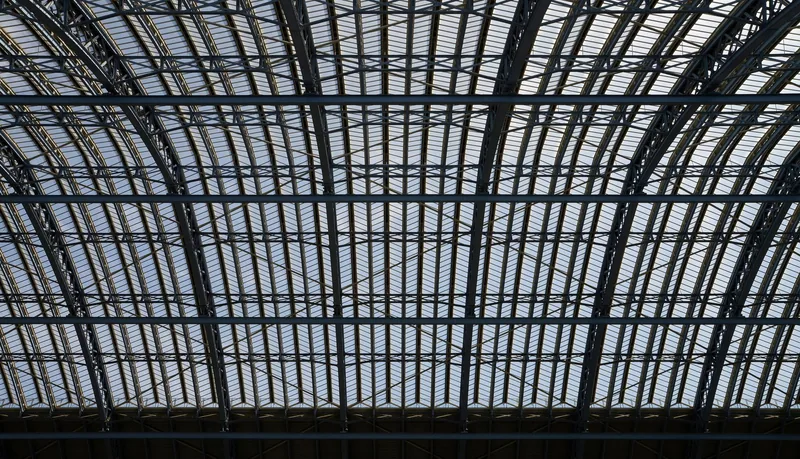
Photo: Alvesgaspar · CC BY-SA 4.0 · Wikimedia Commons · resized
St Pancras is on three levels, and the trains are not on the one you walk into
St Pancras confuses people because the entrances are at street level and the long-distance platforms are one floor up. You walk in from Pancras Road, Midland Road or Euston Road onto a low, shop-lined concourse called the Arcade, with the Thameslink barriers at one end and escalators and lifts up to the main train deck.
Upstairs, under the great Victorian iron-and-glass roof, Eurostar has its own sealed departure area with passport and security checks, entered through gates on the west side; East Midlands Railway trains, including the Luton Airport Express, use platforms at the north end of the same deck; and Southeastern's high-speed trains to Kent use platforms towards the eastern side. Thameslink trains, the ones that run through to Gatwick, Brighton, Luton and Cambridge, stay downstairs on platforms A and B.
Network Rail's own access notes describe three lifts on the main concourse serving the upper-level UK platforms and the Rendezvous, the open area under the clock. Every entrance is at street level, so a wheelchair user or anyone with a heavy case never has to find a staircase here, which is not true of most Victorian stations.
Thameslink platforms A and B are below ground and easy to miss entirely. They are reached from the Arcade through their own ticket barriers, not from the main train deck. Anyone going to Gatwick, Luton Airport Parkway or Blackfriars needs to go down, not up, and our page on how Thameslink works explains the rest of that route.
The walk between the two stations, and the two ways to do it
The concourses are about fifty metres apart. Outside, cross Pancras Road at the signalled crossing and you are there in two or three minutes. Underground, the two stations are also linked through the Tube ticket hall, which is step-free, sheltered and longer.
Allow more than the distance suggests. Both stations have ticket barriers at every platform, both have crowds moving in several directions, and a Thameslink platform at St Pancras is a good five minutes from a King's Cross platform once you have gone down, along and up again. If you have separate tickets and one train is an Advance fare, treat the change as a proper journey rather than a stroll; the timings for every other pair of London terminals are in getting between London's main stations.
Where the platform appears, and when
King's Cross puts its departure board over the middle of the western concourse and holds most long-distance trains back until close to departure, so the concourse works as a waiting room and then empties in a rush. The practical consequence is simple: do not settle in a cafe on the mezzanine with ten minutes to go. Stand where you can see the board and are within a minute of the barriers for platforms 0 to 8, which is the back of the concourse nearest the trains.
St Pancras is calmer, because the long-distance operators there use fewer platforms and tend to show them earlier, and because Eurostar's gates open on a published schedule rather than a platform announcement. Eurostar's own advice is to arrive 75 minutes before departure in Standard and Plus, and our guide to the Eurostar from London explains the checks.
One practical difference between the two buildings. King's Cross has ticket gates on every platform and a single concourse, so once you are through you are committed. St Pancras has separate gatelines for Eurostar, the domestic upper level and Thameslink, and going through the wrong one means coming back out past a member of staff.
Left luggage, toilets and somewhere to sit
Both stations have a left luggage office run by the Excess Baggage Company, open every day from 07:00 to 23:00. Prices start at £10.00 for up to three hours and £15.00 for up to 24 hours per item, and bags are screened before they are accepted, so allow ten minutes in either direction. The cheaper app-based alternatives in nearby shops and hotels are compared in our guide to left luggage at London's stations.
The toilets at King's Cross are free, outside the ticket barriers, and include an accessible unisex toilet with a Changing Places facility and a separate baby-changing area. That matters more than it sounds: at some London terminals the toilets are behind the gateline, so you need a valid ticket to reach them. Here you do not.
For sitting down, the honest answer at King's Cross is the mezzanine above the western concourse, which has the only substantial seating that is not inside a cafe. At St Pancras the Rendezvous under the clock has benches, and the long Arcade has more. Neither station has a general waiting room in the old sense; both have first-class lounges for the relevant ticket holders only. If you have an hour and would rather spend it somewhere pleasant, the Camley Street Natural Park is a five-minute walk behind St Pancras and is free.
Step-free routes, including the Underground
Both main-line stations are rated Category A by Network Rail, meaning step-free access to every platform. At King's Cross the platforms are level with the main entrance and lifts link the concourse with the mezzanine and down to the Underground ticket hall. At St Pancras the street entrances are level with the lower concourse and lifts serve everything above it.
The Underground station is unusually good too. TfL's station data records thirteen lifts and a step-free route from the street to the Victoria, Northern, Piccadilly, Circle, Metropolitan and Hammersmith & City platforms, which makes King's Cross St Pancras one of the very few places in central London where you can change between deep Tube lines without stairs. The Victoria line is the fastest of them for crossing the centre, and the practical detail on staff help is in step-free and accessible transport in London.
The lift to the Underground is not a shortcut between the two main-line stations. It takes you down into the ticket hall, which is inside the Tube gateline. Going between King's Cross and St Pancras step-free without paying a fare means crossing Pancras Road at street level, which is flat and takes about three minutes.
An hour to fill, and nothing you want to carry
Leave the bags in left luggage first, because everything worth doing here involves walking. Within ten minutes on foot you have the canal at Granary Square, the British Library on Euston Road, and the streets north of the station that have been rebuilt over the past fifteen years. Where to eat is a separate question with a separate answer: our guide to eating near King's Cross and St Pancras covers the food inside and outside both buildings, including what to avoid on the concourse.
If you have less than half an hour, stay inside. The two buildings are worth looking at in their own right, and St Pancras in particular repays ten minutes of standing still; the architecture is covered in our page on the St Pancras building itself.
Frequently asked questions
Are King's Cross and St Pancras the same station?
No. They are two separate main-line stations about fifty metres apart, with their own platforms, departure boards, ticket barriers, ticket offices and left luggage offices. They share one Underground station, King's Cross St Pancras, and the walk between the concourses takes two or three minutes across Pancras Road.
Where is the Underground entrance at King's Cross?
Outside the main-line stations, in and around King's Cross Square in front of King's Cross, with a second ticket hall reached from the Euston Road pavement on the north side. All the entrances lead to the same ticket hall below, where six lines meet. There is also lift access down from the King's Cross concourse.
Is there left luggage at King's Cross and St Pancras?
Yes, at both, run by the Excess Baggage Company and open daily from 07:00 to 23:00. Prices start at £10.00 for up to three hours and £15.00 for up to 24 hours per item. Bags are screened, so do not arrive at 22:55 expecting to be served.
Which platform do Thameslink trains use at St Pancras?
Platforms A and B, on the lower level, reached from the Arcade through their own ticket barriers rather than from the main train deck upstairs. Trains from there run to Gatwick, Brighton, Luton Airport Parkway, Bedford and Cambridge through central London.
How long should I allow to change between King's Cross and St Pancras?
Fifteen minutes is comfortable, twenty if you are going to or from a Thameslink platform or you have heavy bags, and longer if one of the tickets is an Advance fare valid on a single train. The walk itself is short; the barriers, the levels and the crowds are what take the time.
Sources
- Network Rail - London King's Cross station information (checked September 2026)
- Network Rail - London St Pancras International station information (checked September 2026)
- National Rail - London King's Cross station facilities and step-free category (checked September 2026)
- Transport for London - Stations, lifts, toilets and step-free data (checked September 2026)
- Eurostar - check-in and arrival times at St Pancras (checked September 2026)