
The worst exchange rate you will be offered on your whole trip is the one at the airport arrivals hall, and "0% commission" does not fix it. For most visitors the cheaper answer is to arrive with almost no cash at all and draw a modest sum out of a machine once you are here.
London is close to cashless. Buses do not take coins at all, black cabs must accept contactless, and market stalls and corner shops mostly take cards. You can spend a week here and never handle a banknote. Our guide to money in London covers cards, cash machines and the choice of billing currency, and our page on saving money in London covers the wider budget.
What follows is about the one thing those pages do not go into: physically exchanging foreign banknotes for pounds. Where that is worth doing, how to read the board in the window, and how much the convenient options actually cost.
Changing money at a glance
- Cash you actually need
- £20 to £40 for most visitors, as a backup rather than a budget
- Worst place to change
- Airport arrivals halls, and any bureau with no competitor in sight
- "0% commission"
- A statement about fees, not about the rate. Compare the rate
- The rate that matters
- The gap between the buy and sell prices on the board
- Legally required
- A bureau de change must be registered with HMRC for money laundering supervision. The register is public
- Usually cheapest
- A cash machine withdrawal in pounds, paid in pounds, with your bank's fees known in advance
How much cash do you really need?
Start with the honest answer: less than you think, and possibly none.
Cards and phones work almost everywhere: shops, restaurants, pubs, museums, taxis, the Tube, buses, ticket machines and market stalls. Buses take no cash whatsoever, and the same contactless card pays your fares all week under the daily and weekly caps, as our comparison of Oyster and contactless sets out. Where cash is still useful is small and specific: a tip left on a table rather than added to the bill, a church donation box, an older launderette with a coin slot, a charity collection, a busker, and the occasional independent café with a card minimum, which is more common among the cheap eats than in restaurants. Tipping is the other reason people like a few notes in a pocket, although the card machine will usually handle it; who expects what is set out on our page about tipping.
A reasonable target is £20 to £40 per person in smaller notes, held as a backup in case a card is blocked or a terminal fails. Building a holiday budget out of cash means carrying a great deal of it, which is a separate problem, as our page on how pickpockets work explains.
One thing to note if you plan to arrive with a large sum: you must declare £10,000 or more, or the equivalent in any currency, when carrying it between Great Britain and a country outside the UK, and the threshold applies to a family or group total as well. Our guide to UK customs allowances covers the declaration.
Why the airport rate is so bad
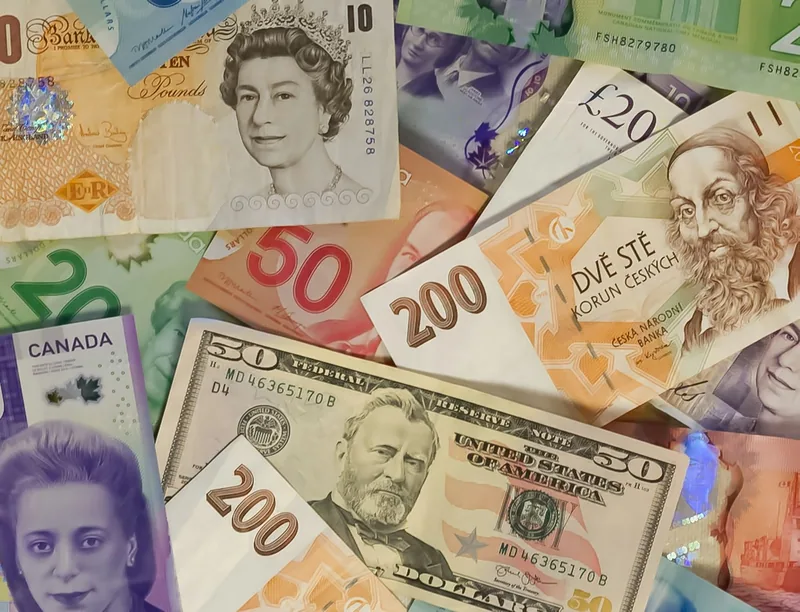
Airport bureaux are not overcharging by accident. They pay high rents for a site where their customers have just landed, have no local currency, and cannot walk to a competitor. That combination sets the price. It applies at every terminal, so arriving at Heathrow rather than Gatwick changes nothing.
The structural point is that an exchange desk makes its money in two different ways, and cutting one does not mean cutting the other:
- Commission is a fee, usually a percentage of the transaction or a flat charge.
- The spread is the gap between the rate at which they buy your currency and the rate at which they sell it back. It is invisible unless you compare it with the market rate.
A desk advertising "0% commission" has removed the first and can widen the second as far as it likes. This is why two bureaux, both claiming no commission, can differ by ten per cent on the same transaction.
Read the small print under the rate in the window. Many boards show their best rate only for transactions above a threshold, often several hundred pounds. Changing £100 gets you a different, worse rate that is printed underneath in smaller type, or quoted only at the counter.
How to read the board
Every bureau displays two columns, and the first thing to work out is which one applies to you.
The board is written from the shop's point of view. If you are handing over euros and receiving pounds, the shop is buying euros, so the column marked "we buy" is yours. The "we sell" column is for someone going the other way. Reading the wrong column makes an ordinary rate look wonderful.
To know whether a rate is good, you need a reference point. Look up the market rate on your phone before you walk in, or use the Bank of England's published daily spot rates. Then compare:
| What you see | What it tells you |
|---|---|
| Buy and sell rates close together | A competitive shop. The narrow spread is the real signal |
| Buy and sell rates far apart | An expensive shop, whatever the commission says |
| "0% commission" and nothing else | No information at all. Ask for the exact amount in pounds you will receive |
| A rate quoted only "for amounts over £X" | Ask what you would get for the amount you are actually changing |
The single most useful question at the counter is not about the rate. It is: "how many pounds will I get for this, in my hand, after everything?" Ask it before you hand anything over, and ask it at two shops.
Where the competitive bureaux are
The pattern in London is simple: rates improve where several bureaux can see each other. A desk on its own in a station concourse or a hotel lobby has no reason to be generous; a row of five windows within fifty metres has every reason.
Clusters of independent exchange shops sit along the main shopping streets where the customers are locals sending money home as well as tourists: Chinatown and the streets around it, Queensway in Bayswater, Edgware Road and parts of Whitechapel. These are not secret and they are not better because they are hidden; they are better because they compete.
Banks in Britain no longer generally change foreign cash over the counter for non-customers, so a high-street bank branch is usually not the answer. Post Office branches and the larger supermarkets offer currency, often with an option to order online and collect, which is worth comparing.
Wherever you go, count the money at the counter before you leave, and keep the receipt.
The registration you can check
A bureau de change is what the law calls a money service business, and HMRC is its supervisor. GOV.UK is blunt about the obligation: a business must not trade without registering under the money laundering regulations, and trading unregistered is a criminal offence that can lead to a penalty or prosecution.
HMRC publishes the Supervised Business Register, and the guidance page explaining how to check it was last updated on 14 September 2026. The register is searchable, with the caveat that a business may be listed under a different trading name, or may not appear yet if its application is still being processed.
For an ordinary transaction of £50 this is over-engineering. It is worth two minutes if you are changing a large sum, or if the shop feels improvised. It is also worth knowing that there is no longer any UK rule specific to how a bureau must display its rates, so nothing obliges the window to make the comparison easy for you.
Expect to be asked for identification on larger transactions, which is the same regime at work rather than an inconvenience aimed at you.
The cash machine, which usually wins
For most visitors the cheapest pounds come out of a wall, not a window.
Britain's cash machines are mostly tied together in one network, called LINK, and a withdrawal made on it usually costs a British debit card holder nothing. Where a machine does impose a charge it has to announce that fact twice, once on external signage and again on the screen, and you may back out before anything is dispensed.
The catch is that all of this is written for domestic customers. LINK explains that a card from an institution outside its membership, which covers the great majority of cards issued abroad, can attract a fee even at a machine a Londoner uses for nothing, and that such fees do not appear on LINK's own locator. On top of that sits whatever your own bank adds. So find out your bank's charge for a sterling withdrawal before you fly, then make one substantial withdrawal instead of half a dozen small ones.
Whatever you do, when a cash machine or a card terminal offers to complete the transaction in your own currency, look at the rate before accepting. Choosing pounds leaves the conversion with your own bank, whose charges you can find out in advance. The alternative hands the conversion to whoever operates the machine. The same choice appears on card terminals in shops, and it is one of the quiet charges our page on common tourist scams covers.
One withdrawal beats five. Where a fixed fee applies, it applies per withdrawal. Taking out £200 once costs a fraction of taking out £40 five times, and most visitors never need more than one withdrawal for a week's incidental spending.
Buying pounds before you fly
Ordering currency at home and collecting it before departure is usually better than changing at the airport on arrival, because you are choosing between competing suppliers rather than accepting the only desk in the hall. Online rates are typically better than walk-in rates at the same company, and click-and-collect avoids posting cash.
Order in good time. Collection slots at airports run out, and same-day walk-in buying is where the rate quietly worsens. Work out roughly what the week will cost first. Realistic daily figures are in our breakdown of the price of a London trip, and nearly all of it can go on a card.
Ask for a mixture of notes. A wallet of £50 notes is awkward here: the Bank of England is clear that legal tender does not mean a shop has to accept a particular note, and plenty of small businesses refuse £50s. Ask for £10s and £20s.
What you get handed, and what to check
Three things are worth a glance before you walk away from the counter.
Polymer, not paper. All four Bank of England denominations are plastic now: £5, £10, £20 and £50. Paper versions of the £20 and the £50 lost legal tender status at the end of September 2022. Their face value survives, and the Bank itself will still exchange them, but no shop is obliged to take one. A bureau should not hand you one at all; if it does, give it straight back.
The King and the Queen together. Notes carrying the portrait of King Charles III were first issued on 5 June 2024 and circulate alongside the Queen Elizabeth II notes, which remain legal tender. Both are normal and neither needs exchanging.
Scottish and Northern Irish notes. Several banks north of the border and in Northern Ireland issue their own sterling notes. They are perfectly genuine, they are not legal tender south of the border, and an English shop is free to refuse one. If a bureau counts a handful into your palm, ask for Bank of England notes instead.
Spending down at the end of the trip
Changing pounds back is the most expensive transaction of all, because you pay the spread a second time. A modest amount of leftover cash is better spent than converted.
Coins cannot be changed at a bureau at all, anywhere. The practical answers are to spend them, or to put them in one of the charity collection containers at the airports, which exist precisely for this. Notes are worth keeping if you expect to return, since sterling does not expire.
Plan the last day so you are not left holding cash you cannot use. Buy the last coffee and the airport water with coins, and pay the rest by card. Our guide to tap water and refill points will save you from buying the water at all.
Frequently asked questions
Where is the best place to change money in London?
Not the airport. Rates improve where bureaux compete with each other, so streets with several exchange windows within sight, such as those around Chinatown, Queensway or Edgware Road, tend to be better than a lone desk in a station or hotel. Compare the actual amount in pounds you would receive at two shops before deciding.
Does "0% commission" mean a good exchange rate?
No. Commission is a separate fee from the rate itself. A bureau with no commission can still make a large margin through the gap between its buy and sell prices. Compare the buy rate against the market rate, or simply ask how many pounds you will be handed for the amount you want to change.
Should I bring cash to London or use a card?
Cards and phones work nearly everywhere, and buses take no cash at all. Most visitors need £20 to £40 in notes as a backup rather than as a budget. If you want pounds on arrival, a single cash machine withdrawal after you land is usually cheaper than exchanging notes at the airport.
Do London cash machines charge foreign cards?
They can. A withdrawal is normally free on the LINK network for a British debit card, but LINK warns that a card from an institution outside its membership, which is most cards issued abroad, can be charged at the very same machine, and that those fees are not shown on its locator. Your own bank may add more. Check with it first, then withdraw once rather than repeatedly.
Can I change leftover pound coins before I fly home?
No. Bureaux de change deal in notes only, so coins cannot be exchanged. Spend them before you leave, or put them in the charity collection containers at the airports. Banknotes are worth keeping if you expect to come back, because sterling notes do not expire even when a design is withdrawn.
Sources
- GOV.UK / HMRC - Check if a business is registered for money laundering supervision (checked September 2026)
- GOV.UK / HMRC - Who needs to register for money laundering supervision (checked September 2026)
- LINK - Charges for cash (checked September 2026)
- Bank of England - What is legal tender? (checked September 2026)
- Bank of England - Withdrawn banknotes (checked September 2026)
- Bank of England - Daily spot exchange rates (checked September 2026)
- GOV.UK - Taking cash in and out of Great Britain (checked September 2026)