
Runnymede and Virginia Water are consecutive stations on South Western Railway's Waterloo to Reading line, and both are free to walk into. Egham, the station for Runnymede, is 39 minutes from Waterloo with an Off-Peak Day Return at £17.40; Virginia Water is the next stop, 43 minutes and £17.80. Runnymede is the riverside meadow where King John sealed Magna Carta in 1215 and now holds three national memorials; Virginia Water is a two-mile lake in Windsor Great Park with a 30-foot waterfall and a folly built from real Roman ruins. Each is a comfortable half day.
You could take in both in one day, but we would not: each has a long walk in it. Our guide to Windsor in half a day covers the castle end of the same landscape, and Salisbury holds one of the four surviving originals of the charter sealed here.
Runnymede and Virginia Water at a glance
- London terminus
- Waterloo, on the Reading line via Staines
- Egham, for Runnymede
- 39 minutes direct; Off-Peak Day Return £17.40 (National Rail, for Thursday 8 October 2026)
- Virginia Water
- 43 minutes direct; Off-Peak Day Return £17.80
- Walk from Egham
- The Coopers Hill Woods entrance is 0.6 miles (1km) from the station
- Admission
- Both free; both charge for parking. The Savill Garden is the only ticketed part
- Virginia Water lake
- Two miles long; full circuit 8.44km (5.25 miles)
- The Cascade
- A 30-foot (9.1m) waterfall completed in March 1789
Two stations, and which one you actually want
The stations are ten minutes apart and the fares are almost identical, so the choice is about what you want to do. Egham is for Runnymede: history, memorials, the Thames Path and a tea room. Virginia Water is for the lake: a long walk round water, a waterfall and a folly, and the Savill Garden if you are prepared to pay for a garden.
When we asked National Rail Enquiries for Thursday 8 October 2026, the direct trains from Waterloo took 39 minutes to Egham and 43 to Virginia Water, and the ones with a change took 48 and 52. Take a direct train. Coming back, the last comfortable departure from Virginia Water was 21:19, reaching Waterloo at 22:05, with two more after that. Our guide to Waterloo station covers the London end and buying British train tickets explains the off-peak rule. The Off-Peak Day Return is the price of two off-peak singles at both stations, so there is nothing to be gained from splitting the journey.
Runnymede: a meadow, and what is standing in it
Runnymede is a stretch of floodplain on the south bank of the Thames between Egham and Old Windsor, owned by the National Trust and paired with Ankerwycke on the opposite bank. It is open land: no gate, no ticket, no opening hour for the meadow itself. The Trust's address is Windsor Road, near Old Windsor SL4 2JL, with pay-and-display car parks on both sides of the A308.
The Trust's Coopers Hill Woods entrance is 0.6 miles, about a kilometre, from Egham station, which makes this one of the few National Trust countryside sites in the south-east that is a genuine walk from a train. Runnymede also carries the Thames Path National Trail for a mile and a quarter, so an obvious plan is to walk in from Egham, along the river and out again. Our guide to the Thames Path covers the London sections.
Three memorials, and what the list entries say about them
The meta description on most pages about Runnymede says two memorials. There are three, and all three are listed buildings.
The Magna Carta Monument is the small domed classical temple on the slope, put up by the American Bar Association. Historic England lists it as entry 1430723, Grade II, listed on 18 December 2015, which makes it one of the more recent additions to the list of anything at Runnymede.
The Kennedy Memorial is the one worth walking up to, and the list entry is unusually good on why. Entry 1031592, Grade II, listed on 15 April 1998: a memorial to President John F. Kennedy made in 1964 and 1965 by the landscape architect Geoffrey Jellicoe, a slab of Portland stone floating on a moulded granite base. It weighs seven tons, was carved out of a fourteen-ton block, and is imperceptibly curved in every direction to counter an optical illusion. Its inscription records that this acre of English ground was given to the United States of America by the people of Britain. Two stone seats, also by Jellicoe, sit in the side of the hill nearby, and the landscape around it is separately registered as a park and garden at Grade II.
The Commonwealth Air Forces Memorial stands above the meadow on Cooper's Hill and is the grandest of the three: entry 1376599, Grade II*, listed on 25 September 1998. It commemorates Commonwealth air force personnel who died in the Second World War and have no known grave, and the view from its tower is the reason to make the climb.
There is a modern one too. Writ in Water, an architectural artwork by Mark Wallinger, stands in the meadow, and the Trust's access notes confirm it is reached by a level path from the Memorials car park. It is a circular brick building with a pool in which the words of Magna Carta's most quoted clause can be read, reversed, in the water.
The practical side of Runnymede
The Magna Carta tea room is at the South Lodge on the road side, in one of the Lutyens lodges that mark the site. It opens daily, serving sandwiches, pasties, sausage rolls, cakes and scones, with indoor and outdoor seating, highchairs and bottle warming, a takeaway-only service for the last half hour, and a small secondhand bookshop inside. The Food Standards Agency rates it 5, from an inspection on 27 April 2026, and the toilets, including an accessible one, are at the rear.
Two accessible paths exist, and they are the reason this site is worth recommending to a wheelchair user: one from the Memorials car park to Writ in Water, and one from the North Lodge along the Thames to Runnymede Pleasure Ground. Both are level, and both come with the Trust's own warning that the riverside and memorial paths flood in winter.
This is a floodplain, and it behaves like one. The Trust's own notes say the Riverside car park is weather-dependent with limited space in autumn and winter, and that the accessible paths are subject to flooding in those months. After heavy rain the meadow can be under water. Check before travelling between November and March, and wear boots whatever the forecast says.
Dogs are welcome across the countryside here and in the tea room on a short lead, which the Trust asks for around the memorials as a matter of respect. On the dated copy of the Trust's page we read, the car parks opened 09:00 to 19:00, the Riverside car park from 07:00, and the tea room 09:00 to 17:00, with last entry to the car parks an hour before closing. Those are seasonal.
Virginia Water: a two-mile lake that was an accident waiting to happen
Virginia Water is the lake at the southern end of Windsor Great Park, two miles long, and a full circuit of it is 8.44 kilometres, about 5.25 miles. The park is open daily and free to enter; the charges are for parking, for the Savill Garden and for the Adventure Play area.
The two things to walk to are close together, both on the signed route from the Virginia Water Pavilion. The Cascade is a waterfall 30 feet, or 9.1 metres, high. It was part of the original plan for the area as a grotto but was not finished until March 1789, and because it is fed directly from the lake it depends on water levels: impressive after heavy rain, disappointing in a dry summer.
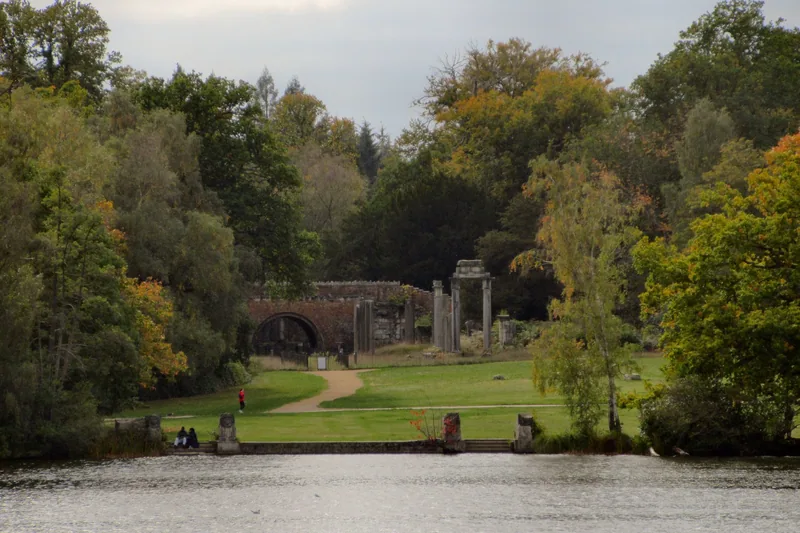
Past it are the Ruins, which are not a ruin. They are a folly created in 1826 out of columns, pedestals and slabs recovered from the Roman city of Leptis Magna in what is now Libya. The stones were given to the Prince Regent, later George IV, in 1816 and spent some years at the British Museum before being put up here. They were restored in 2009 and are now fenced off because of their fragility, so you look at them rather than among them.
Why the lake is there, and the night it emptied
The lake is artificial and it has a disaster in its history. The plan to flood the valley took shape in the 1750s, and the Crown Estate's own account records that around 500 members of the industrious poor were employed to build the ramparts and dam the streams. Then on 1 September 1768 a great storm destroyed the dam and emptied the lake in one go, killing people and livestock downstream and doing about £9,000 of damage, which the Crown Estate puts at roughly £1,616,000 today.
Nothing was repaired until the 1770s, when George III returned to Windsor and had the dam rebuilt to hold a bigger lake. Virginia Water reached its present size in 1790, with fishing temples along the shore and a Chinese junk moored on it, and before reservoirs existed it was the largest man-made lake in England. It was drained during the Second World War so that it would not point out Windsor Castle from the air.
The Savill Garden, the one thing here that costs money
The Savill Garden is a 1.5-mile walk from the Virginia Water Pavilion, and it is the only part of this day with an admission charge. The Crown Estate's published table gives adult entry at £8.50 booked in advance and £10.50 on the day, a child aged 5 to 15 at £4.50 and £5.50, toddlers aged 2 to 4 free, and a carer free on production of a listed document. Parking for the day is included with a paid garden ticket, and combined tickets with catering are £20 a head with a cream tea and £40 with an afternoon tea.
One caution: that table is headed as applying to visits up to and including 27 March 2026, a date already passed when we read it in September 2026. Treat the prices as indicative and check at the gate. For gardens in the same direction that cost less, see our page on RHS Wisley and the Surrey gardens.
Coming by train removes the largest cost of a Windsor Great Park day. Parking in the main park car parks runs from £3.20 for an hour to £16 for four hours or more, card only, with a £16 charge for a lost ticket; motorcycles, cyclists and Blue Badge holders park free. Two adults on Off-Peak Day Returns from Waterloo pay £35.60 and nothing at the barrier. Our ranking of the cheapest day trips from London explains where that leaves the total.
Which to choose, and when
If you have one afternoon and an interest in history, take Runnymede: free, three listed memorials and an artwork, and a shorter walk from the station. If you want a long circular walk with something to look at halfway round, take Virginia Water. With children who will not walk far, Runnymede wins, because the Pleasure Ground at the riverside end has a playground and the accessible path from North Lodge runs to it.
Autumn is the best season for both, for the same reason as our page on autumn colour: mature trees, low light and dry ground before the winter floods. Avoid Runnymede after prolonged rain and the Cascade after a dry month. There is a café at the lake, on the hygiene register as Caffe in the Park at Virginia Water Lake and rated 5 in July 2025, and the tea room at Runnymede; nothing in between, so carry water for the full circuit.
For the rest of this corner of the country, our guides to Windsor Castle, Legoland Windsor and the Chilterns and Ivinghoe Beacon cover the paid, the loud and the hilly alternatives. The full list is under day trips from London.
Frequently asked questions
Which station is nearest to Runnymede?
Egham, on South Western Railway's Waterloo to Reading line, 39 minutes from Waterloo on a direct train with an Off-Peak Day Return at £17.40 in September 2026. The National Trust's Coopers Hill Woods entrance is 0.6 miles from the station, so you can walk in without a bus or taxi.
Is Runnymede free to visit?
Yes. The meadow, the memorials and the Thames Path through it are open land with no admission charge. The National Trust charges for parking in the car parks either side of the A308, free for its own members and for Blue Badge holders, and the tea room and shop are the only other things you pay for.
What are the Virginia Water ruins?
A folly built in 1826 from genuine Roman stone: columns, pedestals and slabs taken from the ruined city of Leptis Magna in present-day Libya, given to the Prince Regent in 1816 and kept at the British Museum before being erected in Windsor Great Park. They were restored in 2009 and are fenced for their protection.
Can you do Runnymede and Virginia Water in the same day?
You can, because they are consecutive stations, but we would not. Each is a half day with real walking in it, and combining them means rushing both and paying two sets of walking time. If you have one day, pick the history or pick the lake.
Sources
- National Trust - Runnymede and Ankerwycke: access, tea room, car parks and the walk from Egham (Internet Archive copy of 5 September 2025; the live site blocks us) (checked September 2026)
- Historic England - Kennedy Memorial, list entry 1031592, Grade II (Internet Archive copy of 2 January 2026) (checked September 2026)
- Historic England - National Heritage List for England open data: Magna Carta Monument (1430723) and Commonwealth Air Forces Memorial (1376599) (checked September 2026)
- The Crown Estate, Windsor Great Park - Virginia Water: the lake, the Cascade, the Ruins and their history (checked September 2026)
- Windsor Great Park - parking charges (checked September 2026)
- Windsor Great Park - The Savill Garden: prices and booking information (checked September 2026)
- National Rail Enquiries - London Waterloo to Virginia Water, times and fares for Thursday 8 October 2026 (checked September 2026)
- Food Standards Agency food hygiene ratings - Magna Carta Tea Rooms, Windsor Road TW20 0AE, and Caffe in the Park at Virginia Water Lake, London Road GU25 4QF (checked September 2026)