
Oxford is one of the easiest day trips from London: fast trains from Paddington take around an hour, the historic centre is compact enough to see on foot, and in one day you can visit a college, the Bodleian Library and a free world-class museum.
Oxford is a university city about 90 km north-west of London. The University of Oxford is not one campus but a collection of more than thirty independent colleges, each with its own buildings, chapel, dining hall and gardens, spread through the streets of the old town. Some colleges open to visitors for a fee, some are free at certain hours, and some stay closed.
That is the key to planning a good day here. The streets, squares and shopfronts cost nothing, but the famous interiors are controlled by the colleges and the university, and their hours change with the academic calendar. A little checking the week before turns a pleasant walk into a much better visit.
Oxford in one day: the essentials
- Fastest route
- GWR train from London Paddington, around 1 hour (fastest 52 minutes)
- Other options
- Chiltern Railways from Marylebone (from 1 hour 12 minutes); Oxford Tube coach, 24 hours a day
- Oyster or contactless
- Not valid for the journey to Oxford: buy a rail ticket
- Christ Church
- Adult £24.95 on the day (weekdays) or £26.95 (weekends), £2 less booked in advance (September 2026)
- Bodleian tours
- 30 minutes from £12.50; 60 minutes from £17.50 (ages 11+)
- Ashmolean Museum
- Free, 10am-5pm
- Time needed
- A full day; leave London by about 9am
Trains from Paddington and Marylebone compared
Most visitors take Great Western Railway (GWR) from London Paddington. GWR says journeys take around an hour and the fastest service takes 52 minutes. There are up to 168 trains a day on the route, which in practice means a departure almost every 15 minutes on weekdays. The fastest direct trains call only at Slough and Reading; others need a change at Reading or Didcot Parkway, so check the details when you book.
Chiltern Railways runs a second route from London Marylebone to Oxford, taking as little as 1 hour 12 minutes. It arrives at the same main Oxford station and also calls at Oxford Parkway on the northern edge of the city. Marylebone is a smaller, calmer station, and it can be the easier start if you are staying in Marylebone, Baker Street or Regent's Park. Our overview of London's main railway stations explains how to reach each terminus.
Your Oyster card or contactless bank card will not cover this trip. Both work only within the London fare area, and Oxford is well outside it, so you need a National Rail ticket from a station machine, ticket office, app or operator website.
Which ticket to buy
For a day trip, the usual choices are an Off-Peak or Super Off-Peak return (valid on any train within the permitted times) or two Advance singles (cheaper, but tied to specific trains and non-refundable). Off-peak times generally start at 9.30am on weekday mornings in cities, while weekends are generally off-peak all day. Railcards give a third off most Off-Peak and Advance fares, and overseas visitors can buy the Two Together and 16-25 railcards online. Our guide to buying UK train tickets explains the fare types and railcards in more detail.
An off-peak return usually beats Advance tickets for Oxford. Advance fares lock you onto one train in each direction, which is a poor fit for a day when a college might close early or you decide to stay for dinner. On a route with trains every quarter of an hour, a flexible Off-Peak return is often worth the small extra cost.
The Oxford Tube and other coaches
The Oxford Tube is a coach service run by Stagecoach. Its website says coaches run 24 hours a day, up to every 10 minutes, with no need to book ahead and no peak or off-peak prices. London stops sit outside Underground entrances, including Victoria and Marble Arch, and some weekday express trips run via Baker Street. It stops at several points in Oxford, finishing in the city centre.
The coach is usually cheaper than the train and handy if you are staying near one of its stops, but it uses the A40 and the M40 motorway, so traffic in west London can add a lot of time, especially on Friday afternoons. For a day trip where every hour counts, we would take the train out in the morning and consider the coach only for a late return. National Express coaches to Oxford leave from Victoria Coach Station too.
If you would like a side-by-side look at trains, coaches and driving on this route, the sister site Viamo has a detailed London to Oxford route comparison.
How the colleges work for visitors
Colleges are living places where students study, eat and sleep, and visitors are guests. Each college decides its own opening hours and prices, and many close during exams, graduation ceremonies and private events. Opening times are posted at the college gate (the entrance lodge, staffed by porters) and on each college website. Where a college is closed, the porters will politely turn you away, even if the door is open.
Term dates matter. Oxford's autumn term, called Michaelmas Term, runs from 4 October to 12 December in 2026. During term, dining halls close at lunchtime while students eat, and some quads (the grassy courtyards) are quieter or closed to the public. Summer and the weeks around Christmas and Easter are the university vacations, when colleges tend to be more open but the city is busier with tour groups.
Christ Church: the college most visitors choose
Christ Church is the largest and grandest college, and the only one whose chapel is also the city's cathedral. The visit takes in Tom Quad, the huge Great Hall with its portraits and long tables, the cathedral and parts of the gardens. The Great Hall is the room Harry Potter fans come for, because it inspired the Hogwarts dining hall in the films.
Tickets include a multimedia guide, which Christ Church says is required for visiting. For 2 September to 3 October 2026, an adult ticket bought on the day costs £24.95 on weekdays and £26.95 at weekends, with £2 off each ticket if you book online or at the Visitor Centre in advance. From 4 October to 12 December 2026 the on-the-day prices are £22.95 on weekdays and £24.95 at weekends. Children aged 5-17 pay £19.50 on weekdays during the summer vacation (£17.50 in term), and under-5s go free with a paying adult. Tickets are released every Friday at about 10am for the following week. Check the official Christ Church tickets page for your date.
For a couple visiting on a weekday in October and booking ahead, that means £41.90 in total. A family of two adults and two children aged 5-17 on the same terms would pay £72.90.
The Great Hall at Christ Church closes at lunchtime. During Michaelmas Term 2026, the hall is closed from 12 noon to 2pm on weekdays and from 10.30am to 2pm on Saturdays while students eat, and on Sundays the whole site opens only at 2pm. The college also closes completely on some days (for example 17 and 18 September 2026). If the hall is the reason you are going, read the known closures page before booking a time slot.
The Bodleian Library and Radcliffe Square
The Bodleian is the university's main research library and one of the oldest in Europe. You cannot simply walk in and browse the reading rooms, but you can walk into the courtyard of the Old Schools Quadrangle, and there are several ways to see the historic interiors.
- The Divinity School: the university's oldest teaching room, with a carved Gothic stone ceiling. A 15-minute self-guided visit costs £3, the cheapest way to see a great Oxford interior.
- 30-minute guided tour: from £12.50, including the Divinity School and Duke Humfrey's Library, the oldest reading room (ages 11 and over).
- 60-minute guided tour: from £17.50, with more rooms and more time (ages 11 and over).
- City walking tour: run by the Bodleian, from £25, available daily.
- Radcliffe Camera and city walking tour: from £30, on Saturdays and Sundays only. It is the one regular way for visitors to step inside the Radcliffe Camera.
These are "from" prices, and the Bodleian tours page shows the actual price and availability for each slot. Tours are small and sell out on busy days, so book a few days ahead if it matters to you.
Next to the Bodleian is Radcliffe Square, dominated by the round, domed Radcliffe Camera, a reading room that is Oxford's most photographed building. It is a working reading room, so outside the weekend tour mentioned above you will see it from outside. The best free view of it is from the square itself, or from the lane beside the University Church of St Mary the Virgin.
The Ashmolean and Oxford's free museums
The Ashmolean Museum on Beaumont Street is the university's museum of art and archaeology and Britain's oldest public museum. Entry is free and you do not need to book for general admission. It opens 10am to 5pm, with last entry at 4.45pm.
Its collections run from ancient Egypt and Greece to Renaissance drawings and modern paintings, so it is an excellent choice for a rainy afternoon. Be aware that four Western Art galleries on the Level 3 Mezzanine (Galleries 63, 65, 66 and 67, which include the Pre-Raphaelites and Pissarro) are closed from 1 June until mid-October 2026. A paid major exhibition, Aphrodite: The Making of a Goddess, opens on 8 October 2026, and the museum strongly recommends booking for it. See the Ashmolean visit page for current details.
If you have already spent a morning in the British Museum during your London stay, you will find the Ashmolean calmer and more manageable. An hour and a half covers the highlights.
A one-day walking route through the centre
Everything below is within walking distance of the railway station, and the whole route is a few kilometres of flat pavement. The times assume you arrive around 10am.
- Station to the Ashmolean (10am): walk east along Park End Street and on towards Beaumont Street. Spend an hour inside, or save the museum for a wet afternoon.
- Broad Street and the Sheldonian (11.15am): walk down to Broad Street, a wide street lined with college fronts and bookshops. The Sheldonian Theatre, designed by Christopher Wren, is where graduation ceremonies are held.
- The Bodleian (11.45am): join a pre-booked tour or pay for the Divinity School, then step out into Radcliffe Square.
- Lunch near the Covered Market (1pm): the historic indoor market off the High Street has cafés and food stalls and is a good place for a quick lunch.
- Christ Church (2.30pm): walk south down St Aldate's for your booked time slot. Allow at least an hour.
- Christ Church Meadow (4pm): a free riverside walk beside the college. On a fine evening it is the calmest place in the city.
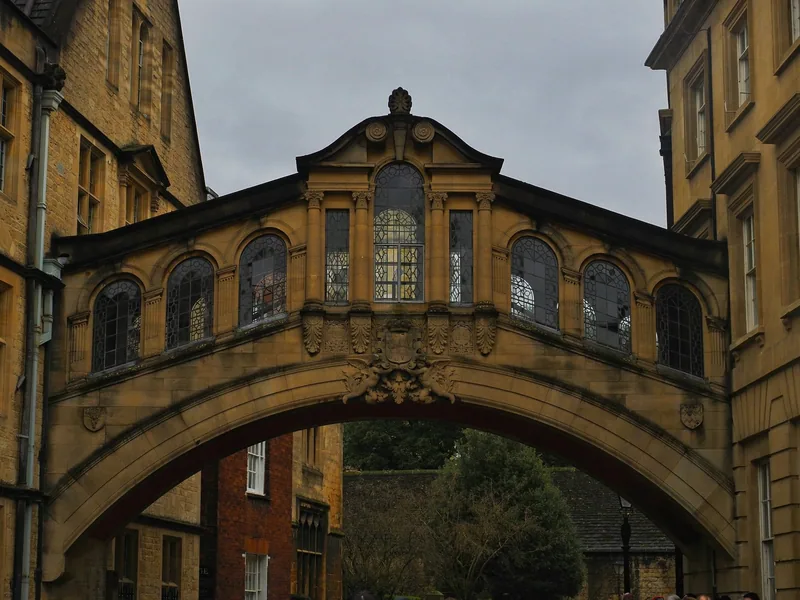
- High Street, Magdalen Bridge and the Bridge of Sighs (5pm): head back via the High Street and New College Lane, where the covered bridge that locals call the Bridge of Sighs links two parts of Hertford College.
From Magdalen Bridge, allow 25-30 minutes to walk back to the station. If your legs have had enough, local buses run through the centre.
Guided tours from London compared with going on your own
Many companies sell coach tours from London that include Oxford, often combined with the Cotswolds, Stratford-upon-Avon or Windsor. They are convenient if you do not want to deal with tickets, and a good guide adds stories you would miss alone. The downside is time: a combined tour may give you only two or three hours in Oxford, and entry to colleges is not always included.
Reasons to go by train on your own
- Around an hour each way, with departures every 15 minutes on weekdays
- You choose which college and museums to see
- You can stay for dinner and take a later train back
- For a couple, rail fares plus one college ticket are often cheaper than two tour seats
When an organised tour makes sense
- You want Oxford and the Cotswolds in one day without a car
- You prefer a guide to explain the colleges
- You do not want to plan train times or book tickets
- You are travelling alone and like company
If you want a guide without the coach, the Bodleian's own city walking tour or a guided college tour gives you the stories while keeping your own timetable. Whoever you book with, check exactly which buildings are included and how long you spend in the city.
Combining Oxford with other trips, and when to go
Oxford sits on the edge of the Cotswolds, and trains towards Moreton-in-Marsh continue from Oxford along the Cotswold Line. That makes it a sensible base for a second day in the villages of the Cotswolds, although fitting both into one day by public transport is tiring. People comparing the two famous university cities should read our Cambridge day trip guide: Cambridge is flatter and more riverside, Oxford busier and more varied. If you prefer Georgian architecture and Roman remains, a day in Bath is a good alternative from the same London station.
Weekdays outside school holidays are the calmest time to visit. Summer brings long evenings but also coach tours and language-school groups, and the city centre can feel crowded around midday. Autumn and early spring are quieter, though several college interiors close on more days during term. Our page on London weather and what to pack gives a fair idea of what to expect, because Oxford's climate is very similar.
If you are deciding which excursions to fit into your stay, our advice on how many days you need in London shows where a day trip fits. For all our other excursions, see the day trips from London overview.
Harry Potter, pubs and other extras
Oxford has several links to the Harry Potter films. Besides the Christ Church hall and staircase, the Bodleian's Divinity School appeared in the films. If the films are a major reason for your trip, the Warner Bros. Studio Tour near Watford is a much bigger experience, and our list of Harry Potter filming locations in London covers spots you can see for free.
Oxford's old pubs, several tucked down narrow lanes, are part of the experience at the end of the day. If you enjoy that kind of place, London has plenty too: see our guide to historic pubs in London.
Frequently asked questions
How long does the train from London to Oxford take?
GWR trains from London Paddington take around an hour, and the fastest service takes 52 minutes. Chiltern Railways trains from London Marylebone take from 1 hour 12 minutes. Journeys can take longer at weekends and on public holidays because of engineering work.
Is Oxford worth a day trip from London?
Yes, for most visitors. The centre is compact, the journey is short, and one day is enough for a college, the Bodleian and a museum. You will not see everything, but you will get a clear sense of the city and its university.
Can you go inside the Oxford colleges?
Many colleges admit visitors at set hours, often for a fee, and some are closed to the public. Christ Church is the easiest to plan because it sells timed tickets online. Always check each college website on the day, because closures for exams and events are common.
Can I use my Oyster card or contactless to get to Oxford?
No. Oyster and contactless pay as you go only work within the London fare area, and Oxford is well outside it. Buy a National Rail ticket before you board, or buy an Oxford Tube coach ticket if you go by coach.
Is Oxford or Cambridge better for a day trip?
For a first visit we would take Oxford: the station is five to ten minutes from the centre rather than twenty, and three of its best museums are free and open on Mondays. Cambridge is the smaller and prettier town, and better if punting is the point. Our comparison of Oxford and Cambridge for a day trip sets the two against each other in detail.
Sources
- GWR - London to Oxford trains (checked September 2026)
- Chiltern Railways - London to Oxford train (checked September 2026)
- Oxford Tube - coach travel between London and Oxford (checked September 2026)
- Christ Church, Oxford - Tickets and information (checked September 2026)
- Christ Church, Oxford - Known closures (checked September 2026)
- Bodleian Libraries - Tours (checked September 2026)
- Ashmolean Museum - Plan your visit (checked September 2026)
- National Rail - Off-Peak and Super Off-Peak tickets (checked September 2026)