
The deer rut is the red and fallow deer's mating season, and in Richmond Park and Bushy Park it runs from late September to early November. You can watch it free from either park's paths, but the Royal Parks asks everyone to stay at least 50 metres from the deer, and dog owners at least 100 metres from a male that seems active.
During the rut the big males, called stags in red deer and bucks in fallow deer, roar, round up females and fight rivals with their antlers. It is one of the great wildlife sights in Britain, a train ride from Waterloo, and it is also when people get hurt, almost always because they walked too close.
Our guides to Richmond Park and Bushy Park cover each park as a whole. This page is only about the autumn: what the deer are doing, the rules that apply, how the culls change the gate times, and how to plan a morning of watching without becoming part of the problem.
The rut at a glance
- When
- Late September to early November (the Royal Parks, October 2026). Its safety pages treat September to November as the rutting season
- Where
- Richmond Park (over 630 deer) and Bushy Park (over 320 deer), both free
- Distance
- At least 50 metres from any deer, all year. Dog owners: at least 100 metres from an active male in the rut
- Dogs
- On a lead near deer, or walked outside the park. Leads compulsory everywhere 1 May to 31 July
- Richmond Park culls
- November to early December and February to early March. In November 2026: six weeks from Sunday 2 November, pedestrian gates locked 8pm to 7.30am except Friday and Saturday nights (checked November 2026)
- Bushy Park culls
- September to mid-October and November to mid-December. In November 2026: from Monday 2 November for about six weeks, pedestrian gates 8am to 10.30pm Sunday to Thursday (checked November 2026)
- Cost
- Free entry; free car parks in both parks
What the stags and bucks are actually doing
In red deer, the larger species, the biggest stags gather groups of females, called hinds, and spend their days keeping them together and chasing away challengers. A dominant stag may hold up to 40 hinds, while smaller stags wait at the edges for a chance.
Most of what you see is display rather than fighting. A roar warns off rivals, and a deeper roar signals a bigger animal. If neither backs down, the two walk side by side to size each other up, and only then lock antlers and push. Stags also thrash vegetation and roll in muddy pools called wallows.
Fallow deer rut differently. The bucks groan rather than roar, and instead of holding a harem they may gather in a lek, a display ground where several males show off to the does.
By the end of the season the harem holders are worn out: a stag can lose up to a third of its weight in a fortnight of intense activity, and younger males get their chance.
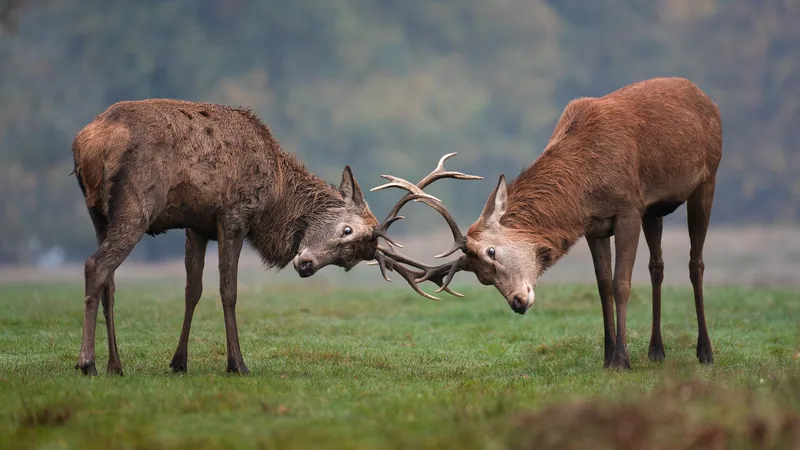
Photo: Julian Herzog (Website) · CC BY 4.0 · Wikimedia Commons · resized
The 50-metre rule, and why the parks insist on it
The Royal Parks asks every visitor to keep a minimum of 50 metres from the deer at all times of year, and never to touch, feed or photograph them at closer range. Fifty metres is roughly the length of an Olympic swimming pool; if a deer walks towards you, move away.
The reasons are physical. The park pages give up to 200 kilograms for the largest males and a top speed of 30 mph, and the Royal Parks compares being hit by a charging stag to being hit by a motorbike. It also records that a young girl being photographed next to a rutting stag in Bushy Park was injured in 2018, and that a visitor was taken to hospital after an injury from a male deer in Richmond Park the year before. In its words, incidents happen almost exclusively when people get closer than 50 metres.
A resting stag in the grass is not tame. Late in the rut the dominant males lie down for long periods because they are exhausted. The Royal Parks warns specifically against taking this as an invitation to walk up to one. If a deer advances on you, do not wave or shout; back away slowly, and if you need cover, put a car or a large tree between you and the animal.
It is also illegal to feed the deer in either park, and the parks ask visitors not to picnic close to them. If deer approach your picnic, cover the food, close your bags, move back and wait for them to leave. Leave the conkers and sweet chestnuts on the ground too: the deer need them to build up fat for winter.
Dogs during the rut: the parks' own advice
Deer can feel threatened by a dog even at a distance, and male deer are more likely to attack dogs during the rut. The Royal Parks' first recommendation is simply to walk your dog somewhere else during the rutting and birthing seasons. If you do bring one, keep it on a lead near deer and under close control, and keep at least 50 metres away, or 100 metres if a male seems active.
Never let a dog run between a stag and his hinds. If a stag does come at you and your dog, the parks' advice is to let the dog off the lead: it can escape more easily on its own, and it may be the reason the deer is agitated in the first place.
Chasing deer is an offence, and the owner of a dog that chases wildlife in the Royal Parks can be prosecuted. The parks ask witnesses to report it to the Metropolitan Police online or on 101, or on 999 in an emergency; our page on emergency numbers in London explains which to use. Travelling with a dog from central London is covered in dogs on London transport.
The rules tighten again in spring: from 1 May to 31 July, the birthing season, dogs must be on a lead everywhere in both parks.
Photographing the rut with a long lens
The rut draws photographers in large numbers, and the parks have a problem with it. The Royal Parks says it has seen dozens of photographers surrounding a single stag, which is dangerous for them and stressful for the animal. The rule is the same 50 metres for everyone with a camera, and the parks tell photographers to use a long lens.
The parks point photographers to the British Deer Society's code of conduct. It recommends a lens with a focal length of 300 mm, says never to surround deer, and tells you to move back and use a longer lens if an animal shows signs of stress. A phone will not give you a close portrait; binoculars are the cheaper way to see the detail. Our page on photography and drone rules in London covers the general rules, including commercial shoots in the Royal Parks.
Do not join a crowd that has formed around a stag. If you see a ring of people with cameras, the animal is already being pressed, and adding yourself makes it worse. Walk on and find deer that are moving freely, or watch from the far side at a proper distance.
Where to watch in Richmond Park
Richmond Park is about 1,000 hectares of open grass, bracken and old oaks, and the herds roam all of it. The Royal Parks does not publish where the deer will be on a given day. Walk the open grassland away from the busiest car parks and look for groups of females: in the rut, a stag will rarely be far from them.
Three areas are signposted as deer refuges. The deer go in and out as they like, but visitors and dogs must not. They are not viewing areas, and standing at the edge of one to get closer misses the point of them.
Richmond and North Sheen stations, to the north, and Norbiton, to the south, are 15 to 25 minutes' walk from the nearest gate, according to the park; our guide to Richmond covers the town at the bottom of the hill. Drivers can use seven main car parks, including Pembroke Lodge, Sheen Gate, Robin Hood Gate, Roehampton Gate and Pen Ponds.
In September and October the pedestrian gates in Richmond Park are open around the clock, so an early start is possible on foot. Vehicle gates open at 7am during British Summer Time and 7.30am otherwise, and close at dusk. The deer cull begins in November, and from then until early December the walkers' gates are locked at night except on Friday and Saturday nights.
Where to watch in Bushy Park
Bushy Park is about 445 hectares, flatter and much quieter than Richmond, with over 320 deer. The fallow herd has roamed here since Tudor times; the red deer descend from animals introduced after the Second World War. The same advice applies: walk the open grass, look for the hinds and give the stags their distance.
The two nearest stations are Hampton Wick and Teddington, both on South Western Railway and both about five minutes' walk from a gate. Drivers can use the car parks at Coleshill Road Gate, the Pheasantry Café and the Diana Fountain. Our guide to Teddington and Hampton covers the streets around it.
Timing is the catch at Bushy. Its first cull of the year runs from September to mid-October, which overlaps the rut, and during the culls the pedestrian gates open at 8am and close at 10.30pm. The park's FAQ describes those hours for the whole cull period. The notice for the November 2026 cull is more specific: gates open from 8am, vehicle gates locked at 7pm and pedestrian gates at 10.30pm from Sunday to Thursday, and all gates open as normal on Saturdays and Sundays. Check the park's page for the week you go, because a dawn visit depends on it.
Bushy Park's 8am cull opening falls in the middle of the rut. Richmond Park has no autumn cull before November, so if you want to be among the deer at first light in early October, Richmond is the one where the walkers' gates are open.
Why both parks cull, and what closes
The Royal Parks culls both herds to keep them at a size the land can feed; without it, the charity says, food would run short and more deer would suffer from malnutrition, cold and disease. No contraceptive is licensed for free-living deer in the UK. Venison sales pay for deer feed and the wildlife officers.
For a visitor, the culls change only the gate hours, as set out in the box at the top of this page. The dates move a little each year, so treat the months as the rule and the park notices as the detail.
Planning a rut morning, and what to combine it with
Allow two or three hours on foot, wear boots, bring binoculars and leave the dog at home. Our guide to London in October covers the weather and what else is on in the same weeks, and the autumn colour page explains where the trees turn first.
Bushy Park sits beside Hampton Court Palace, so a morning in the park and an afternoon in the palace is an easy day. From Richmond Park, the Isabella Plantation is inside the same walls, a woodland garden of ponds and paths that makes a quieter end to a morning on the open grass.
Greenwich Park's deer live in an enclosure, so you will not see a free-roaming rut there; the Greenwich Park guide explains why. For deer in open forest further afield, see the New Forest in a day.
Frequently asked questions
When is the deer rut in Richmond Park?
The Royal Parks gives the rut as running from late September to early November, and its safety pages treat September to November as the rutting season. The peak varies from year to year, so a visit in October is the safest bet for seeing activity.
How close can I get to the deer during the rut?
No closer than 50 metres, which is the Royal Parks' minimum for every visitor all year. For dog owners in the rut, the parks ask for at least 100 metres from any male that seems active. Photographers are told to use a long lens rather than walk closer.
Can I bring my dog to Richmond Park in October?
You can, but the Royal Parks recommends walking dogs outside the park during the rut. If you bring one, keep it on a lead near deer and well away from stags and their females. Letting a dog chase deer is an offence and the owner can be prosecuted.
Is Richmond Park or Bushy Park better for the rut?
Both have red and fallow deer rutting at the same time. Richmond is larger, has more deer and keeps its walkers' gates open around the clock until the November cull. Bushy is quieter and flatter, but its first cull overlaps the rut, so the walkers' gates open only at 8am in that period.
Sources
- The Royal Parks - Deer safety advice (checked November 2026)
- The Royal Parks - 12 things you should know about the deer rutting season (checked November 2026)
- The Royal Parks - Autumn through the ages (checked November 2026)
- The Royal Parks - Deer in Richmond Park (checked November 2026)
- The Royal Parks - Deer in Bushy Park (checked November 2026)
- The Royal Parks - Richmond Park FAQs (checked November 2026)
- The Royal Parks - Bushy Park FAQs (checked November 2026)
- British Deer Society - Photographing deer: code of conduct (checked November 2026)