
Box Hill is a chalk escarpment on the North Downs above the River Mole, with a view south over the Weald and a network of footpaths through beech and box woodland. It is under an hour from London by train, an off-peak day return cost £15.80 in October 2026, and you can pay with contactless because the station sits inside the pay-as-you-go area.
This is the closest thing London has to a mountain day. You leave a city terminus in the morning, and an hour later you are climbing a proper hill on a proper path, with a proper view at the top. No coach, no guide, no entrance fee for the hill itself.
The hill is the best-known corner of the Surrey Hills National Landscape, the protected area that runs across the county from Farnham to the Kent border. Box Hill gets the crowds; the rest of it is surprisingly empty even on a Saturday.
Box Hill: the practical facts
- Station
- Boxhill and Westhumble, about a mile and a half from the summit
- From London Waterloo
- 49 minutes on the fastest direct train
- From London Victoria
- 56 minutes on the fastest direct train
- Fare
- Off-peak day return £15.80, or £7.90 each way on contactless pay as you go
- Cost to walk the hill
- Nothing. The National Trust charges for the car park, not the hill
- On site
- National Trust café, toilets, shop, indoor and outdoor seating
- Accessible route
- An all-terrain wheelchair tramper is available to hire free of charge
- Address for drivers
- Box Hill, Tadworth KT20 7LF
Waterloo is faster than Victoria, and the fare is the same
Boxhill and Westhumble station is served from both London terminals and the two routes are not equal. On the timetable we checked for a weekday in October 2026, the fastest direct train from London Waterloo took 49 minutes, and the fastest direct train from London Victoria took 56 minutes.
The fare is identical either way: an off-peak day return was £15.80, made up of two off-peak singles at £7.90. Waterloo is therefore the better choice unless Victoria happens to be closer to your hotel. Our guide to the London terminals explains how to reach both.
You can tap in with a contactless card and skip the ticket machine. Boxhill and Westhumble is inside the pay-as-you-go area, so the off-peak single is charged at £7.90 the same as a paper ticket. That makes this one of the very few real countryside walks you can do on the same card you use for the Tube. Our guide to Oyster and contactless explains how capping works.
One caution: caps and daily limits work differently outside the London zones, so check our page on travel zones if you plan to combine this with a lot of Tube travel on the same day. If you prefer a paper ticket, our guide to UK rail tickets covers the options.
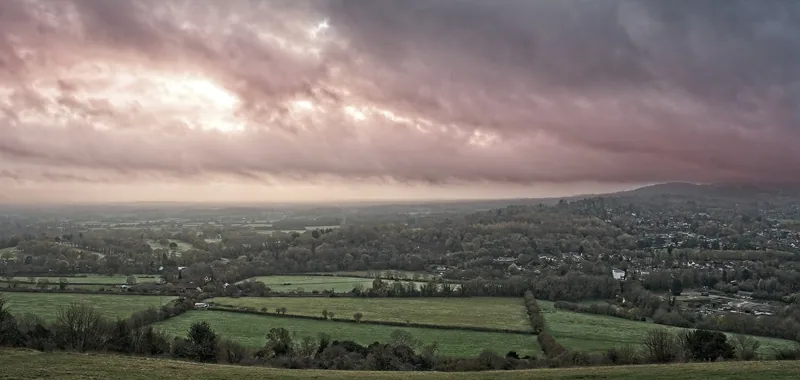
Photo: mendhak · CC BY-SA 4.0 · Wikimedia Commons · resized
The walk from the station to the summit
The station is about a mile and a half from the top of Box Hill, and the walk up is the main event rather than an inconvenience. From the platform you drop down to the River Mole and reach the Stepping Stones, a line of flat blocks set in the riverbed that you cross on foot.
From the far bank the path climbs steeply up the face of the hill by a long flight of steps. It is a real climb and it will make you warm in any weather. At the top you come out onto open chalk grassland with the National Trust café, shop and toilets a short walk away, and the view opens out south across the Weald towards the South Downs.
Coming down, a gentler route contours round the side of the hill instead of returning down the steps, which is much easier on the knees. Either way, allow two to three hours for the round trip from the station with a stop at the top.
The Stepping Stones are impassable when the river is high. After heavy rain the Mole rises over them and the crossing is closed, which means a detour to the road bridge. Chalk paths also become slippery in the wet, and the steps up the face are steep. Check the forecast in our guide to the British weather by month, and see what to pack before you travel in trainers.
One more thing about the seasons. The box trees that give the hill its name are evergreen, so unlike most English woodland this is a hill that still looks like something in January. Winter is also when the view is clearest and the paths are emptiest, although the steps are slippery and the light goes early. Late spring, when the chalk grassland flowers and the beech comes into leaf, is the prettiest time, and early autumn is the best compromise between weather and crowds.
What the hill costs, and what it does not
Walking on Box Hill is free. The National Trust looks after the site and charges for the car park, not for access, so arriving by train means you pay nothing beyond the fare.
The visitor facilities at the top include a café with indoor and outdoor seating, toilets and a bookshop. For accessibility there is disabled parking, an accessible toilet, automatic doors at the café, an easier-access path along the Natural Play Trail, and an all-terrain wheelchair tramper that can be hired free of charge. Our guide to accessible travel has more on planning ahead for that sort of thing.
Buses, if you would rather not climb
If the climb from the station is too much, two bus routes reach the hill itself. Metrobus 21, running between Epsom, Leatherhead, Dorking and Crawley, goes to the Box Hill east car park, but it does not run on Sundays or bank holidays. Arriva 465, from Kingston to Dorking, stops at the foot of the hill, leaving a mile and a half to the summit.
Neither is a substitute for the train from London, but the 21 is genuinely useful for anyone who wants the view and the café without the steps. Check current timetables before relying on either.
Why there are so many cyclists
The Zig Zag Road, the twisting lane that climbs the western side of Box Hill, was part of the route of the Olympic road races in 2012, and it has been one of the most ridden climbs in southern England ever since. On a fine Saturday morning you will see hundreds of cyclists on it.
Walkers and cyclists mostly use different routes, so this is not a conflict, but be careful where paths cross the road, and do not expect solitude at the summit car park on a summer weekend. Our page on London 2012 and the Olympic Park covers what else survives from that summer.
Beyond Box Hill: the rest of the Surrey Hills
Box Hill is one hill in a long ridge, and the walking does not stop at the café. Two long-distance paths cross the area: the North Downs Way National Trail, which runs along the chalk ridge, and the Greensand Way, which follows the sandstone hills to the south. Leith Hill, usually described as the highest point in south-east England, is a few miles west.
The Surrey Hills organisation publishes a set of Rail to Ramble routes, which are circular walks designed to start and finish at a railway station. Those are the ones to look at if you want a full day rather than a climb and a cup of tea.
At the foot of the hill, Denbies Wine Estate at Dorking is one of England's larger vineyards and offers tours and tastings. Dorking itself, a station further on, has a high street, antique shops and more places to eat than Westhumble, which has almost none.
A day plan that works
| Time | Plan |
|---|---|
| 09.20 | Train from Waterloo, arriving Boxhill and Westhumble about 10.10 |
| 10.20 | Walk down to the Stepping Stones and cross the Mole |
| 10.45 | Climb the steps to the viewpoint |
| 11.30 | Café at the top, or a picnic on the grass |
| 12.30 | Ridge walk along the top, then the gentler path down |
| 14.30 | Lunch in Dorking, a mile further on, or back to the station |
| 16.30 | Train home |
Bring water and food. Westhumble is a hamlet, not a village with shops, and the café at the top has queues at lunchtime on fine days.
How it compares with a London park, and with the coast
Box Hill is not the same experience as Richmond Park or Hampstead Heath, both of which are large and green but flat by comparison and full of other Londoners. The point of Box Hill is the climb, the drop and the long view south from the top.
If you want a coastal walk instead, the Seven Sisters give you chalk cliffs about two hours from Victoria, and Lewes and Arundel put a castle at the end of a shorter walk. For something completely flat and historical, St Albans has a Roman park twenty minutes from St Pancras. If you would rather stay in town, our guide to walking in London and our page on roof gardens and free terraces cover the urban alternatives, and the wider list is in our overview of day trips from London.
Frequently asked questions
How do you get to Box Hill from London by train?
Take a direct train to Boxhill and Westhumble station, 49 minutes from London Waterloo or 56 minutes from London Victoria. The station is about a mile and a half from the summit, with the climb starting at the Stepping Stones over the River Mole.
How much does it cost to visit Box Hill?
Nothing to walk on the hill. An off-peak day return from London cost £15.80 in October 2026, or £7.90 each way on contactless pay as you go. The National Trust charges for its car park, so arriving by train avoids that too.
How long does it take to walk up Box Hill?
From the station, allow about 40 minutes to the summit including the walk down to the Stepping Stones and the climb up the steps, and two to three hours for a relaxed round trip with a stop at the top.
Can you use an Oyster card or contactless to get to Box Hill?
Contactless pay as you go works to Boxhill and Westhumble, charged at £7.90 for an off-peak single. Daily capping behaves differently outside the London zones, so check how it interacts with the rest of your travel if you are using the Tube heavily the same day.
Is Box Hill suitable for wheelchairs or pushchairs?
The summit area has disabled parking, an accessible toilet, a café with automatic doors and an easier-access path along the Natural Play Trail, and an all-terrain wheelchair tramper can be hired free of charge. The climb up from the station is not accessible; use the Metrobus 21 to the east car park instead, remembering it does not run on Sundays.
Sources
- Surrey Hills National Landscape - Box Hill: facilities, access and how to get there (checked September 2026)
- Surrey Hills National Landscape - Walking, including Rail to Ramble routes (checked September 2026)
- National Rail Enquiries - London Waterloo to Boxhill and Westhumble, times and fares (checked September 2026)
- National Rail Enquiries - London Victoria to Boxhill and Westhumble, times and fares (checked September 2026)