
You cannot smoke or vape inside any enclosed place the public can use in England: no pubs, no restaurants, no shops, no stations, no hotel rooms. Outdoors you generally can. A packet of cigarettes costs more here than almost anywhere in Europe, and on 1 October 2026 the duty on a packet of 20 rises by another £1.21.
This page is about England, and London specifically. Scotland, Wales and Northern Ireland have their own versions of most of these rules, and some differ. Where a rule applies across the whole United Kingdom we say so.
Two changes are worth knowing about before you arrive: single-use disposable vapes can no longer be sold anywhere in the UK, and a new duty on vaping liquid starts on 1 October 2026. Both are explained below.
The rules in one box
- Indoors, public places
- No smoking. Offence since 1 July 2007 in England
- Fixed penalty
- £50, reduced to £30 if paid promptly
- Vaping indoors
- Not covered by the smoking law, but banned by almost every venue and by TfL
- Public transport
- No smoking and no e-cigarettes anywhere on the TfL network
- Disposable vapes
- Illegal to sell or supply anywhere in the UK since 1 June 2025
- Minimum age to buy
- 18 now. From 1 January 2027, nobody born on or after 1 January 2009 may be sold tobacco
- Bringing tobacco in
- 200 cigarettes, or 50 cigars, or 250 g of tobacco, or 200 heated-tobacco sticks
Indoors means indoors, and the law is old
England's smoking ban came into force on 1 July 2007 under the Health Act 2006. It makes premises that are open to the public, and shared workplaces, smoke-free wherever they are enclosed or substantially enclosed. That covers pubs, restaurants, cafés, shops, offices, theatres, museums, stations and public transport.
Smoking in a smoke-free place is a criminal offence under section 7 of the Act. In practice it is dealt with by a fixed penalty notice of £50, reduced to £30 if you pay within the discount period, under regulations made in 2007. Occupiers who fail to stop people smoking face larger penalties, which is why staff will ask you to put it out rather than ignore it.
The phrase "substantially enclosed" matters for pub gardens and terraces. A covered smoking area with walls on more than half its perimeter is caught by the ban; one that is genuinely open is not. That is why pub smoking shelters are built with deliberate gaps.
There is no national rule requiring you to stand a certain distance from a doorway. That is a common belief and it is not the law in England. Individual premises, hospitals and some public authorities set their own rules on their own land, and those you do have to follow.
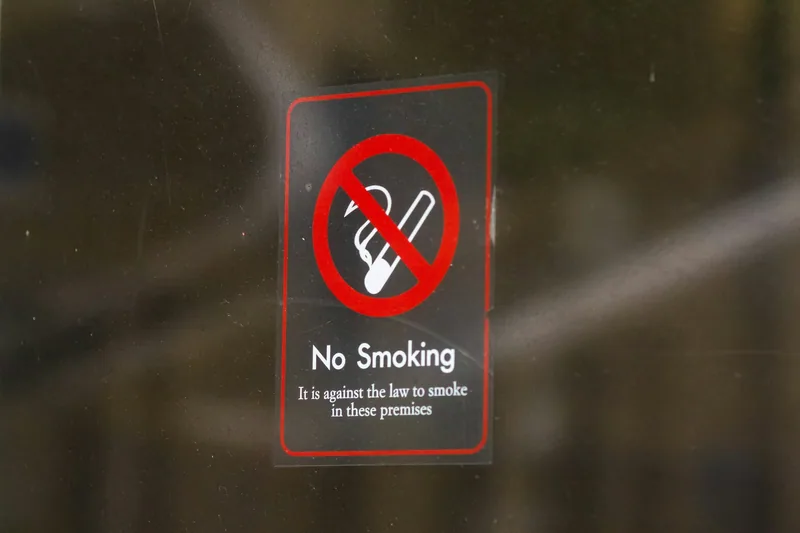
Where you can smoke in London
Outdoors, in the street, in a park, in a beer garden, and at pavement tables outside a pub or café. That is the general position.
Hotel rooms are the exception people get wrong. Whichever part of London you stay in, the overwhelming majority of hotels are entirely non-smoking, and a room that smells of smoke at check-out typically attracts a cleaning charge running into three figures. The same applies to serviced apartments and short lets. It is one of the charges our page on hotel extras and hidden costs covers.
Railway stations are smoke-free throughout, including the open-air platforms at most National Rail termini, and airports allow it only in designated areas, which at some terminals means outside the building entirely. If you are connecting through Heathrow without clearing immigration, assume there is nowhere to smoke.
Royal Parks and borough parks do not ban smoking in general, but individual areas such as children's playgrounds often do, by notice. The same goes for the open squares and terraces at places like the Southbank Centre, where the landowner rather than the law sets the rule.
Watch where the ash goes. Dropping a cigarette end in the street is littering, and several London boroughs issue fixed penalty notices for it through street enforcement officers. Bins on London streets often have a metal plate on top for exactly this.
Vaping: a separate law, and the same practical answer
The 2007 smoking ban is about burning tobacco, so it does not by itself cover e-cigarettes. Almost nothing follows from that, because venues set their own rules and the overwhelming majority treat vaping exactly like smoking.
Transport for London is explicit. Its Conditions of Carriage state that on buses, trams and trains, in bus and rail stations and on tram platforms, you must not smoke or use an electronic cigarette. That is a contractual rule across the whole network, and staff enforce it.
Pubs, restaurants, shops, museums, theatres and hotels almost all ban it too. Assume you cannot vape indoors anywhere in London unless a member of staff has told you otherwise, and ask rather than trying.
Disposable vapes cannot be sold here any more
Since 1 June 2025 it has been illegal for a business anywhere in the United Kingdom to sell, supply, offer or stock single-use disposable vapes, with or without nicotine. The ban was made for environmental reasons and applies online as well as in shops. Reusable and refillable devices remain legal.
For a visitor this means one thing above all: if you use disposable vapes at home, you will not be able to buy replacements in London. Bring a refillable device, or expect to buy one here.
The ban is on business sale and supply, not on you having one. But a shop that sells you a disposable vape is breaking the law, which is worth knowing if one is offered under a counter.
What it costs, and what happens on 1 October 2026
Tobacco in Britain is expensive by design, because most of the price is tax.
Duty on cigarettes rose on 26 November 2025 to £353.50 per 1,000 cigarettes plus 16.5% of the retail price, which HMRC calculated as adding 57p to a packet of 20. From 1 October 2026 it rises again, to £394.09 per 1,000 plus 16.5%, which HMRC says adds £1.21 to a packet of 20. The minimum excise duty, the floor below which the tax cannot fall, goes to £518.75 per 1,000 cigarettes on the same date.
| Product | Duty increase from 1 October 2026 |
|---|---|
| Packet of 20 cigarettes | +£1.21 |
| 30 g of hand-rolling tobacco | +£2.54 |
| 10 g of cigars | +81p |
| A typical 6 g pack of heated tobacco | +45p |
For a retail price, the most recent official figure we can point to is the Office for National Statistics average price for 20 king-size filter cigarettes, which stood at £16.60 in January 2025 in the retail prices index series. Duty has risen twice since, so treat that as a floor rather than a current price, and expect central London to charge more than the suburbs. If you smoke, budget for it: it is one of the costs that quietly reshapes a week, as our guide to what a London trip costs sets out.
Vaping liquid is taxed from 1 October 2026 as well. HM Revenue and Customs is introducing Vaping Products Duty at a flat rate of £2.20 per 10 millilitres of vaping liquid, whether or not it contains nicotine. From 1 April 2027 all vaping products outside duty suspension must carry a duty stamp. Expect prices to move accordingly.
The age rules, and the one that changes in 2027
It is currently illegal to sell tobacco or vaping products to anyone under 18, and shops operate age-verification policies that ask for identification from anyone who looks younger than a stated age, often 25. Acceptable identification means a document showing a photograph, a date of birth and either a holographic mark or an ultraviolet feature; digital identification may also be accepted where the shop's policy allows it. For most visitors that means a passport, which is also the document you will be asked for at bars and clubs, so decide in advance whether you want to carry it.
The bigger change is already law. The Tobacco and Vapes Act 2026 creates what the government calls a smoke-free generation: from 1 January 2027 it will be an offence in England and Wales to sell tobacco products, herbal smoking products or cigarette papers to anyone born on or after 1 January 2009. The date of birth, not the age, is the test, and it does not move as those people get older.
For a visitor arriving in 2027 or later, this means a young adult who can legally buy cigarettes at home may not be able to buy them in England, and shops will ask for identification. The same Act also amends the smoke-free premises rules, but those amendments were not yet in force in September 2026.
Oral tobacco, known in Scandinavia as snus, is a separate matter: regulations prohibit anyone from producing or supplying tobacco for oral use in the UK. You cannot buy it here.
Bringing tobacco into Britain
If you are arriving from outside the UK, you have a personal allowance. For Great Britain it is one of the following, or a proportional combination: 200 cigarettes, 100 cigarillos, 50 cigars, 250 g of tobacco, or 200 sticks of heated tobacco.
Two traps. Travellers under 17 have no tobacco or alcohol allowance at all and must declare anything they carry. And if you exceed the allowance, tax and duty become payable on the whole quantity in that category, not merely on the excess, and allowances cannot be pooled between members of a group.
Declare online up to five days before arrival, or at the border using the red channel. Our guide to UK customs allowances covers alcohol, food and the rest of the list.
Note also that since 1 January 2021 there has been no tax-free shopping for departing visitors in Great Britain, so buying cigarettes airside on the way out does not save you UK duty in the way it once did; our page on tax-free shopping in the UK explains what changed.
Buying tobacco and vapes here
Cigarettes are sold in newsagents, convenience shops, supermarkets and some pubs, but you will not see them. Display of tobacco at the point of sale is prohibited, so the stock sits behind plain sliding shutters and you have to ask. Packaging is standardised: the same drab green, the same typeface, large health warnings and no branding beyond the name.
Vape shops are common in London, particularly on the high streets outside the very centre, away from the tourist streets described in our guide to Oxford Street, and larger chemists and supermarkets stock refill liquids and devices. Prices vary widely, and duty-paid liquid will become easier to identify once duty stamps arrive in 2027.
Where a shop offers something notably cheap, be careful. Illicit tobacco is sold in parts of London, it does not meet UK packaging requirements, and buying it funds exactly the sort of operation our page on common tourist scams describes.
Smoking, drinking and the venues that have both rules
A pub is the place where the two sets of rules meet, and the practical shape is this: drink inside, smoke outside, and do not take the glass into the street where a local order prohibits it.
A discretionary service charge, licensing hours and the age rules for alcohol are set out in our guide to alcohol laws and drinking in public, and the etiquette of ordering at the bar in our page on pub etiquette. If you step outside for a cigarette, take your coat and leave someone with the table.
Beer gardens are the main place smoking and non-smoking visitors negotiate. In summer, the pleasant tables fill with smokers by mid-evening, which is worth knowing if you are travelling with children. Our list of historic London pubs notes which ones have proper outdoor space.
Frequently asked questions
Can you smoke in pubs in London?
Not inside. Premises open to the public have been smoke-free in England since 1 July 2007 wherever they are enclosed or substantially enclosed, which covers every pub interior. Beer gardens and pavement tables are fine, and so are smoking shelters built open enough not to count as enclosed.
Can I vape indoors in London?
Assume not. The 2007 smoking law is about tobacco rather than e-cigarettes, but almost every venue bans vaping anyway, and Transport for London's Conditions of Carriage prohibit e-cigarettes on buses, trams and trains and in stations. Ask a member of staff rather than trying.
Can I buy disposable vapes in the UK?
No. Since 1 June 2025 it has been illegal for businesses anywhere in the United Kingdom to sell, supply, offer or stock single-use disposable vapes, with or without nicotine, in shops and online. Reusable and refillable devices are still sold. Bring a refillable device with you.
How much does a packet of cigarettes cost in London?
More than almost anywhere in Europe, and rising. The last official average price we can cite is the ONS figure of £16.60 for 20 king-size filter cigarettes in January 2025. Duty rose by 57p a packet in November 2025 and rises by a further £1.21 on 1 October 2026, so expect a current price well above that, with central London dearer than the suburbs.
How much tobacco can I bring into the UK?
Into Great Britain, one of the following, or a proportional mix: 200 cigarettes, 100 cigarillos, 50 cigars, 250 g of tobacco, or 200 heated-tobacco sticks. Travellers under 17 have no allowance and must declare anything they carry. Going over the limit makes duty payable on the whole quantity, not just the excess, and allowances cannot be shared between people.
Sources
- Health Act 2006, section 2 (smoke-free premises) (checked September 2026)
- Smoke-free (Penalties and Discounted Amounts) Regulations 2007, regulation 2 (checked September 2026)
- GOV.UK / Defra - Single-use vapes ban (checked September 2026)
- Tobacco and Vapes Act 2026, section 1 (checked September 2026)
- GOV.UK / HMRC - Tobacco Products Duty rates (checked September 2026)
- GOV.UK / HMRC - Introduction of Vaping Products Duty from 1 October 2026 (checked September 2026)
- GOV.UK - Bringing goods into the UK: tobacco allowances (checked September 2026)
- Transport for London - Conditions of Carriage, clause 2.4 (checked September 2026)