
London's nightlife is spread across several districts rather than one strip: Soho and the West End for bars, pubs and LGBTQ+ venues, Shoreditch, Dalston and Hackney for late bars and clubs, and Brixton, Camden, Vauxhall and Elephant & Castle for live music and big club nights. There is no single closing time, so check each venue's hours, and plan your journey home before you go out.
A night out in London usually starts in a pub or bar after work, moves on to a restaurant, a show or a gig, and for some people ends in a club in the early hours. Pubs tend to close earlier than cocktail bars, and clubs open late and keep going until the morning. The distances are large, so most people choose one area for the evening and stay there.
This guide explains which areas suit which kind of night, how the licensing rules work, what to expect at the door, and how to get back to your hotel safely when the Tube has stopped. Prices for drinks and entry vary so much between venues that we do not quote them; the venue's own website is the place to check.
Going out in London: key facts
- Legal drinking age
- 18 to buy alcohol or drink it in a bar; bring photo ID
- Closing times
- Set by each venue's licence, not by one national rule
- Night Tube
- Friday and Saturday nights on the Central, Jubilee, Northern, Piccadilly and Victoria lines, plus the Windrush line
- Other nights
- Night buses (routes starting with "N") and licensed taxis
- Smoking
- Not allowed inside pubs, bars and clubs
- Emergency
- 999 (or 112); police non-emergency 101
Soho and the West End: the easiest first night out
If you only have one evening, start in Soho. The streets between Oxford Street, Regent Street, Charing Cross Road and Shaftesbury Avenue are packed with pubs, wine bars, cocktail bars, late-night restaurants and small music venues, and everything is within walking distance. Our guide to Soho's streets and history gives a fuller picture of the area by day and night.
Soho is also the centre of London's LGBTQ+ nightlife, with bars clustered around Old Compton Street and the streets nearby. Most welcome everyone, and the atmosphere is friendly rather than exclusive. For venues, events and practical advice, see our guide to LGBTQ+ London.
Covent Garden and the streets around Leicester Square are busier with tourists and pre-theatre diners. They work well before or after a show; our West End theatre guide explains show times, so you can book a table around the performance. Mayfair and St James's, to the west, have hotel bars and cocktail lounges that are quieter and noticeably more expensive.
Soho empties out slowly, not all at once. Pubs start closing first, then bars, and late venues fill up after midnight. If you want a seat in a popular bar, arrive early in the evening; if you want to dance, there is little point arriving before 11pm.
East London: Shoreditch, Hoxton and Dalston
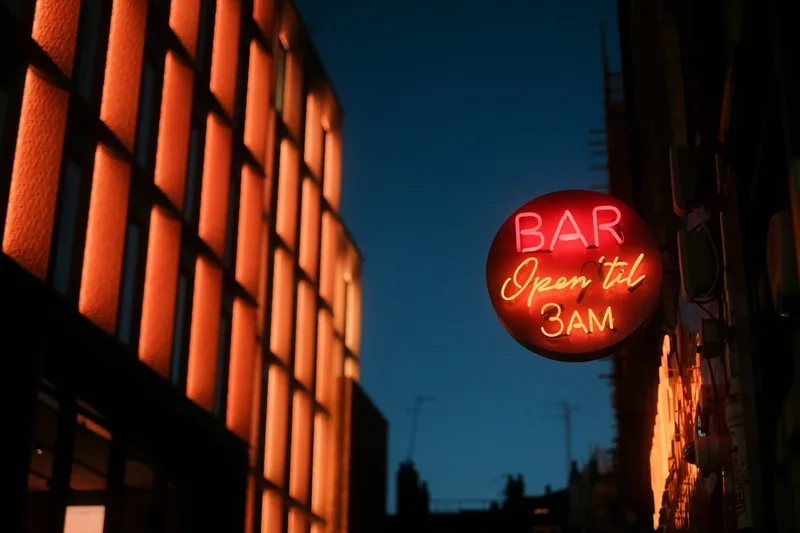
East London is where many younger Londoners go out, especially at weekends. Shoreditch and Hoxton, just north of the City, have converted warehouses, cocktail bars, rooftop terraces, food halls and clubs, with street art on many walls. Our Shoreditch neighbourhood guide covers the area's layout and how to reach it.
Further north, Dalston and parts of Hackney have smaller late bars, music venues and club nights with a more local crowd. The Windrush line of the London Overground runs through Shoreditch High Street, Haggerston and Dalston Junction, and it is part of the Friday and Saturday night service, which makes getting home from these areas easier than it once was.
Expect queues outside the best-known places on Friday and Saturday nights, and expect door staff to check ID. Weeknights are quieter and some venues open only from Thursday to Saturday, so check the listing before you travel across town.
South London: Brixton, Vauxhall, Clapham and Elephant & Castle
South of the river, Brixton is known for music. It has large concert venues, reggae and soul history, late bars and food markets, and a busy Friday and Saturday crowd. Read our Brixton area guide before you go; the Victoria line gets you there quickly from the West End.
Vauxhall has long been one of London's main areas for LGBTQ+ club nights, several of them running into the morning. Clapham, a little further out, is popular with young professionals for bars and pubs along its high street. Elephant & Castle is home to Ministry of Sound, one of London's best-known clubs, on Gaunt Street near the Northern and Bakerloo line station.
Peckham and Deptford, in south-east London, have bars in former industrial buildings and rooftop terraces that are popular on summer evenings. They are further from central hotels, so check the route home before you go.
North London: Camden, Islington and King's Cross
Camden Town has pubs and small venues where many bands have played early in their careers, plus a late-evening crowd around the market and the Regent's Canal. It suits people who want guitar music, rock pubs and a relaxed dress code. Our Camden Town guide explains what is where, and our overview of live music venues across London lists the halls, jazz clubs and small stages worth booking.
Islington's Upper Street has a long line of pubs, restaurants and bars that are busy but less rowdy than the West End. Around King's Cross, the former railway yards now hold bars and restaurants by the canal, and the area is easy to reach from many hotels. Farringdon, on the edge of the City, is where you find Fabric, one of London's longest-running clubs, close to the Elizabeth line and Thameslink station.
Pubs, bars and clubs: what the evening actually looks like
The pub is still the starting point for most Londoners. You order and pay at the bar, there is usually no table service, and you are not expected to tip for a round of drinks. If you are new to British pubs, our short guide to how to order and behave in a pub will save you some confusion, and our list of historic pubs worth visiting suggests places with real character.
Cocktail bars and hotel bars often have table service and may add a discretionary service charge to the bill. Rooftop bars are popular from late spring to early autumn and often need a booking; our guide to London's rooftop bars explains which ones you can walk into and which you must reserve.
Clubs usually sell tickets online in advance, and many nights are cheaper or only available that way. Popular events can sell out days ahead. Door policies vary: some clubs care about how many people are in a group, some about dress, and some only about age. If you want a different kind of night, London's comedy clubs are a good alternative that ends at a sensible hour.
Licensing hours and why closing times vary
England no longer has one fixed closing time for pubs. Under the Licensing Act 2003, each pub, bar or club has its own premises licence from the local council, and that licence sets the hours when it may sell alcohol. A venue that wants longer hours has to apply to change its licence. This is why one pub on a street may close at 11pm while the bar next door serves until 3am.
The same law treats hot food sold between 11pm and 5am as "late night refreshment", which also needs a licence. That is why late kebab shops and burger places display licence notices. Councils can also restrict alcohol sales between midnight and 6am in problem areas, so late opening depends on the neighbourhood as well as the venue.
Every licensed venue in England must follow some national conditions. One is that free tap water must be provided on request where it is reasonably available. Another is that the venue must have an age verification policy, which means staff ask anyone who appears under 18 (or an older age chosen by the venue) for photo ID showing their date of birth before serving them.
Age, ID and the rules on alcohol
You must be 18 to buy alcohol or to drink it in a pub, bar or club. According to GOV.UK, 16 and 17 year olds may drink beer, wine or cider with a meal if an adult buys it for them, but they cannot buy it themselves. Many clubs admit only people aged 18 or over, and some set a higher age for particular events, so read the ticket conditions.
Bring a passport or a national photo ID card as proof of age, even if you look older. The law lets each venue set a higher age than 18 for these checks, so you can be asked for ID even if you are well over 18. A photo of your passport on your phone is often refused. If you do not want to carry your passport, check with the venue in advance which documents it accepts.
No ID often means no entry, even at 40. Door staff can refuse anyone they choose, and a group can be turned away because one person cannot prove their age. Keep your ID with you but separate from your phone, so that one theft does not ruin the whole night.
Smoking, including in "substantially enclosed" areas, is banned inside pubs, bars and clubs, so smokers use outside areas or the pavement. Drinking alcohol is not allowed on the Tube, buses, trams or trains run by TfL, and you must not carry an open container of alcohol on them. Councils can also restrict drinking in the street in particular areas, and police can ask you to hand over your drink there.
Getting home: Night Tube, night buses and taxis
On Friday and Saturday nights the Night Tube runs all night on the Central, Jubilee, Northern, Piccadilly and Victoria lines, and the London Overground runs a night service on the Windrush line. Fares are off-peak and daily caps still apply. Our guide to which lines run through the night explains the routes and frequencies.
On other nights, and in areas without a Night Tube line, night buses take over. Their route numbers usually start with "N", and you pay with contactless or Oyster (cash is not accepted on London buses). Read our guide to London buses and night buses and check the last Tube times in the TfL Go app before you leave the bar.
Black cabs can be hailed in the street when the yellow "TAXI" sign on the roof is lit, and they must accept contactless card payment. The minimum fare is £4.40, and fares are higher at night and at weekends (September 2026). Minicabs, including app-based ones, must be booked; TfL's advice is "Stay safe - always book your minicab". Our guide to black cabs, minicabs and ride apps compares them.
Anyone offering a ride outside a club is not a licensed minicab. Licensed minicab drivers cannot pick up passengers who have not booked. Book through a licensed operator or its app, check that the car and driver match the booking, or walk to a black cab rank.
Staying safe on a night out
London is a large city, and most nights out pass without problems. The main risks for visitors are phone theft, pickpocketing in crowded areas and drinks being spiked. Our guide to staying safe in London covers areas, common scams and phone snatching, which is the crime visitors most often report.
Spiking means putting alcohol or drugs into someone's drink, or injecting them, without their knowledge. The Home Office lists these warning signs: confusion, nausea or vomiting, hallucinations, poor coordination or vision, difficulty speaking clearly, and memory loss. If you think you or a friend has been spiked, tell venue staff, get medical help by calling 999 or 111, and report it to the police on 999 or 101 as soon as possible, because some drugs leave the body within 12 hours.
Stay with your friends, agree a meeting point if you get separated, and keep enough battery to pay for your journey home, because a flat phone can mean no ticket. On the Underground and rail network you can text British Transport Police on 61016. Our page of emergency numbers and what to do lists the rest. Travelling alone? Our tips for solo travellers in London include advice for evenings out.
Quieter evenings if clubs are not your thing
Not every good night in London involves a dance floor. Many museums and galleries stay open late on certain evenings, the South Bank is lively after dark with free views along the river, and jazz clubs and cabaret venues offer a seated night out. Our round-up of the best evening things to do in London covers night views, late openings and walks.
If you are travelling as a family or simply prefer an early night, the West End theatres and the pubs of Covent Garden and Borough give you a taste of the evening atmosphere without the late hours or the cost of a club ticket.
Frequently asked questions
What time do pubs and clubs close in London?
There is no single closing time. Each venue's licence sets its own hours, so many traditional pubs close around 11pm or midnight while some bars serve until 2am or 3am and clubs often stay open until the morning. Check the venue's website for the night you plan to go.
What is the drinking age in London?
You must be 18 to buy alcohol or drink it in a pub, bar or club. Venues must have an age verification policy, so carry photo ID such as a passport or national ID card. Venues may choose a higher age than 18 for these checks, so expect to be asked.
Which area of London is best for nightlife?
For a first visit, Soho is the easiest choice because pubs, bars, LGBTQ+ venues and late restaurants are all within walking distance. Shoreditch and Dalston suit people who want bars and clubs with a younger crowd, while Brixton and Camden are good for live music.
Does the Tube run all night in London?
Only on Friday and Saturday nights, and only on the Central, Jubilee, Northern, Piccadilly and Victoria lines plus the Windrush line of the Overground. On other nights, and on other lines, you need a night bus or a licensed taxi after the last train.
Can I pay by card in London bars and clubs?
Almost always, and some venues no longer take cash at all. Contactless card and phone payments are normal. Black cabs must also accept contactless card payment, which helps when you are heading home late.
Sources
- GOV.UK - Alcohol licensing (checked September 2026)
- legislation.gov.uk - The Licensing Act 2003 (Mandatory Licensing Conditions) Order 2010, Schedule (checked September 2026)
- legislation.gov.uk - Licensing Act 2003, Schedule 2: late night refreshment (checked September 2026)
- GOV.UK - Alcohol and young people (checked September 2026)
- Home Office - Spiking: advice and support (checked September 2026)
- Transport for London - Night Tube (checked September 2026)
- Transport for London - Taxi fares (checked September 2026)