
The UK does not make visitors buy travel insurance, but the NHS charges most overseas visitors 150% of the standard rate for hospital treatment and asks for the estimated cost in advance. Insurance exists to stand between you and that bill, and to cover the things the NHS never pays for at all, such as getting you home.
This page is about the insurance side of a trip: what a policy needs to cover for the UK specifically, what the NHS will and will not charge you for, and the gaps that catch visitors out. The medical side, meaning which service to use when you are actually ill, is set out separately in our guide to using the NHS as a visitor, and the practical side of coping alone is in our page on travelling to London by yourself.
Travelling alone raises the stakes, because there is nobody with you to make the phone calls, carry your bag or remember the name of your hotel if you are hurt. That is the single strongest argument for buying cover even on a short trip.
Cover for a UK trip at a glance
- Is insurance compulsory?
- No. Neither the ETA nor a Standard Visitor visa requires it
- NHS charge for non-exempt visitors
- 150% of the standard NHS rate for hospital care
- When you pay
- Full estimated cost in advance, unless delay would harm urgent treatment
- Unpaid bills
- Debts of £500 or more unpaid for two months are reported to the Home Office
- Free to everyone
- A&E treatment, GP consultations, NHS 111, treatment for most infectious diseases
- EU visitors
- An EHIC covers medically necessary state treatment, but is not a substitute for insurance
What the NHS actually charges a visitor
England operates a residence-based health system, not an insurance-based one. If you are visiting from outside the European Economic Area and no exemption applies to you or to the treatment, the NHS charges 150% of its standard rate for secondary care, meaning hospital treatment. The NHS website puts it plainly: make sure you are covered by personal medical or travel insurance for the whole of your visit.
You are normally asked to pay the full estimated cost before treatment begins. The exception is treatment a clinician judges to be urgent, where payment would cause a dangerous delay; you are billed afterwards instead. Bills of £500 or more that go unpaid for two months are reported to the Home Office, and unpaid NHS debt can be a reason to refuse a future visa or ETA application.
Some things are free to everybody, whatever your nationality or status. Accident and emergency treatment is free, although that stops the moment you are admitted to hospital as an inpatient. GP and nurse consultations in primary care are free. So are NHS 111, treatment for most infectious diseases including sexually transmitted infections, and family planning. Our healthcare page has the full list and explains which service fits which problem.
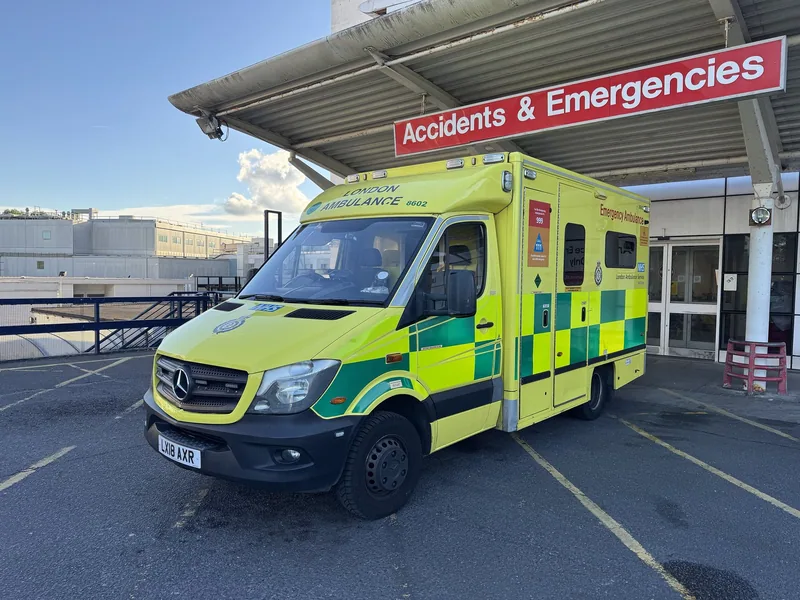
Photo: Elshad · CC BY 4.0 · Wikimedia Commons · resized
Why a large bill is the realistic risk, not a small one
The scenario people insure against is not a sore throat. A broken ankle on an escalator, chest pain in a hotel room, an allergic reaction in a restaurant: these lead to an ambulance, a hospital admission, imaging, a night on a ward and possibly surgery. That is secondary care, and for a chargeable visitor it is billed at 150% of the NHS rate.
The second large cost is getting home afterwards. The NHS does not repatriate anybody. If you cannot fly in a normal seat, someone has to pay for a stretcher, a medical escort or an air ambulance, and those are the costs that run into five and six figures. Repatriation cover, and cover for a relative to fly out and stay with you, are the reasons a policy is worth having even for a short trip.
A&E is free, but the ward upstairs is not. Visitors sometimes read that emergency care is free and assume the whole episode costs nothing. The free part ends at the point of admission. Everything after that, including the bed, the scans and the operation, is chargeable if you are not exempt.
EHIC, GHIC and the confusion between them
These two cards are often mixed up, and they point in opposite directions.
The UK Global Health Insurance Card (GHIC) is issued by the NHS to people who live in the UK. It covers them when they travel to the European Economic Area and some other countries. It is of no use to someone coming the other way, and a visitor to Britain cannot apply for one.
The European Health Insurance Card (EHIC) issued by an EU country works in England. If you are visiting from an EU country and fall ill or have an emergency, your EHIC covers treatment that becomes medically necessary during your stay, including treatment of pre-existing conditions and routine maternity care, as long as the purpose of the trip was not to give birth or to get treatment. A Provisional Replacement Certificate does the same job if your card has not arrived.
Three national variations matter. Swiss visitors can use an EHIC only if they are eligible for one in Switzerland, which depends on nationality and status. Norwegian residents and citizens get medically necessary treatment on production of a valid Norwegian passport. Visitors from Iceland and Liechtenstein may be charged the full 150% rate.
The NHS is explicit that an EHIC is not an alternative to travel insurance. It covers state healthcare only. It does not cover private treatment, repatriation, a cancelled flight, a stolen laptop or the cost of changing your ticket.
Australia, New Zealand and other reciprocal agreements
The UK has reciprocal healthcare agreements with a small number of countries, and they are narrower than people assume. Residents of Australia are covered for immediate medical treatment only. Citizens resident in New Zealand are covered only for treatment needed promptly for a condition that arose or got worse after arrival, not for routine monitoring of something they already had.
Neither agreement covers repatriation, and neither turns into a general entitlement to NHS care. The NHS publishes a table of reciprocal agreements; check your own country on it rather than relying on what a friend was told.
What a policy for a UK trip should include
Insurance is a regulated financial product and we do not recommend particular insurers or policies. What we can set out is the checklist that matters for Britain specifically, so you can compare like with like.
| Cover | Why it matters in the UK | What to check |
|---|---|---|
| Emergency medical treatment | NHS charges non-exempt visitors 150% of standard rates | The overall limit, and whether the UK is included in the region you bought |
| Repatriation | The NHS never pays to get you home | That it includes a medical escort and a companion's costs |
| Pre-existing conditions | Undeclared conditions are the commonest reason claims fail | Declare everything, including medication you take daily |
| Cancellation and curtailment | Strikes, weather and illness before departure | Whether industrial action announced before you bought is excluded |
| Travel delay and missed departure | Rail and airport disruption is common | How many hours' delay triggers it, and what evidence is needed |
| Baggage and personal belongings | Phone theft is the most frequent crime against visitors | The single-item limit, which is often lower than a phone's value |
| Personal liability | Damage or injury you cause to someone else | That it is included at all on the cheapest policies |
| Excess | The amount you pay on every claim | Whether it applies per person and per section of the policy |
Read the exclusions before you read the headline figures. Alcohol-related injuries, unlicensed e-scooters, motorcycling without the right licence, and anything you do after ignoring official advice are all common grounds for refusal. Riding a rental e-scooter outside the legal rental trials is a specific trap; our page on e-scooters and e-bikes in London explains what is and is not legal here.
Cover you may already have
Before buying, check what you hold already. Some bank accounts and credit cards include travel insurance, sometimes only if the trip was paid for on that card, and the medical limits are occasionally lower than a stand-alone policy. Some home contents policies cover belongings away from home, which can overlap with baggage cover.
If you travel more than twice a year, an annual multi-trip policy is usually cheaper than buying single-trip cover each time. Younger travellers should also check whether a parent's family policy still covers them, because the age limit is often lower than people assume; where the rest of a tight budget goes is set out in our page on visiting London as a student. Whichever you have, take the policy number and the 24-hour emergency assistance number with you in a form you can reach without your phone, because the phone is the thing most likely to be stolen.
Photograph the policy and keep a paper copy in your luggage. Insurers' emergency lines need the policy number before they will authorise anything, and a hospital reception desk will ask for it too. A screenshot in a phone that has just been snatched from your hand on Oxford Street is not a plan.
Theft, police reports and why claims fail
Almost every baggage or theft claim requires a police report, usually within 24 hours. In London, a non-emergency crime can be reported online or by calling 101, and the report gives you a crime reference number, which is what the insurer wants. Without it, most policies simply decline.
Claims also fail on value: many policies cap a single item at a figure well below the price of a current phone or camera. If you are carrying something expensive, check that limit and consider listing the item specifically. Our guides to how pickpockets work in London and the scams to know about cover the situations these claims come from, and our page on safety in London puts the risk in proportion.
If a passport is among the things taken, the insurance claim is only part of the problem; see what to do if you lose your passport in London for the consular steps.
Disruption cover: strikes, weather and delays
The claims most visitors actually make are not medical. They are about missed connections, cancelled trains and nights in an airport hotel. Two details decide whether you are covered.
The first is timing: insurers exclude events that were already public knowledge when you bought the policy, so buying cover after a strike has been announced will not help for that strike. Our guide to visiting London during a strike explains how industrial action is announced here and how much notice you usually get.
The second is evidence. Keep the boarding pass, the delay notice, the receipts and the written confirmation from the airline or train company. Reimbursement from the operator and a claim on the policy are separate routes, and you usually have to try the operator first.
One date is worth flagging separately. No train runs anywhere in Britain on Christmas Day, and London's Underground and buses stop too, which is a planned closure rather than a disruption and is therefore not something any policy will pay for. If your flight lands or leaves on 25 December, arrange the transfer yourself; what closes on public holidays sets out which services still run.
Before you leave home
- Declare every medical condition and every medication, including ones that feel irrelevant. Non-disclosure voids more claims than anything else.
- Check the UK is in your policy's region. Some European policies define their area in a way that no longer includes Britain by default.
- Bring your EHIC or Provisional Replacement Certificate if you are an EU visitor, and your passport if you are Norwegian.
- Carry prescriptions and the generic names of your medicines. UK pharmacists will not recognise every foreign brand name.
- Save 999, 111 and your insurer's assistance line in your phone and on paper; see our page on emergency numbers in London.
- Check your entry permission separately. Insurance does not affect it; our page on UK entry requirements and the ETA covers who needs what.
Frequently asked questions
Do I need travel insurance to visit the UK?
It is not a legal requirement and neither the Electronic Travel Authorisation nor the Standard Visitor visa asks for proof of it. The NHS advises visitors staying less than six months to have personal medical or travel insurance, because hospital treatment is charged to most overseas visitors at 150% of the standard rate.
Is emergency treatment free for tourists in London?
Accident and emergency services are free to everyone, but that ends if you are admitted to hospital as an inpatient. From that point the treatment is chargeable unless you are exempt. Ambulance transport to A&E is part of the free emergency service; the care that follows admission is not.
Can a visitor to the UK use a GHIC?
No. The UK Global Health Insurance Card is issued to people who live in the UK for use when they travel abroad. A visitor coming to Britain from an EU country should bring their own European Health Insurance Card instead, which covers medically necessary state treatment during the stay.
Does an EHIC replace travel insurance in England?
No, and the NHS says so directly. An EHIC covers state healthcare that becomes medically necessary during your visit. It does not cover private treatment, the cost of flying you home, lost or stolen belongings, cancelled flights or any other travel expense.
What happens if I cannot pay an NHS bill?
The hospital will invoice you and pursue the debt. Debts of £500 or more that remain unpaid for at least two months are reported to the Home Office, and that can lead to a future visa or ETA application being refused. Tell your insurer as soon as treatment starts so the hospital can bill them directly.
Sources
- NHS - Visitors from outside the European Economic Area (checked September 2026)
- NHS - Visitors from EU countries, Norway, Iceland, Liechtenstein or Switzerland (checked September 2026)
- NHS - Get healthcare cover abroad with a UK GHIC or UK EHIC (checked September 2026)
- NHS - Reciprocal healthcare agreements table (checked September 2026)
- GOV.UK - NHS entitlements: migrant health guide (checked September 2026)
- GOV.UK - Standard Visitor (checked September 2026)
- GOV.UK - Contact the police (checked September 2026)