
In most British pubs you order and pay at the bar, not at your table, and you carry your drinks back yourself. Nobody will bring you a menu or a bill unless the pub runs table service, and a tip at the bar is not expected.
The pub is where many Londoners meet friends, watch football, eat a cheap lunch or have one drink on the way home. It works differently from a café or restaurant in much of the world, and the unwritten rules confuse many visitors. The good news is that the rules are simple, staff are used to first-timers, and nobody minds if you ask.
This guide explains how ordering works, what the drinks on the bar are called, how rounds and tipping work, and the legal rules on age, smoking and drinking outside. Legal points come from GOV.UK and the legislation itself; the rest is long-standing custom.
Pub basics at a glance
- Ordering
- At the bar, unless the pub tells you it has table service
- Paying
- When you order; card and contactless are widely accepted
- Tipping at the bar
- Not expected
- Beer measures
- Pint (568 ml), half pint, two-thirds or a third
- Legal age to buy alcohol
- 18
- Smoking
- Not allowed indoors; many pubs have an outdoor area
Ordering at the bar, step by step
Walk in, find a table if you want one, then go to the bar. There is no formal queue, but bar staff keep track of who arrived first. Stand at the bar where you can be seen, have your card ready and wait. Waving money, tapping on the bar or calling out is considered rude and usually makes you wait longer.
When it is your turn, say what you want clearly: "A pint of the pale ale and a glass of the house red, please." If you do not know the beers, ask what the staff recommend or ask for a small taste of a cask ale before you decide; many pubs are happy to offer one. You pay straight away, and you carry the drinks to your table.
Food works in one of two ways. In many pubs you also order food at the bar, giving your table number, and staff bring the plates out. In pubs that run more like restaurants, someone will show you to a table and take your order there. If you are unsure, look for a sign at the door or simply ask at the bar.
Note your table number before you queue for food. Pub tables usually have a number on a small card or plate. Staff will ask for it when you order food at the bar, and they cannot bring your meal without it.
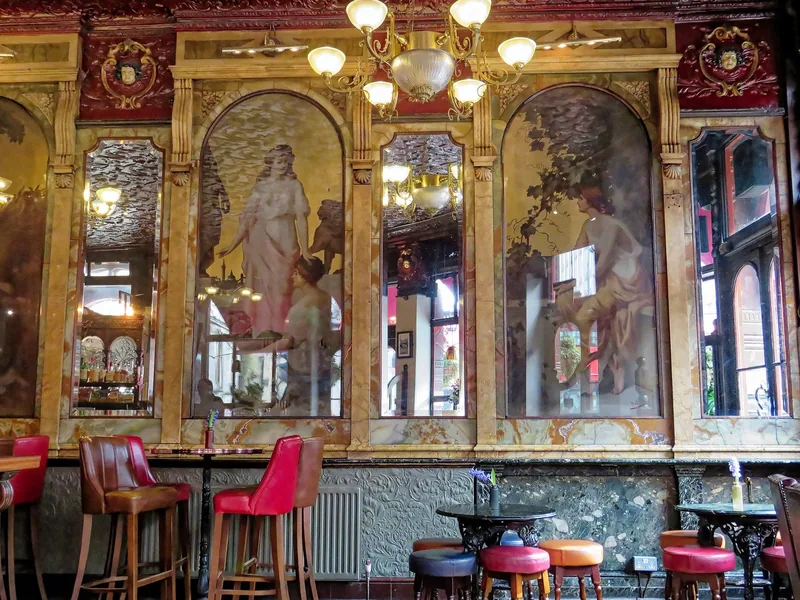
Photo: Acabashi · CC BY-SA 4.0 · Wikimedia Commons · resized
What to ask for: beer, cider, wine and spirits
Draught beer and cider in the UK must by law be served in set sizes: a third of a pint, half a pint, two-thirds of a pint, or multiples of half a pint. A pint is 568 ml, which is larger than the 500 ml glass common in much of Europe. Asking for "a half" of anything is perfectly normal.
The main types you will see on the bar are:
- Lager: pale, cold and fizzy, served from the modern taps. This is what most visitors expect beer to taste like.
- Cask ale (real ale): traditional British beer that finishes maturing in the barrel in the pub cellar. It is pulled up by hand pumps with tall handles, served cool rather than ice-cold and with little fizz. Bitter, best bitter and golden ale are common styles.
- Stout and porter: dark, roasted beers. Guinness is the best-known stout.
- Cider: made from apples and often as strong as beer or stronger. Ask about the strength if you are not used to it.
Wine by the glass must be offered in 125 ml or 175 ml measures (or multiples of them), and many pubs also sell 250 ml glasses. Gin, rum, vodka and whisky are served in measures of 25 ml or 35 ml, or multiples of them; a pub uses one size or the other, not both. "A double" means twice the pub's single measure.
Non-drinkers are well looked after. Most pubs now sell alcohol-free beer, soft drinks, juices and often coffee. Nobody expects you to drink alcohol, and ordering a lime and soda or an alcohol-free lager is completely normal.
Buying rounds with friends
When British people drink in a group, they usually buy "rounds": one person buys drinks for everyone, then the next person buys the next round, and so on. It is a strong social habit. If you join a group and someone buys you a drink, you are expected to buy a round later in the evening.
Rounds get expensive in large groups, especially if you drink slowly. It is fine to say at the start, "I'll just get my own, thanks", or to join a smaller round with one or two people. What is frowned upon is accepting several drinks and then leaving before your turn.
Tipping and service charges in pubs
You do not need to tip when you buy drinks at the bar. Some regulars say "and one for yourself" when paying, which means the staff member may add the price of a drink for themselves to the bill, but this is a friendly gesture rather than an expectation.
Pubs that serve food at the table sometimes add a service charge to the bill, like restaurants. Check the menu and the bill. A charge described as discretionary or optional is exactly that. Since 1 October 2024, the law requires employers to pass all tips, gratuities and service charges on to workers in full, without deductions. Our guide to tipping in London covers restaurants, taxis and hotels.
Most pubs accept cards and contactless payment, and some are cashless. See our guide to money, cards and contactless in London if you are unsure about using your own card.
Age, ID and children in pubs
According to GOV.UK, it is illegal for anyone under 18 to buy alcohol or to drink it in a pub. The one exception: 16- and 17-year-olds with an adult may drink beer, wine or cider with a meal, but they may not buy it themselves. It is also an offence for an adult to buy alcohol for someone under 18.
Many pubs and bars run a "Challenge 25" policy, which means staff ask for photo ID from anyone who looks under 25. Foreign visitors should carry a passport or national ID card if they look young; a photo of your passport on your phone may not be accepted.
Children are often welcome, especially during the day and when the family is eating. Under the Licensing Act 2003, children under 16 must be with an adult (someone aged 18 or over) in premises used mainly for drinking, and a pub's own licence may set further limits, such as an evening curfew for children. If a pub says no children after a certain time, that is its licence or its choice. For family-friendly ideas, see our guide to London with kids.
Dogs, phones, football and other house rules
Dogs are welcome in many London pubs, usually on a lead and often only in the bar area rather than the dining room. Look for a water bowl by the door or a sign saying dogs are welcome, and ask if in doubt.
Pubs showing sport are easy to spot: they advertise matches on boards outside. On a Premier League weekend, pubs near the grounds of London's clubs fill with home fans. If you are not supporting the home team, it is wise not to wear the other side's shirt; our guide to Premier League football in London explains match days. Many historic pubs have no screens at all, which suits those who want to talk.
Other points of good manners are the same as anywhere: do not take someone's seat if their coat or bag is on it, ask before taking a spare chair from another table, and take empty glasses back to the bar if the pub is busy. Our broader guide to British etiquette for visitors explains queuing, politeness and the famous British reserve.
Smoking, vaping and drinking outside
Smoking has been banned in enclosed and substantially enclosed public places in England, including pubs, since 1 July 2007. Smokers go outside, often to a beer garden or the pavement. Vaping indoors is not covered by that law, so it is up to each pub; most do not allow it inside.
Standing outside with your drink is a normal part of London pub life on warm evenings, and many pubs allow it on the pavement in front. Drinking in public is not banned across the country, but local councils can make orders that allow the police to tell you to stop and hand over your drink, and refusing is an offence. Under-18s can be stopped, fined or arrested for drinking in public. Do not walk off down the street with a pub glass.
Drinking alcohol, or carrying an open alcoholic drink, is not allowed on TfL buses, trains, stations or tram platforms. Finish your drink before you get on the Tube.
Keep your phone off the pub table. Phones placed on a table near the door or on a pavement terrace are a common target for snatch thefts in busy parts of London. Keep your phone and bag in sight and closed, especially when you sit outside. Our guide to staying safe in London has more advice.
Opening hours, last orders and getting home
There is no national closing time. Since 2005, each pub's hours have been set by its own licence, so one pub may close at 23:00 and its neighbour much later. Many pubs still ring a bell to announce "last orders", your final chance to buy a drink, and then call "time" when drinks must be finished. You normally have a short while to finish your glass before staff ask you to leave.
Pubs in the City of London, the financial district, can be quiet or even closed at weekends because their customers are office workers. Pubs in residential areas are often busiest on Sunday afternoons, when many serve a traditional Sunday roast.
If you are out late, the Night Tube runs on Friday and Saturday nights on the Central, Jubilee, Northern, Piccadilly and Victoria lines, and night buses cover much of London. For where to go once the pubs close, see our guide to London nightlife.
Choosing your first pub
For a first visit, pick a pub that is quiet enough to watch how others order. A weekday afternoon is ideal. Pubs near the big stations and in the West End are busy and quick; neighbourhood pubs are slower and friendlier to questions.
For history as well as a drink, our guide to London's historic pubs picks out old taverns and riverside inns worth the journey. If you want a view rather than a wood-panelled room, try one of the rooftop bars, where table service and booking are more common. Solo travellers will find the pub one of the easiest places in London to sit alone with a drink; our page on solo travel in London has more tips.
Cask ale tasters cost nothing to request. If the names on the hand pumps mean nothing to you, ask the bar staff for a small taste of one or two before choosing. Many pubs offer this, and it is the easiest way to find a British beer you actually like.
Frequently asked questions
Do you order at the bar or at the table in a British pub?
In most pubs you order and pay at the bar, then carry your drinks to your table. Food is often ordered at the bar too, using your table number. Some pubs, especially those run more like restaurants, have table service; if staff show you to a table, they will usually take your order there.
Should I tip the bartender in a London pub?
No, a tip is not expected when you buy drinks at the bar. Some regulars offer to buy the staff member a drink as a friendly gesture. If you eat at a table and the bill includes a discretionary service charge, it is optional, and by law tips and service charges must go to the staff.
How big is a pint in the UK?
A British pint is 568 ml, more than the 500 ml glass common in continental Europe. Draught beer and cider can also be served as a half pint, a third or two-thirds of a pint. Asking for a half is completely normal.
Can children go into pubs in London?
Often yes, if they are with an adult. Children under 16 must be accompanied in pubs used mainly for drinking, and each pub's licence can add limits, such as no children after a certain time. Under-18s cannot buy alcohol, but 16- and 17-year-olds may drink beer, wine or cider with a meal if an adult buys it.
What does "last orders" mean?
Last orders is your final chance to buy a drink before the pub closes, often announced by ringing a bell. Closing time depends on each pub's licence. After "time" is called, you have a short while to finish your drink before staff ask you to leave.
Sources
- GOV.UK - Alcohol and young people (checked September 2026)
- legislation.gov.uk - Licensing Act 2003, section 145: unaccompanied children (checked September 2026)
- GOV.UK - Weights and measures: specified quantities (checked September 2026)
- legislation.gov.uk - Health Act 2006, section 2: smoke-free premises (checked September 2026)
- GOV.UK - Tips at work (checked September 2026)
- legislation.gov.uk - Anti-social Behaviour, Crime and Policing Act 2014, section 63 (checked September 2026)
- Transport for London - Conditions of Carriage (checked September 2026)