
London tap water is treated to a legal drinking standard and costs nothing. Carry an empty bottle, fill it at a public fountain, in a museum or at the bar of any pub, and you will not need to buy water at all during your trip.
Visitors from countries where tap water is not drinkable often assume the same is true here, and spend several pounds a day on bottles. They do not need to. Water from any cold tap in a London kitchen, bathroom or public building is treated drinking water, checked constantly by the company that supplies it and by an independent regulator.
The only real question is practical: where do you fill up when you are out all day? That is what most of this page is about. If you are counting every pound, our guide to saving money in London covers the bigger costs; this page deals with the small one that adds up fastest.
Drinking water in London: the short version
- Is it safe?
- Yes. Treated to UK drinking water standards and tested continuously
- Who supplies it
- Thames Water across almost all of London
- Taste
- Hard water, high in calcium and magnesium; a faint chlorine smell is normal
- Public fountains
- Around 100 across the city, marked with a blue water droplet
- In a pub or licensed restaurant
- Free tap water on request is a condition of the licence
- Cost of a bottle instead
- Roughly £1 to £2.50 a time in a shop or café (September 2026)
How safe London tap water really is
Almost all of London is supplied by Thames Water. The company says it runs more than 500,000 tests a year, taking samples from mains, pipes and randomly chosen customers' taps, and that since 2010 more than 99.95% of samples taken at the tap have met the required standard. Quality is regulated separately by the Drinking Water Inspectorate, a government body that can take enforcement action against a water company.
That applies to the cold tap in the kitchen. Two small exceptions are worth knowing. Water from a hot tap may have sat in a storage tank, so it is not intended for drinking. And a tap marked "not drinking water", which you occasionally see in older buildings and on some trains, means exactly that.
Very old properties can still have lead pipework, which is why Thames Water has a lead pipe replacement programme. In a hotel or a modern flat this is not something a short-stay visitor needs to think about. If a tap has not been used for hours, running it for a few seconds before you fill a bottle is sensible anywhere in the world.
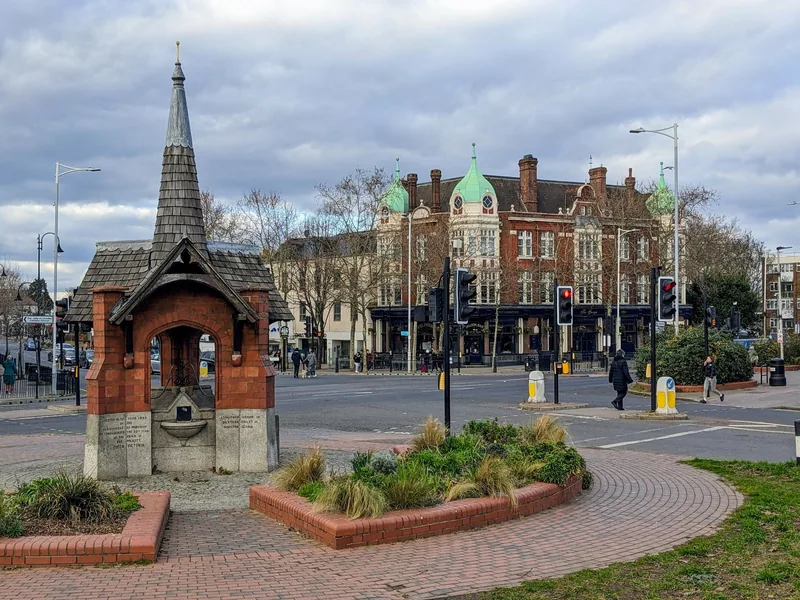
Photo: The wub · CC BY-SA 4.0 · Wikimedia Commons · resized
Why the water tastes different from home
London sits on chalk and clay, and the water is hard. It carries a lot of dissolved calcium and magnesium, which is why kettles in London flats fur up with white scale and why a cup of tea sometimes has a thin film on top. The minerals are harmless. If the taste bothers you, a jug left in the fridge for an hour loses most of the chlorine smell.
Visitors from soft-water countries such as Norway, Scotland or parts of Germany notice the difference immediately. Visitors from Spain or the Middle East usually think London water tastes clean. Neither reaction says anything about safety.
Brushing your teeth and making up baby bottles are both fine. Cold tap water is drinking water, so there is no need to buy bottled water for either. For infant feeds, the usual advice is to run the cold tap first and boil the water, exactly as you would at home.
The rule that gets you a free glass in any pub
This is the single most useful thing to know. Every premises in England licensed to sell alcohol for drinking on the premises operates under a set of mandatory conditions set by law. One of them says that free tap water must be provided on request to customers where it is reasonably available.
In practice that means any pub, bar, licensed café or restaurant will give you a glass of tap water if you ask at the bar, and cannot charge for it. Most will also fill a water bottle if the bar is not busy, although that part is goodwill rather than law. Ask politely, say please, and wait your turn; our guide to ordering in a British pub explains how bar service works if you have not done it before.
Cafés and coffee shops that do not sell alcohol are not covered by the rule. Most independent ones will still fill a bottle, and many display a Refill sticker to say so.
Public drinking fountains and where to find them
The Mayor of London and Thames Water have installed a network of around 100 public drinking fountains in busy parts of the city. Each is topped with a distinctive blue water droplet, they run all day and night, and they are free. Some have a low spout for filling a bottle and a higher one for drinking directly.
There is an official map of them at apps.london.gov.uk/water-fountains. It is worth opening once at the start of a day's sightseeing rather than hunting when you are already thirsty. The fountains cluster where the crowds are: parks, main shopping streets, squares and station approaches.
Older Victorian drinking fountains also survive across the city, some of them restored and working, some purely ornamental. The ones in Hyde Park and Kensington Gardens are among the easiest to find, and the royal parks generally have working fountains near the main gates and playgrounds.
Refill: the cafés and shops that will fill your bottle
Refill is a national scheme run by the environmental charity City to Sea. Businesses sign up to fill a reusable bottle free of charge, then put a Refill sticker in the window and appear on the scheme's app and map at refill.org.uk. Thousands of London cafés, shops, galleries and offices take part.
The etiquette is simple. Go to the counter, hold up the bottle, ask if they do refills. Do not help yourself to a tap behind the counter, and do not expect a refill in the middle of a lunchtime rush in a tiny takeaway. A second's eye contact and a thank-you is all it takes.
Museums, galleries and other reliable places to fill up
The single most dependable source of free water in central London is a museum. Almost all of the big ones have water fountains or filling points near the cloakrooms and the cafés, and the large national museums are free to enter, so you can walk in, fill up and walk out. Our list of museums with free entry doubles neatly as a list of places to refill a bottle.
Other reliable stops:
- Mainline railway stations. Most of the big terminals have at least one free water point, usually near the toilets or on the concourse.
- Food markets. Several, including Borough Market, have installed public fountains to cut down on plastic bottles among their traders and visitors.
- Shopping centres and department stores. Look near the toilets and the food courts.
- Sports centres, libraries and university buildings that are open to the public.
The Underground is the exception. There are no drinking fountains on platforms or in tunnels, and the trains have no water on board, so fill up before you go down. Our guide to using the Tube explains why carrying water matters on the deep lines in summer, when carriages can get uncomfortably warm.
The Tube in a heatwave is the one place you will regret an empty bottle. The Central, Bakerloo, Northern and Victoria lines run deep underground with limited ventilation, and there is no water available once you pass the gateline. Fill up at street level, and if you feel unwell get off at the next station and tell a member of staff.
Taking a bottle through airport security
You cannot take water through the security search. GOV.UK's hand luggage rules limit liquids to containers of 100ml or less, carried in a single resealable bag of no more than one litre, roughly 20cm by 20cm. A full water bottle will be taken off you.
An empty bottle is fine. Empty it before you join the queue, put it through the scanner with your bag, and fill it at a water point after security. Every London airport has them, although at Heathrow they are sometimes tucked beside the toilets rather than signposted in the departure lounge. Airside bottled water is among the most expensive in the country, so this one habit pays for itself on the first trip.
What you actually save
A 500ml bottle of water costs roughly £1 in a supermarket and can be £2.50 or more from a café, a station kiosk or a tourist attraction (September 2026). Two adults drinking three bottles each on a warm sightseeing day are spending somewhere between £6 and £15 a day on something that comes out of the tap for nothing.
Over a five-day trip for a family of four, that is easily £60 to £100 that could go towards a meal or a show. A reusable bottle bought in any London chemist or supermarket for a few pounds pays for itself before lunch on the first day. Students working to a tight daily budget will find more of the same thinking in our guide to visiting London as a student.
Buy the bottle when you land, not before you fly. A soft, collapsible bottle takes almost no room in hand luggage, but a rigid one bought at a Boots or a Sainsbury's near your hotel costs a few pounds and can be left behind at the end of the trip. Either way, the second day of the trip is when it starts saving you money.
Water, toilets and planning a day out
The two questions go together: drinking more water means needing a toilet more often, and public toilets in London are less common than visitors expect. Our guide to finding a toilet in London is worth reading alongside this page, because the same buildings tend to solve both problems: museums, big stations, department stores and shopping centres.
On a hot day, plan the refills the way you plan the sights. Fill up at breakfast, again at the first museum, again after lunch. On a cold, wet day you will drink less than you think and should still carry something, because London's heated indoor spaces are dry. Our page on the London climate and what to pack has the seasonal picture.
Families should note that children need more frequent stops for both water and toilets than an adult itinerary allows. Our family guide to London builds that into the day. Bank holidays and the days around Christmas are the exception to all of this, because many of the buildings you would rely on are shut; see what is open on those dates in our guide to London's public holiday closures.
Frequently asked questions
Can you drink tap water in London?
Yes. Tap water in London is treated drinking water, supplied mainly by Thames Water and regulated by the Drinking Water Inspectorate. Use the cold tap rather than the hot one, and avoid any tap labelled as not for drinking. It is safe for brushing teeth, making tea and making up baby feeds.
Why does London water taste of chalk or chlorine?
London has hard water, high in naturally occurring calcium and magnesium from the chalk the city sits on, and a small amount of chlorine is used to keep the supply safe through the pipe network. Neither is harmful. Chilling water in the fridge for an hour removes most of the chlorine smell.
Do restaurants in London have to give you free tap water?
Premises licensed to sell alcohol for drinking on the premises must provide free tap water on request where it is reasonably available, which covers pubs, bars and most restaurants. Cafés without an alcohol licence are not covered by that rule, although many will still fill a bottle if you ask.
Where can I refill a water bottle in central London?
The most reliable places are museums, mainline railway stations, shopping centres and the roughly 100 public fountains marked with a blue droplet. The Mayor's fountain map and the Refill app both show locations. There is no drinking water once you are through the barriers on the Underground.
Can I take a water bottle through security at a London airport?
Only if it is empty. UK hand luggage rules allow liquids only in containers of 100ml or less inside one resealable bag of up to a litre. Empty the bottle before the search and refill it at a water point in the departure lounge, where bottled water is expensive.
Sources
- Thames Water - Water quality (checked September 2026)
- Thames Water - Water fountains (checked September 2026)
- Greater London Authority - London's Water Fountains map (checked September 2026)
- Drinking Water Inspectorate - Learn more about your water (checked September 2026)
- legislation.gov.uk - Licensing Act 2003 (Mandatory Licensing Conditions) Order 2010, Schedule (checked September 2026)
- GOV.UK - Hand luggage restrictions: liquids (checked September 2026)
- City to Sea - Refill (checked September 2026)