
Much more of Camden Market is under cover than its reputation suggests, and the driest parts are the ones visitors walk past: a Victorian horse tunnel, a run of brick railway vaults, and a modern set of food halls with a roof. Plan the route in the right order and you can spend three hours there in steady rain with under ten minutes of it spent outside.
Camden is usually described as an outdoor market, and on a dry Saturday that is how it behaves. But the site is built on the remains of a Victorian railway goods depot, and the railway left behind tunnels, vaults and stable ranges that were roofed for horses and carts. Those roofs are still there. Add the covered halls at Hawley Wharf and you have one of the largest indoor shopping areas in north London, without anybody calling it a shopping centre.
Our main guide to Camden Market sets out what the four trading areas sell and when they open. This page is only about staying dry: which sections have a roof, the route between them that keeps you under cover, what has been demolished, and the two places where you will get soaked whatever you do. The wider area is in our Camden Town neighbourhood guide.
Camden in the wet: the short answer
- Fully covered
- The Horse Tunnel and the vaults under Stables Market; the food halls and retail floors at Hawley Wharf; the indoor units of Camden Lock Market
- Partly covered
- The cobbled alleys of Stables Market, where awnings and canopies span most but not all of the route
- Not covered at all
- West Yard, the canal towpath, the bridge over the lock, Camden High Street
- Longest unavoidable soaking
- About five minutes, crossing the canal bridge between Hawley Wharf and the Stables
- Best wet-weather hours
- Weekday mornings from 10am; the covered sections fill from about 12:30 once it starts raining
Which of the four trading areas actually has a roof
Camden is four markets that grew into each other, and they are not equally weatherproof. Ranked by how much of the floor area is under something solid, the order is Hawley Wharf, then the underground parts of Stables Market, then the indoor units at Camden Lock, then the open yards.
| Area | Cover | What you can do there in rain |
|---|---|---|
| Hawley Wharf, Chalk Farm Road NW1 8AA | Fully enclosed halls over several floors, with lifts | Eat, shop, cinema, indoor amusements. Food halls trade 11.30am–11pm daily; the retail units open at noon Monday to Wednesday |
| Stables Market, lower level | Brick tunnel and vaults, roofed and dry throughout | Vintage clothing, furniture, records, antiques dealers |
| Stables Market, upper alleys | Canopies and awnings over most of the walkway | Alternative fashion and band merchandise; expect drips at the junctions |
| Camden Lock Market | Indoor halls plus open-air stalls beside the water | Crafts and jewellery indoors; the outdoor stalls pack up early in heavy rain |
| West Yard | None, beyond individual stall roofs | Street food, eaten standing up under an umbrella |
The practical consequence is that a rainy visit should start at the top of Chalk Farm Road and work downhill, rather than the usual route up from the station. You arrive in the covered part first and leave the exposed parts for a gap in the weather.
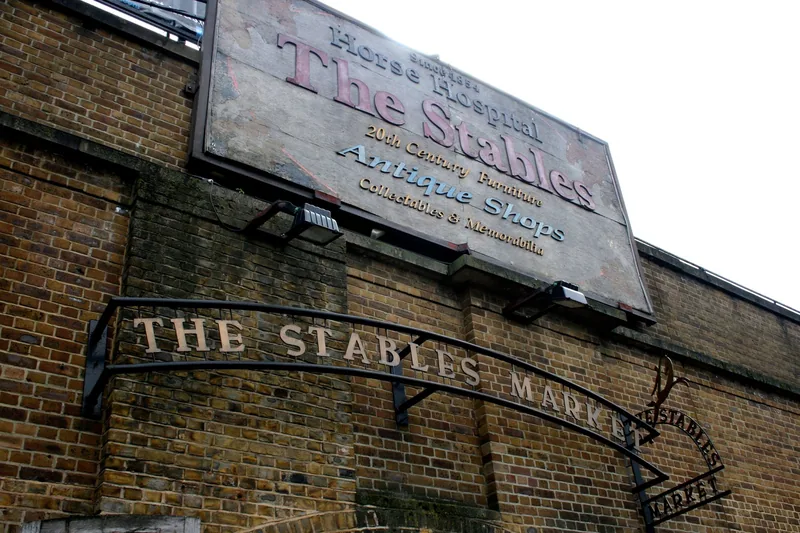
Photograph by Mike Peel (www.mikepeel.net) · CC BY-SA 4.0 · Wikimedia Commons · resized
The Horse Tunnel and the vaults, which are the driest place in Camden
The lower level of Stables Market is a genuine piece of railway engineering rather than a themed basement. The site was the northern half of the Camden Goods Depot, built for the London and Birmingham Railway from 1837 on land bought from Lord Southampton, and opened to traffic in 1839. Horses did the shunting and the local delivery work, and they needed to cross under the tracks.
Historic England's statutory list entry for the Interchange building on the other side of the canal, list entry 1113238, records the result: in the rebuilding of 1854 to 1856 a new stables yard was laid out with a horse tunnel linking it to the marshalling yards, and a second tunnel was driven on the western side of the main line, reached by horse stairs added in 1876. The market's underground section is signed as the Horse Tunnel Market, and the vaults leading off it were built as warehousing. The Horse Hospital at the northern end of the site is separately listed at Grade II* as list entry 1258100, added to the list on 30 September 1981.
For a visitor in bad weather the useful part is simple. Brick barrel vaults do not leak, there is no daylight to lose, and the dealers down there sell the sort of stock that suffers in rain — paper, textiles, furniture, vinyl — so they stay open when the outdoor stalls give up. If you are interested in the trade rather than the fashion, our guide to London's antiques markets explains how the indoor arcades work and what the dealers expect.
The tunnel entrance is easy to miss from Chalk Farm Road. Come in through the main Stables gateway and look for the level that drops away below you rather than the alleys climbing ahead. Most visitors walk straight past it at street level and then complain that Camden has no indoor section.
Hawley Wharf, and why it is the right answer with children
Hawley Wharf is the newest section, on the south bank of the canal, and it is the only part of Camden built as a covered development rather than converted into one. The food halls run from 11.30am to 11pm every day, which is four hours longer than the market above; the shops keep shorter hours and open at noon from Monday to Wednesday.
It is also the part built with lifts and level floors throughout, which makes it the section to start and probably finish in with a wheelchair or a pushchair; our main market guide lists the facilities in detail. There is a cinema in the railway arches and an indoor amusement park, which between them will absorb an afternoon that the weather has ruined. Our page on London cinemas worth visiting covers the alternatives if you would rather see a film somewhere with more character, and step-free transport in London explains getting here without stairs.
The dry route, in order, from Camden Town station
There is no covered walkway from the Underground, and the walk up Camden High Street is the wettest five minutes of the day. Accept that, then minimise everything after it.
- Camden Town station to the canal bridge: about five minutes on open pavement, under shop awnings on the left-hand side if you stay tight to the buildings.
- Turn right into Hawley Wharf before you cross the bridge. You are now indoors, and can stay indoors for as long as you like.
- Cross the bridge to the Lock. Thirty seconds of rain. Head for the indoor halls rather than the stalls in West Yard.
- Walk north to the Stables gateway on Chalk Farm Road: two or three minutes, partly under canopies.
- Drop into the Horse Tunnel and work through the vaults and the covered alleys. This is the long indoor stretch.
- Leave from the northern end and walk two minutes to Chalk Farm station, which is closer to the Stables than Camden Town is.
That sequence keeps you out of the rain for all but about eight minutes, and it has the side benefit of running against the flow of the crowd, which climbs from Camden Town towards Chalk Farm. Our guide to the Northern line explains the two branches, which matters here because Camden Town and Chalk Farm are on the same one.
Two things older guides send you to that are not there
The shipping-container market on Buck Street, opposite Camden Town station, is not part of Camden Market and should not be in your plan: its own domain is now parked with no website behind it. Several printed guides still list it as the covered option nearest the Tube, which it is not.
The other change matters more if you were hoping to arrive by water. The London Waterbus from Little Venice no longer calls at London Zoo; Camden Market is its eastern stop. A boat in the rain is a covered boat, which makes it a better idea than it sounds, but you cannot use it to combine the market with the zoo any more. Our guide to Little Venice and the Regent's Canal has the current route.
Entrances are worth knowing in advance, because two of them save you a walk on an exposed street. The Waterside Halls at Hawley Wharf can be entered from the high street, from Water Lane, from Kentish Town Road via Water Lane, or from the towpath. Stables Market has an entrance off Chalk Farm Road and a second one through the Horse Hospital.
The towpath is the one place not to be in heavy rain. It is unlit in places, the cobbles and the timber edging are slippery, and there is no shelter between Camden Lock and either St Pancras Lock to the east or the zoo to the west. In a downpour, take a bus along Camden Road or Prince of Wales Road instead of walking the canal.
The Saturday vintage market, and when the covered sections fill up
From 3 October to 28 November 2026 the market is running a vintage fashion, vinyl and homewares market every Saturday, in partnership with a car-boot operator. It is worth knowing about in the rain for one reason: it draws a crowd into exactly the covered spaces you were relying on. If your only free day is a wet Saturday in that window, arrive at 10am rather than after lunch.
The general pattern in poor weather is that the whole site is quiet until about 11am, the covered sections fill between 12:30 and 3pm as people give up on the yards, and the indoor food halls stay busy until mid-evening. Weekday mornings are a different experience entirely. If you are choosing between markets for a wet day, see how Camden compares in our piece on Camden Market or Borough Market, and our markets by day of the week guide for what else is trading.
Eating under a roof, and what it costs
Almost all of Camden's sit-down food is under cover, and almost all of its cheap food is not. The stalls in West Yard and the Lock yards are open-air counters with standing room; the halls at Hawley Wharf and the restaurants in North Yard, which occupy listed buildings, have tables and a roof. Prices rise accordingly, and the gap between a street-food portion and a restaurant main course in Camden is roughly the gap between a quick lunch and a proper one.
We have not repeated the recommendations here: our guide to where to eat near Camden Market names the traders and the sit-down places, with their hygiene ratings and the walk that gets you away from the market prices.
What to bring, and what not to bother with
An umbrella is more trouble than it is worth in the Stables alleys, which are narrow and crowded, and several of the covered walkways are low. A hood is better. The cobbles in the Stables and around the Lock are uneven and get genuinely slippery, so this is not the day for smooth-soled shoes. Cash is still useful in the vaults, where some dealers prefer it, although nearly everyone now takes cards.
If the rain is the sort that does not stop, Camden is a reasonable place to be but not the best one in London. Our guide to what to do in London on a rainy day has the indoor alternatives, and the Roundhouse, five minutes north of the Stables in the old railway engine house, often has something on in the afternoon. For the general packing question, see what to pack for London.
Frequently asked questions
Is Camden Market indoors or outdoors?
Both. Hawley Wharf is fully enclosed with lifts to every floor, the lower level of Stables Market is a roofed Victorian horse tunnel with brick vaults leading off it, and Camden Lock has indoor halls as well as open-air stalls. West Yard, the towpath and the bridge over the lock have no cover at all.
Does Camden Market close when it rains?
The market does not close, but individual traders do. The open-air stalls in the yards may pack up early in sustained heavy rain, while the indoor units, the tunnel dealers and the food halls trade their normal hours. The whole market closes only on Christmas Day.
Which part of Camden Market is undercover?
The Horse Tunnel Market and the vaults beneath Stables Market, the enclosed halls at Hawley Wharf, and the indoor units at Camden Lock. The Stables alleys above ground are partly covered by canopies, which handle drizzle but not a downpour.
Which station is best for the covered part of Camden Market?
Chalk Farm, not Camden Town. Chalk Farm is closer to the northern entrance of Stables Market, which puts you within a minute or two of the tunnel and the vaults. Camden Town leaves you five minutes of open pavement away at the far end of the site.
Can you get around Camden Market with a wheelchair in bad weather?
Hawley Wharf is the section to use: it is step-free with lifts to all floors, baby changing and a Changing Places toilet. The Stables and the Lock are largely step-free but the ground is cobbled and uneven, and wet cobbles are hard work in a chair or with a pushchair.
Sources
- Historic England - The Interchange including the Horse Tunnel and stairs, vaults and canal basin, list entry 1113238 (checked September 2026)
- Historic England - Horse Hospital with ramps and boundary wall, list entry 1258100 (checked September 2026)
- Historic England - National Heritage List for England, open data service (checked September 2026)
- Canal & River Trust - Regent's Canal (checked September 2026)
- Transport for London - live Tube, DLR and Overground status (checked September 2026)