
London's antiques trade runs on a weekly rhythm: Bermondsey at six on a Friday morning, Portobello on a Saturday, Camden Passage midweek and at the weekend, and a handful of indoor arcades that open normal shop hours all year. You can walk round every one of them without spending a penny, and the arcades are the easiest place to learn what things are actually worth.
An antiques market is not the same as a general street market. The stalls are run by dealers who buy to sell on, the stock changes every week, and prices are rarely marked in a way that means anything until you ask. Our guide to Portobello Road covers the biggest of them on its busiest day, and Old Spitalfields and Brick Lane deal with the east London end of the trade. This page is about the rest: where dealers buy, what the indoor arcades are for, and how to tell a real Georgian teapot from a Victorian one pretending to be older.
Two warnings before you start. Nothing here opens seven days a week, and several of the best places open only one morning. Check the day before you plan your route.
When London's antiques markets open
- Bermondsey Antique Market
- Every Friday, 6am to 2pm, Bermondsey Square SE1
- Camden Passage, Islington
- Wednesday, Saturday and Sunday in all three market areas; Friday in two of them; closed Tuesday
- Alfies Antique Market
- Tuesday to Saturday, 10am to 6pm, Church Street, Marylebone
- The London Silver Vaults
- Monday to Friday 9am to 5.20pm, Saturday 9am to 12.50pm, Chancery Lane
- Grays Antique Market
- 58 Davies Street, Mayfair, next to Bond Street station (check the current hours)
- Sunbury Antiques Market, Kempton Park
- Second and last Tuesday of the month, 6.30am to 2pm
Hours checked September 2026. Market days change around bank holidays, so confirm on the market's own website.
Bermondsey on a Friday morning
Bermondsey Square holds London's most serious general antiques market, and it holds it once a week, on a Friday, from 6am to 2pm. The market is run on behalf of Southwark Council and has been trading on or near the square for about seventy-five years. Entry is free.
Six in the morning sounds like a stunt. It is not. Dealers set up from about four, and the traders who buy for shops elsewhere in Britain are picking over the tables in the dark with torches, because the first hour is when the unusual things go. By nine the crowd is ordinary shoppers, and by midday a fair number of stalls have already packed up. If you want the experience rather than the bargain, arrive at eight, when it is light, still busy and much easier to browse.
The stock is broad and unglamorous in the best way: silver cutlery, pocket watches, medals, costume jewellery, brass, prints, small furniture, glassware, the odd box of dental instruments. Prices are usually lower than in the arcades because you are buying closer to the trade. The square itself is a short walk from Bermondsey station on the Jubilee line and from London Bridge, and it sits at the top of the street that runs down to Borough Market, so a Friday can easily take in both. Our guide to Borough and Bermondsey covers the area around it.
Bring cash and a torch to Bermondsey. Many stalls take cards, but not all, and the first two hours in winter are genuinely dark. A phone torch is enough to check a hallmark or spot a repair, and it is what the dealers around you will be using.
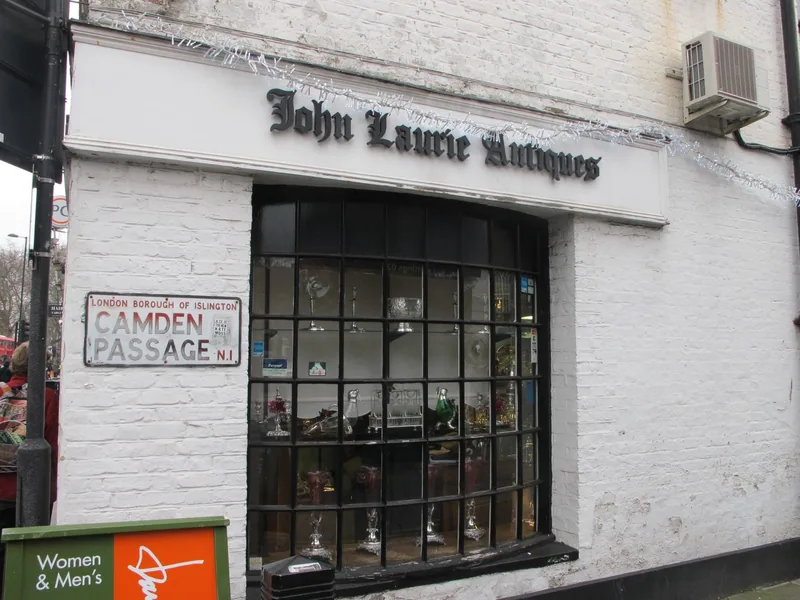
Camden Passage: the market that is also a street of shops
Camden Passage, in Islington, is a narrow pedestrian lane behind the Angel. It is not connected to Camden Town or to Camden Market, which confuses a lot of visitors. There are three small outdoor market areas along it, and a permanent row of dealers' shops and cafes that trade whether the stalls are out or not.
All three market areas run on Wednesday, Saturday and Sunday. On Friday only two of them open, Camden Passage Market and Pierrepont Arcade Market. Tuesday is the one day everything outdoors is shut. The mix leans towards small, portable things: silver, jewellery, prints, textiles, ceramics, vintage clothing and a strong showing of decorative pieces aimed at people furnishing London flats.
Camden Passage is the friendliest of the markets for a first visit, because the shops behind the stalls give you a price to compare against and nobody minds if you browse for an hour. Angel station is two minutes away. Our guide to Islington has more on the surrounding streets.
The indoor arcades: Alfies, Grays and the Silver Vaults
An arcade is a building full of separate dealers, each with a locked cabinet or a small unit. They keep shop hours, they are dry and warm, and the people behind the counters are specialists. If you want to learn what something costs before you risk money on a market stall, this is where to do it.
Alfies Antique Market on Church Street in Marylebone is the biggest indoor market in London: four floors of an art deco building with close to a hundred dealers, covering antique jewellery, vintage fashion, fine art, furniture, textiles, ceramics, glass and silver. It opens Tuesday to Saturday, 10am to 6pm, and closes on Sunday and Monday. The rooftop cafe is one of the more pleasant places to sit in Marylebone.
Grays Antique Market occupies two floors at 58 Davies Street, immediately beside Bond Street station, which makes it the easiest antiques stop to fit into a West End day. The stock is weighted towards fine jewellery, watches, Asian art and small decorative pieces, and prices run from a few hundred pounds into five figures. Check the current opening hours on the market's website before you go; they are not published on every page. Our guide to Bond Street and Mayfair puts it in context with the shops around it.
The London Silver Vaults are something else again: a set of underground strongrooms beneath Chancery Lane, with the entrance on Southampton Buildings, holding the largest collection of silver for sale anywhere. Some of the shops have been in the same family for three or four generations. They sell antique, modern and contemporary silver and silver plate from the 1600s onwards, plus jewellery and oddities such as enamel boxes and silver cutlery sets for twenty-four. Opening hours are Monday to Friday 9am to 5.20pm and Saturday 9am to 12.50pm, so a weekday is the only way to see it properly. It is free to walk in, and worth doing even if you are buying nothing, because there is nowhere else quite like it.
Kempton Park: where the dealers buy
Sunbury Antiques Market at Kempton Park Racecourse is where a good deal of the stock in London's shops comes from. It runs on the second and the last Tuesday of every month, from 6.30am to 2pm, with more than 700 traders spread across two indoor grandstands and a large outdoor area. Admission is £5 a head between 6.30am and 8am, and free after that (September 2026).
Getting there is simpler than it sounds. Kempton Park has its own station, about 200 yards from the North entrance, with two trains an hour from London Waterloo and Clapham Junction and a journey time of around 44 minutes. Contactless and Oyster do not reach that far out, so buy a train ticket; our guide to buying UK rail tickets explains the fare types, and a railcard you can buy as a visitor takes a third off the off-peak fare.
This is a buying market rather than a sightseeing one. It is outdoors in large part, it starts before dawn, and the sellers expect you to know roughly what you are looking at. Go if you are furnishing something or genuinely collecting. Skip it if you want a pleasant morning out.
Telling the genuine from the nearly genuine
Almost nothing at a London antiques market is an outright fake. The problem is subtler, and it comes in four recognisable forms.
- Reproduction. Made in the style of an earlier period, often honestly, often decades ago. A Victorian copy of a Georgian chair is a genuine Victorian chair, but it is not Georgian, and it is worth a fraction of one.
- Marriage. Two old pieces joined to make one saleable object: a period teapot with a replaced handle, a chest with a later top, a watch case with a different movement inside.
- Later decoration. Plain Georgian silver engraved or embossed in the nineteenth century to make it more decorative. It reduces the value sharply and is easy to miss.
- Restoration passed over in silence. Re-gilding, replaced veneer, re-cut glass, a repainted dial. Restoration is normal and acceptable; not being told about it is not.
The single most useful skill for a visitor is reading a British hallmark. Silver and gold sold in the UK must be hallmarked by an assay office, and a full hallmark tells you three things: who submitted it, how pure the metal is, and where it was tested. London's assay office mark is a leopard's head, and the Goldsmiths' Company Assay Office has been striking marks since 1300. It also runs a public "trace a hallmark" service, which is the quickest way to check something after you have photographed it. A piece described as "silver" with no hallmark at all deserves a direct question.
Ask that question plainly, in these words: how old is it, what has been replaced or repaired, and will you write that on the receipt? A dealer who is confident about a piece will answer all three without hesitation. Dealers belonging to the trade associations, LAPADA and BADA, display the badge on the stall and sign up to a code of practice, which is a reasonable shorthand at a market where you know nobody.
Anything containing elephant ivory is a legal trap. Under the Ivory Act 2018 it is an offence to buy or sell most items made of or containing ivory from listed species unless the item is registered or holds an exemption certificate. The maximum penalty is a £250,000 fine or up to five years in prison, and the law puts the duty on the buyer to check that the item is registered before taking ownership. If a stallholder cannot show you a registration, walk away.
Prices, haggling and paying
Haggling is expected at the outdoor markets and much less so in the arcades. The convention is simple: ask "what is your best price on this?" rather than naming a low number yourself. A discount of around ten per cent is normal on a marked price at a stall, more if you are buying several things from the same dealer, and very little on a piece the dealer knows is rare.
Cash still helps at Bermondsey and Kempton, where a note in hand is a real argument. Most dealers take cards, but a card payment removes the discount in some cases because the dealer pays a fee. Our guide to money and cards in London covers what your bank may add on top.
Always take a receipt with the dealer's name, address and a written description including the date or period. It is the only thing that gives you a claim later if the piece turns out to be something else, and it is what an insurer or a customs officer will want to see.
Getting it home
Visitors from outside the UK cannot claim a VAT refund on goods bought in a British shop and carried home, a rule that has applied since 2021 and that our page on tax-free shopping in the UK explains in full. Having the dealer ship the item abroad for you is the one route that can remove the VAT, and most established dealers will arrange it.
Shipping is also the sensible answer for anything heavier than a few kilograms. Arcade dealers usually have a packer they use; market stallholders often do not, so ask before you buy. For fragile pieces, insured courier shipping typically costs more than people expect, and it is better to know that before you commit.
Two practical points for the day itself. Antiques are awkward on public transport, and a mirror or a lamp base on a crowded Tube is a miserable experience; our notes on carrying bulky things on the Underground are worth two minutes. If you are shopping on your last day, the storage options in our guide to left luggage in London will take a parcel as readily as a suitcase.
Which market for what
| You are looking for | Go to | Day |
|---|---|---|
| Silver, cutlery and tableware | The London Silver Vaults | Monday to Saturday morning |
| Jewellery and watches at the top end | Grays, Mayfair | Weekdays |
| Furniture, lighting and interiors | Alfies, Marylebone, or Kempton Park | Tuesday to Saturday, or market Tuesdays |
| Small collectables and a cheap start | Bermondsey Square | Friday morning |
| Prints, textiles and decorative pieces | Camden Passage, Islington | Wednesday, Saturday, Sunday |
| Vintage clothing rather than antiques | See our vintage and second-hand guide | Varies |
If you have one morning and no plan, take Friday at Bermondsey and walk north over Tower Bridge afterwards. If you have a weekend, Camden Passage on Saturday followed by Portobello on the same day is a lot of walking but covers both ends of the trade. Sunday is thinner: Camden Passage runs, and Greenwich Market fills the rest of the day pleasantly enough without being antiques markets in any serious sense. The wider picture is in our overview of shopping in London, and the cheapest hunting ground of all is covered in our guide to London's charity shops.
Frequently asked questions
Which is the best antiques market in London?
For serious buying at trade prices, Bermondsey Square on a Friday morning and Sunbury Antiques Market at Kempton Park on market Tuesdays. For browsing in comfort with expert dealers on hand, Alfies in Marylebone and the London Silver Vaults. Portobello Road is the biggest and the busiest, but Saturday crowds make close inspection difficult.
Do I need cash at a London antiques market?
Most dealers now take cards, but not all outdoor stallholders do, and cash still helps when you are negotiating a price. Take some notes for Bermondsey and Kempton Park in particular, and expect the arcades in Mayfair and Marylebone to handle cards without any difficulty.
Can I get a VAT refund on antiques bought in London?
Not if you carry the item home yourself. Refunds of VAT on goods taken out of Great Britain by visitors ended in 2021. If the dealer ships the item directly to an address abroad, the sale can be zero-rated for VAT, so ask about shipping before you agree a price.
Is it rude to haggle in a London antiques market?
No, at the outdoor markets it is expected, as long as you are polite and specific. Ask the dealer for their best price rather than naming a figure far below the marked one. In the indoor arcades a small reduction is sometimes possible, but hard bargaining is not the custom there.
What time should I arrive at Bermondsey Antique Market?
The market opens at 6am and trade buyers arrive first, so the most unusual pieces are gone within the first hour or two. Arrive between 7am and 9am for the best combination of choice and daylight. Stalls start packing up from about midday and the market closes at 2pm.
Sources
- Bermondsey Antique Market - opening times (checked September 2026)
- Camden Passage, Islington - market opening times (checked September 2026)
- Alfies Antique Market - visitor information (checked September 2026)
- The London Silver Vaults - opening hours and shops (checked September 2026)
- Sunbury Antiques Market at Kempton Park - dates, admission and travel (checked September 2026)
- GOV.UK - Deal in items made of or containing ivory (checked September 2026)
- The Goldsmiths' Company Assay Office - hallmarking (checked September 2026)