
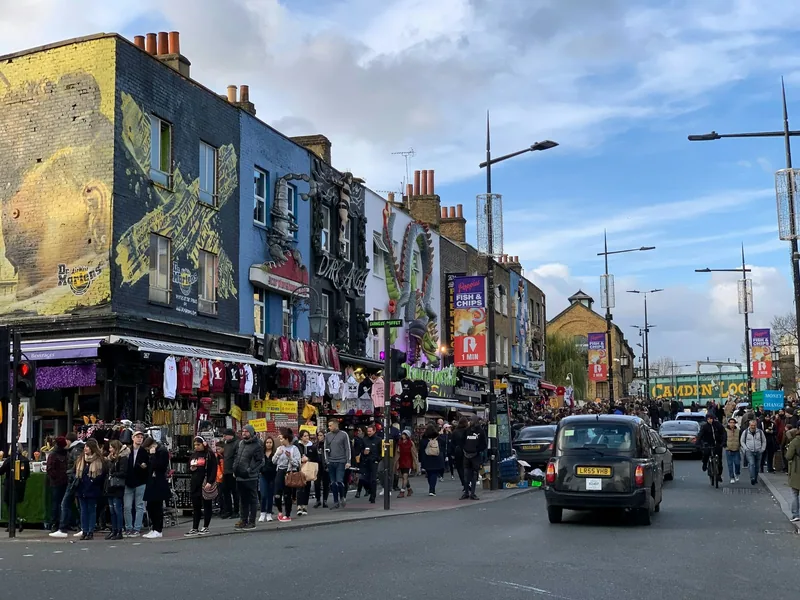
Camden Town is a loud, crowded and cheerful area of north London built around a cluster of markets on the Regent's Canal. Come for street food, alternative fashion, a canal walk and live music at night, and try to visit on a weekday morning if you want space to move.
Camden sits about three kilometres north of Oxford Street, just east of Regent's Park. For most visitors "Camden" means the stretch of Camden High Street and Chalk Farm Road between Camden Town Tube station and the canal bridge, plus the markets that spread out on either side of the water. It has been known since the 1970s for punk, goth and rock culture, and although the markets are now much more polished and food-focused, the area still looks and sounds different from central London.
It is not a place of grand buildings or museums. It is a place to walk, eat, browse and people-watch, and in the evening to hear a band. It suits teenagers, young adults and anyone curious about London's alternative side. It suits people who dislike crowds much less well, because on a sunny Saturday the pavements can be packed from the station to the lock.
Camden Town in brief
- Best for
- Street food, markets, alternative fashion, live music, canal walks
- Main stations
- Camden Town (Northern line), Chalk Farm (Northern line), Camden Road (Overground, Mildmay line)
- Camden Market hours
- Daily 10am-7pm, including bank holidays (individual traders vary)
- Tube fare from Oxford Circus
- £3.10 peak, £3.00 off-peak with contactless or Oyster
- Quietest time
- Weekday mornings
- Busiest time
- Saturday and Sunday afternoons, especially in summer
- Time needed
- Half a day for the markets and canal; an evening for music
How Camden's markets fit together
"Camden Market" is really several markets under one management, spread over a few blocks. First-time visitors often think they have seen it all after the first set of stalls near the station, but the larger areas are further north, around the canal. Walk up Camden High Street, cross the canal bridge, and the main areas open up on your left and right.
- Camden Lock. The original market beside the canal lock, with food stalls, small shops and seating by the water.
- The Stables. The biggest and most atmospheric part, in former horse stables and railway arches. This is where you find vintage clothing, furniture, jewellery and many of the food stalls. A bronze statue of the singer Amy Winehouse, who lived in Camden, stands here.
- Hawley Wharf. The newest section, on the opposite side of Chalk Farm Road, with food halls, shops and restaurants in modern buildings.
- Buck Street Market. A smaller market close to the Tube station, built from shipping containers.
According to Camden Market's own website, the market is open every day from 10am to 7pm, including bank holidays. Hawley Wharf's food halls stay open later, from 11.30am to 11pm, while its shops keep shorter hours. Individual stalls set their own times, so a few will open late or close early, especially on quiet weekdays. Check the official opening times and map before you go.
For more detail on stalls, what to buy and how prices compare, see our full guide to Camden Market itself. If second-hand clothing is your main interest, our round-up of vintage shopping across London puts Camden alongside Brick Lane and other areas.
Eating your way through Camden
Food is now the main reason many people come. The Stables and Camden Lock have dozens of street-food stalls covering cuisines from across the world, and Hawley Wharf adds sit-down places and food halls. Portions are generous, and a hot meal from a stall usually costs less than a restaurant meal in the West End, although it is no longer the bargain it once was. Most traders take cards and contactless payment.
Stallholders sometimes stand in the walkway and offer free samples to draw you in. There is no obligation to buy, and a polite "no, thank you" is fine. Seating is limited, so at busy times people eat standing up or on the canal-side steps.
There is a good choice of vegetarian and vegan food, and many stalls label their dishes clearly. Our guides to vegan and vegetarian eating in London and cheap meals around the city list more ideas if you want to compare Camden with other food markets.
Walk past the first food stalls before you choose. The stalls closest to the entrances catch the most passing trade and the longest queues. Take one full loop of the Stables before you decide: you will have seen far more choice, and you can come back to the place that looked best.
The Regent's Canal and Camden Lock
The Regent's Canal was built in the early 19th century to carry goods across north London to the Thames. Today it is used by narrowboats, walkers, runners and cyclists, and it is one of the best ways to see a quieter side of the city. Camden Lock, beside the market, is a working lock, and you can often watch boats being moved through it by hand.
From Camden you can follow the towpath in two directions. West, the canal curves through Regent's Park, past the edge of London Zoo, and on to Little Venice near Paddington. This walk takes about an hour at an easy pace. East, the towpath leads in about 25 to 30 minutes to King's Cross, with its redeveloped canal-side squares and restaurants.
The towpath is narrow in places and shared with cyclists. Keep to one side, listen for bells and step aside to let bikes pass. After dark some stretches are poorly lit and very quiet, so it is better to walk it in daylight.
Live music and nights out
Camden has been a centre of London's music scene for decades, and it is still one of the easiest places in the city to see a band on almost any night of the week. The venues range from large halls to small rooms above pubs.
- The Roundhouse on Chalk Farm Road is a former railway engine shed turned into a large circular performance space. It hosts concerts, theatre and circus.
- KOKO, a restored Victorian theatre near Mornington Crescent station, puts on concerts and club nights.
- The Electric Ballroom on Camden High Street is a long-running concert venue and club.
- The Jazz Cafe on Parkway programmes soul, jazz, funk and hip hop.
- Smaller pubs with back rooms or upstairs stages, such as the Dublin Castle on Parkway, put on up-and-coming bands, often for a few pounds.
Buy tickets from the venue's own website or its official ticket partner, and be wary of resale sites charging far above face value. For a wider view of where to hear music across the city, see our guide to London's live music venues, and for clubs and late bars our overview of nightlife by area.
Camden is lively on Friday and Saturday nights, with queues outside pubs and clubs and a lot of drinking on the street. Most of the time this is good-humoured, but it can get rowdy after the pubs close. The Northern line runs all night on Fridays and Saturdays as part of the Night Tube, which makes getting home straightforward.
Camden at different times of day
Camden changes a lot over a day and a week, and the time you choose shapes the whole visit.
| When | What it is like | Good for |
|---|---|---|
| Weekday, 10am-12 noon | Stalls are opening, walkways are clear, the canal is calm | Browsing, photos, families with buggies |
| Weekday afternoon | Steady but manageable crowds; school groups and tourists | Food and shopping at a normal pace |
| Saturday and Sunday, midday-5pm | Very crowded, especially in good weather; queues at popular stalls | Atmosphere, if you enjoy busy markets |
| Evenings | Market winds down after 7pm; pubs, bars and venues take over | Live music, drinks, dinner |
| Late on Friday and Saturday | Loud, busy and sometimes rowdy on the High Street | Nightlife; less pleasant for families |
Weekend afternoons are Camden at its most crushed. On a warm Saturday or Sunday the pavement from the Tube to the canal bridge can move at a shuffle, and the station itself gets very crowded. If you can only come at the weekend, arrive when the market opens at 10am and leave by lunchtime, or use Chalk Farm or Camden Road station instead of Camden Town.
Staying safe and avoiding hassle
Camden is generally safe during the day, but the dense crowds make it one of the places where pickpockets and phone snatchers operate. Keep your phone in a front pocket or a zipped bag when you are not using it, and be careful when you stop to take a photo on the canal bridge or in narrow market lanes.
You may be offered drugs on Camden High Street or near the canal, particularly in the evening. Ignore the offer and keep walking. Buying or carrying illegal drugs is a criminal offence in the UK. Our page on staying safe in London covers common scams and what to do if something is stolen.
Toilets are limited for the size of the crowds, and cafés and pubs will usually expect you to buy something before you use theirs. Our guide to finding a toilet in London explains the options.
Getting to Camden and getting around
Camden Town station is on both branches of the Northern line, so trains come from the West End (via Tottenham Court Road and Leicester Square) and from the City (via Bank and King's Cross). A pay-as-you-go journey from Oxford Circus to Camden Town costs £3.10 at peak times and £3.00 off-peak (fares from July 2026). Camden Town is in Zone 2 but is charged like Zone 1 on this journey, so check other journeys on TfL's single fare finder.
North of Camden Town the Northern line splits into two branches. Trains heading for Edgware call at Chalk Farm; trains heading for High Barnet do not. Check the front of the train or the platform display before you board. Camden Market's own site says the market is about five minutes' walk from Camden Town, ten from Chalk Farm and eight from Camden Road on the Overground.
Buses are a good alternative. The market's website lists route 24 from Victoria, 274 from the West End side and 214 from King's Cross. A bus fare is £1.75 (rising to £1.85 on 1 November 2026), and you can change buses free within an hour. Our guide to using London's buses explains how the Hopper fare works. From Regent's Park or King's Cross, walking is often the nicest option.
Nearby: Primrose Hill, Regent's Park and the zoo
Camden's noise is only a short walk from some of north London's calmest green spaces. Cross the railway bridge from Chalk Farm Road and you reach Primrose Hill, a grassy hill with a wide view south over the city skyline. It is a favourite spot for picnics and sunsets, and the streets around it are among the prettiest in the area.
Below it lies Regent's Park, with rose gardens, a boating lake and long tree-lined walks. Our guide to Regent's Park and Primrose Hill covers both. On the north side of the park, reachable along the canal in about 15 minutes from Camden Lock, is London Zoo, which makes Camden an easy half-day add-on to a family zoo visit.
Reasons to go
- Huge choice of street food in one place
- Vintage, alternative and one-off shopping
- Live music every night of the week
- Canal walks to King's Cross and Little Venice
- Free to wander, no ticket needed
Reasons to think twice
- Very crowded at weekends
- Some stalls sell the same mass-produced souvenirs
- Rowdy on Friday and Saturday nights
- Pickpockets in the crowds
- Few classic sights or museums
Is Camden a good place to stay?
Camden has hotels, hostels and short-let apartments, and it is well connected to both the West End and the City on the Northern line. It suits younger travellers and people who want nightlife on the doorstep. Light sleepers should avoid rooms facing Camden High Street, Chalk Farm Road or Parkway, where noise continues late at weekends. Quieter streets towards Primrose Hill or Mornington Crescent are a better choice for families.
Our overview of the best areas to base yourself in London compares Camden with central options such as Bloomsbury and with other lively areas like Shoreditch.
Frequently asked questions
What day is best to visit Camden Market?
A weekday is best if you want to browse comfortably, ideally between 10am and noon. The market is open every day, but Saturdays and Sundays bring the largest crowds, especially in summer. Come at the weekend only if you enjoy a busy atmosphere.
Is Camden Market free to enter?
Yes. There is no entry fee for any part of Camden Market. You only pay for what you buy, and you can walk through the Stables, Camden Lock, Hawley Wharf and Buck Street Market as often as you like.
How do I get from central London to Camden Town?
Take the Northern line to Camden Town, which is about 10 minutes from Leicester Square or King's Cross. From Oxford Circus the pay-as-you-go fare is £3.10 at peak times and £3.00 off-peak. Buses 24, 214 and 274 are cheaper alternatives.
Is Camden safe at night?
Camden is busy and generally safe in the evening, but it can be loud and rowdy around the pubs on Friday and Saturday nights. Stay on the main, well-lit streets, avoid the canal towpath after dark and keep your phone and wallet secure in crowds.
Can you walk from Camden to King's Cross along the canal?
Yes. The Regent's Canal towpath runs east from Camden Lock to King's Cross, a walk of about 25 to 30 minutes. It is flat and easy, but narrow in places and shared with cyclists, so it is best walked in daylight.
Sources
- Camden Market - Opening times and map (checked September 2026)
- Transport for London - Single fare finder (checked September 2026)
- Transport for London - Bus and tram fares (checked September 2026)
- Transport for London - Night Tube (checked September 2026)
- Mayor of London - MD3517 July 2026 fare changes (checked September 2026)