
The Northern line is the black one, and it is the only Underground line with two separate routes through the middle of London: one through Charing Cross and the West End, one through Bank and the City. It has 52 stations, five ends, and a single station in the north where all of it comes together. Learn to read the platform indicator at Camden Town and the line is easy. Ignore it and you will end up somewhere you did not intend.
Nothing else on the map works like this. Every other line is one route with branches at the edges; the Northern is two routes that share both ends. The fares, the map and the etiquette are in our guide to the Underground. This page is about the shape of the line, what the trains are like, where the long walks are, and what it actually costs you when you board the wrong one.
The Northern line in brief
- Colour on the map
- Black
- Stations
- 52
- Northern ends
- Edgware (Zone 5), High Barnet (Zone 5) and Mill Hill East (Zone 4)
- Southern ends
- Morden (Zone 4) and Battersea Power Station (Zone 1)
- Two central routes
- Via Charing Cross and via Bank
- Air conditioning
- None, and no announced replacement date (September 2026)
- Step-free from street to platform
- 19 of 52 stations, two of them in one direction only
- Night Tube
- Friday and Saturday nights, via Charing Cross only
How to read a Northern line platform indicator
Every indicator on the line gives you two pieces of information, and you need both. The first is the terminus: Edgware, High Barnet, Mill Hill East, Morden or Battersea Power Station. The second is the central route, printed as "via Charing X" or "via Bank".
Going north from the centre, the terminus is what matters, because the branches split at Camden Town. Going south from north London, the route is what matters, because the two halves of central London are served by different trains. A southbound train from Camden Town signed "Morden via Charing X" calls at Euston, Warren Street, Goodge Street, Tottenham Court Road, Leicester Square, Charing Cross, Embankment and Waterloo. One signed "via Bank" calls at Euston, King's Cross St Pancras, Angel, Old Street, Moorgate, Bank, London Bridge and Borough. They meet again at Kennington.
The usual pairing is that Edgware trains run via Charing Cross and High Barnet trains run via Bank, but it is not a rule and it changes through the day. Read the indicator, not the habit.
Euston is the one station where both routes call, with different platforms for each. If you are not sure which route you want, get to Euston or Camden Town and look at the indicators there rather than guessing at a station further out. Both are busy enough that the next train on either route is usually two or three minutes away.
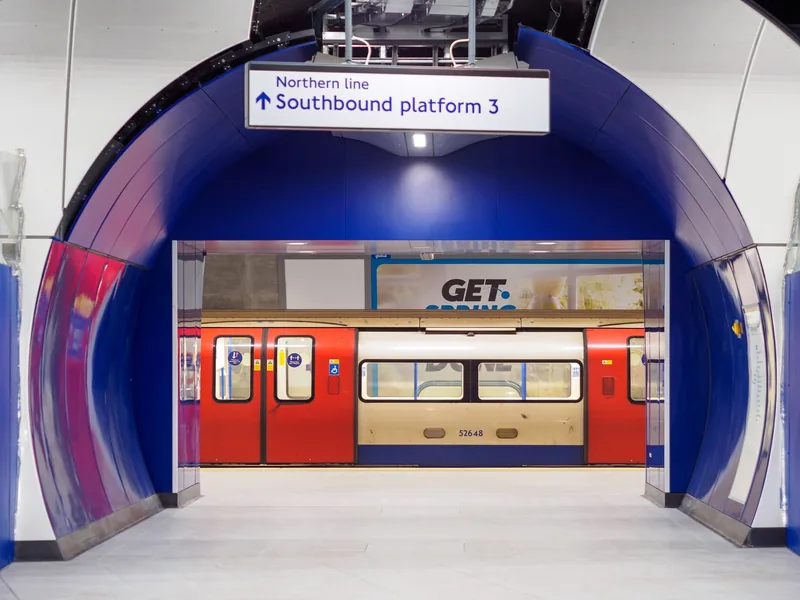
Photo: Prateek Karandikar · CC BY-SA 4.0 · Wikimedia Commons · resized
What the wrong train actually costs
The honest answer depends on which mistake you make, and it is usually less than people fear.
Getting the wrong northern branch is cheap. The branches separate after Camden Town, so if you wanted Chalk Farm and you are on a High Barnet train, you get off at Kentish Town, come back one stop and wait. Ten minutes, and you will feel silly.
Getting the wrong central route is the expensive one. If you wanted Charing Cross and the train took you to Bank, TfL's journey planner puts Bank to Charing Cross at about 13 minutes with a change, using the Waterloo & City line and then the Northern line back. At a weekend it is worse, because the Waterloo & City line does not run at all on Saturday or Sunday, and you are walking or taking the Central and Bakerloo lines instead. Add the wait at each end and the mistake costs twenty minutes rather than half an hour, but it is the one worth avoiding.
Where each end of the line puts you, and what that means when you are choosing a hotel, is worked through in our guide to staying in Camden and north London.
The trains, and the temperature
The Northern line runs a fleet delivered in the mid-1990s, upgraded with automatic train operation in 2014. The carriages have no walk-through gangways, no next-station screens and narrow doorways, and the tunnels here are among the tightest on the network, which is why the trains feel smaller than the ones on the Circle or District.
It is the fourth hottest line by TfL's own platform temperature data: an average of 28.8 °C during the evening peak in August 2024, behind the Victoria, Central and Bakerloo lines. There is no air conditioning and no announced date for a new fleet, which our page on air conditioning on the Tube sets out in full.
The one genuinely modern stretch is the newest: Nine Elms and Battersea Power Station opened in 2021 as a two-station extension from Kennington, with wide platforms and lifts from street to train. If you want to know what a twenty-first-century Tube station feels like, ride one stop past Kennington; the building at the end of it is covered in our guide to Battersea Power Station.
Two interchanges to allow extra time for
London Bridge is the one that catches people. TfL's own step-free interchange data measures the accessible route from the Northern line platforms to the Jubilee line platforms at 410 metres, which is the longest single step-free interchange it publishes anywhere on the network. On foot by escalator it is shorter but still a walk, and on top of that you have the main-line concourse above you; the building itself is in our guide to London Bridge station.
Bank is the other. The Northern line platforms sit inside a complex that also holds the Central, Waterloo & City and DLR platforms plus a long passage to Monument, and a change here can take longer than the Tube journey either side of it. The Northern line platforms at Bank were rebuilt in 2022 with a new southbound tunnel and a much wider concourse, so it is better than it was, but it is still the place to allow ten minutes.
Two changes go the other way and are easier than they look. At Euston the Bank-branch Northern platforms and the Victoria line platforms are at the same level with a level path between them, so it is a cross-platform change in both directions. The same is true at Stockwell. Both are useful if you are heading for the Victoria line, and both are faster than the map suggests.
Step-free access, including the station that only works one way
Working from TfL's detailed station data, 19 of the 52 stations have a step-free route from the street to a platform. In the central section that means King's Cross St Pancras, Moorgate, Bank, London Bridge, Tottenham Court Road, Nine Elms and Battersea Power Station, with Elephant & Castle and Borough part of the way there.
Those two are the interesting ones. At Elephant & Castle two lifts run from the southern booking hall to the southbound platform only, so you can get a step-free train towards Morden but not towards the City. At Borough it is the other way round: the northbound platform is reachable and the southbound is not. Neither is a lift failure; it is how the stations were built, and TfL's own data records it.
Euston, Waterloo, Charing Cross, Embankment, Leicester Square, Angel, Old Street, Camden Town, Kennington, Goodge Street and Warren Street all have stairs somewhere in the route. Camden Town is the one visitors feel most, because it is the station for the market; the alternatives on a market day are in our guide to Camden Town.
Further out the line is better: Colindale, Edgware, Finchley Central, Golders Green, Hendon Central, High Barnet, Mill Hill East, Morden, West Finchley and Woodside Park are step-free. Work to add Burnt Oak, on the Edgware branch, started on 24 August 2026 and runs to early 2028, with a new footbridge and lift; TfL says the station stays open for most of that but will close for about two weeks before the end of 2026. Elephant & Castle is also being rebuilt, with new passenger tunnels being dug from 2026 to late 2027 and a new entrance that will eventually give step-free access from the street to both platforms. How assistance works without booking is in our guide to step-free and accessible transport in London.
A lift symbol at Elephant & Castle does not mean you can travel in both directions. If you need a step-free route northbound from there, plan on King's Cross St Pancras, Moorgate or Bank instead, or ask staff at the gateline to sort the route out before you go down.
Weekends, and the Mill Hill East problem
Weekend closures on the Northern line usually hit one branch rather than the whole line, and the branch most often affected is the shortest. Mill Hill East is a single-track spur from Finchley Central with its own shuttle for much of the week, and when work is on it is the first thing to go.
Saturday and Sunday service across the line is also thinner. TfL's timetable data for Camden Town shows about 20 trains an hour on each route through the day at weekends against 24 at weekday peaks, and Camden on a Saturday is the single busiest place on the line. What that does to the station, and how to avoid it, is in our Camden guide above.
Check the Friday status rather than the Saturday morning one, on TfL's live status page. The first and last trains for each branch vary by up to half an hour, and the actual times are in first and last Tube trains.
Night Tube: the Bank branch sleeps
On Friday and Saturday nights the Northern line runs all night from Morden to Edgware and from Morden to High Barnet, and only via Charing Cross. There is no night service through Bank, none on the Battersea branch and none to Mill Hill East.
For a night out in the West End this is exactly the right half of the line: Leicester Square, Tottenham Court Road, Euston and Camden Town all stay open. If your hotel is at Angel, Old Street, Bank or London Bridge, the Northern line will not bring you home and you want a night bus or the Central line instead. Our guide to the Night Tube has the other lines, and the Jubilee line runs all night along its whole length if you are heading south-east.
The journey the line is really for: the West End to open country in a quarter of an hour
Forget the branches for a moment. The Northern line does something no other line does: it climbs out of the West End straight into the high ground of north London. Tottenham Court Road to Hampstead takes about 14 minutes on TfL's journey planner, and Tottenham Court Road to Highgate about 16.
From Hampstead station you are three minutes from the edge of Hampstead Heath, which is eight hundred acres of rough grass and woodland with the best free view in London from Parliament Hill. Hampstead is also the deepest station on the Underground, and the lifts are the practical way up rather than the emergency spiral staircase beside them. The village at the top is covered in our guide to Hampstead, and the other end of the ridge in Highgate and Crouch End.
Going the other way, the line is the reason the far south-west of London is reachable at all: Tooting, Balham, Colliers Wood and Morden are Northern line stations, and Morden is where the deep Tube surfaces at a 1926 station that was designed as the end of the line and still is. The southern end of the line and the areas around it are in our guides to Tooting and Elephant and Castle.
| From Tottenham Court Road | Journey time | What is at the other end |
|---|---|---|
| Camden Town | About 8 minutes | Camden Market and the canal |
| Hampstead | About 14 minutes | The Heath and Parliament Hill |
| Highgate | About 16 minutes | Highgate Wood and the cemetery |
| Waterloo | About 6 minutes, via Charing Cross | The South Bank |
| London Bridge | About 9 minutes, via Bank | Borough Market and the Shard |
Frequently asked questions
What is the difference between the Northern line via Bank and via Charing Cross?
They are two separate routes through central London that share the same line either side. Via Charing Cross calls at Euston, Warren Street, Goodge Street, Tottenham Court Road, Leicester Square, Charing Cross, Embankment and Waterloo. Via Bank calls at Euston, King's Cross St Pancras, Angel, Old Street, Moorgate, Bank, London Bridge and Borough. The routes rejoin at Kennington in the south and at Euston and Camden Town in the north.
How much time does it cost if I take the wrong Northern line train?
On the northern branches, about ten minutes: get off at the first station after Camden Town, come back one stop and wait. On the central routes it is worse. Bank to Charing Cross takes about 13 minutes with a change, and at weekends the Waterloo & City line that makes that change quick does not run at all.
Which Northern line stations are step-free?
Nineteen of fifty-two in TfL's station data. In the centre these are King's Cross St Pancras, Moorgate, Bank, London Bridge, Tottenham Court Road, Nine Elms and Battersea Power Station. Elephant & Castle is step-free to the southbound platform only and Borough to the northbound platform only. Euston, Waterloo, Charing Cross, Leicester Square, Angel, Old Street and Camden Town are not step-free.
Does the Northern line run all night?
On Friday and Saturday nights only, from Morden to Edgware and from Morden to High Barnet, and only via Charing Cross. The Bank branch, the Battersea Power Station branch and the Mill Hill East spur have no night service. Night fares are charged at the off-peak rate and count towards the daily cap.
Which Northern line station is closest to Hampstead Heath?
Hampstead, on the Edgware branch, which is about three minutes' walk from the western edge of the Heath and about 14 minutes from Tottenham Court Road. For Parliament Hill and the swimming ponds, the Overground station at Hampstead Heath is closer. Hampstead is the deepest station on the Underground and has lifts rather than escalators.
Sources
- Transport for London - Stations, platforms, lifts and step-free interchange data (feed of 3 August 2026) (checked September 2026)
- Transport for London - Northern line route and branch data (checked September 2026)
- Transport for London - Burnt Oak station step-free access (checked September 2026)
- Transport for London - Elephant & Castle station (checked September 2026)
- Transport for London - The Night Tube (checked September 2026)
- London Datastore - London Underground average monthly temperatures (checked September 2026)
- Transport for London - Step-free access (checked September 2026)