
Borough for lunch, Camden for shopping. Borough Market sells food and almost nothing else; Camden Market sells clothes, records, jewellery and gifts, with street food alongside. But one Northern line train links them in about 14 minutes, so for a lot of visitors this is not a choice at all.
The two are London's best-known markets and they are often put side by side, which makes them sound like alternatives. They are not really competing. One is a food market with a thousand years of history behind it, tucked under railway arches by London Bridge. The other is a sprawl of stalls and units beside a canal in north London that grew out of a crafts fair in 1974.
Our full guides to Borough Market and Camden Market cover each one in detail. This page is about deciding between them when you have one morning.
The deciding facts
- Borough Market opening
- Six days a week: shut Mondays, 10:00 to 17:00 midweek, from 09:00 on Saturdays, and 10:00 to 16:00 on Sundays
- Camden Market opening
- Seven days, 10:00 to 19:00, bank holidays included; Christmas Day is the only closure
- Entry
- Free at both
- Between them
- Camden Town to London Bridge, Northern line, about 14 minutes with no change
- Borough sells
- Produce, cheese, bread, fish, meat, and street food to eat on the spot
- Camden sells
- Alternative and vintage clothing, records, jewellery, gifts, and street food
- Worst time at both
- Saturday afternoon
Monday and Sunday decide it for you
Before you weigh up atmosphere, look at the calendar. Two days of the week make the decision themselves.
On a Monday, go to Camden. Borough shuts on Mondays for eleven months out of twelve; December is the exception, when it trades daily apart from the Christmas break. Turn up on a Monday in June and you get shutters, with only the permanent restaurants and shops at the market's edges still open. Camden trades on every day of the year bar Christmas Day.
On a Sunday afternoon, go to Camden as well, but for a different reason. Borough closes at 16:00 on Sundays, an hour earlier than the rest of the week, and the good stalls thin out before that. Camden runs to 19:00 every day, and the Hawley Wharf food halls stay open until 23:00.
There is one more timing trap. Camden's Hawley Wharf retail units do not keep the same hours as the rest of the market: they open at 12:00 from Monday to Wednesday, 11:00 on Thursday to Saturday, and 11:00 on Sunday. A 10:00 arrival gets you the Stables and Camden Lock but not everything.
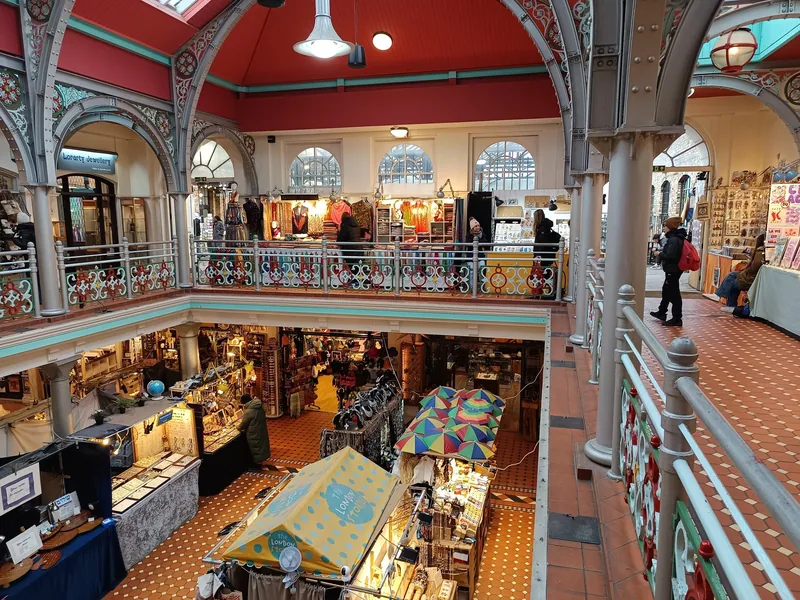
Photo: Fry72 · CC BY-SA 4.0 · Wikimedia Commons · resized
Lunch: what each one actually costs
Both markets are priced for visitors rather than for weekly shopping, and both are more expensive than a supermarket meal deal. The difference is what you get for the money.
At Borough, a street-food main from a stall is a proper lunch, and the produce stalls let you assemble a picnic of bread, cheese and fruit for less than a cooked plate costs. Many stalls hand out samples, which is a real saving if you are grazing rather than eating one meal. There is free seating in the market and the churchyard next door, and the toilets are free.
At Camden, the street food is cheaper per portion and more international, and the Hawley Wharf food halls are the part that stays open into the evening. What Camden does not have is Borough's produce: you cannot do your shopping there.
Prices at both change constantly and we do not print stall prices that will be wrong by next season. Our guide to eating cheaply in London gives the benchmarks, and London's food markets compares both with the smaller ones that Londoners actually use.
Borough's samples are a lunch strategy, not a trick. Cheese, charcuterie, olives and bread counters expect you to taste before you buy, and a slow circuit of the produce stalls before you commit to one hot dish is the way regulars use the market. Buy something from at least one of the stalls you taste at; that is the deal.
Shopping: only one of them sells things
If your plan involves bringing something home that is not edible, Camden is the only answer of the two. Borough has excellent food shops, a few kitchen and cookware traders and not much else.
Camden's strength is second-hand and alternative clothing, boots, band T-shirts, records, silver jewellery and the kind of gift that is difficult to find in a shopping centre. Quality varies enormously between units, and the tourist-facing stalls near the Tube station sell the same souvenirs as everywhere else in London. The better material is deeper in, in the Stables and the upper levels of the Lock.
Bargaining is accepted at Camden on second-hand items and at market stalls, and not at Borough, where prices are set by the trader and the produce is not negotiable. Our guides to vintage and second-hand shopping and London's record shops name the places that beat Camden at its own game, mostly in the east. At the opposite end of the scale, our comparison of Harrods and Selfridges covers the two stores most visitors put on the same list.
The weekend problem, and the hours that fix it
Both markets are unpleasant on a Saturday afternoon. Borough's aisles are narrow and the crush between about 12:30 and 15:00 makes it hard to see a stall, let alone order from one. Camden's bottleneck is different: the pavement between Camden Town station and the Lock is the busiest stretch, and at weekends it moves at a shuffle.
| When | Borough | Camden |
|---|---|---|
| Weekday before 12:00 | The best time; traders have time to talk | Quiet, but Hawley Wharf shops are still shut |
| Weekday 12:00-14:00 | Office lunch rush; queues at hot stalls | Comfortable |
| Weekday after 15:00 | Calm again, some stalls packing up | Good; food halls open into the evening |
| Saturday | The worst day, from late morning | Very busy all day |
| Sunday | Shorter hours, closes 16:00 | Busy, but the market runs to 19:00 |
| Monday | Closed, except in December | Open, and the quietest day of the week |
The practical conclusion is that a Tuesday or Wednesday morning at Borough is a different market from a Saturday at Borough, and if your only option is Saturday you may prefer Camden, where the crowd is part of the point rather than an obstacle.
With children, and in the rain
Camden is the better family visit, mainly because children can look at things without anyone worrying about a cheese counter being knocked over. It also has more to occupy a bored teenager, and the canal and the lock are worth a stop on their own.
Borough is harder work with a pushchair. The aisles are narrow, the surface is uneven in places and the crowd does not part. Come early or not at all.
For rain, Borough wins clearly. Most of it sits under the railway viaducts and a market roof, so you can spend an hour there in heavy rain and stay dry. Camden is largely outdoors, with the Stables and the food halls as the covered exceptions. Our page on what to do when it rains in London has more indoor options near both.
Getting there, and doing both in one day
Borough Market is at 8 Southwark Street, SE1 1TL, beside London Bridge station, which is on the Jubilee and Northern lines and is a National Rail terminus. Camden Market is a five-minute walk from Camden Town on the Northern line, eight minutes from Camden Road on the Overground and ten minutes from Chalk Farm.
The two sit on the same Tube line. A Northern line train via the Bank branch runs from Camden Town to London Bridge in about 14 minutes with no change, which TfL's journey planner confirmed in September 2026. A single Tube fare between them was £3.10 with contactless and £3.00 with Oyster at the time of writing, and both markets are free to enter.
If you want both, do Camden first thing, take the Northern line south before noon, and eat at Borough. That order works because Camden is at its best early and Borough is at its best before the lunch rush is over, and it leaves you on the south bank in the afternoon within walking distance of Tate Modern and Tower Bridge. Our guide to using the Underground explains the Northern line's two branches, which is the one thing to get right here.
What each does badly
Borough's weakness is that it has become a destination, and the prices reflect it. Some of the produce is exceptional and some of it is ordinary food with a Borough markup. It is also small: an hour covers it comfortably, and people who allow half a day end up in the surrounding restaurants instead.
Camden's weakness is the first hundred metres. The stretch by the station sells mass-produced souvenirs and phone cases to people who never get any further, and a visitor who turns round there goes home thinking Camden is a tourist trap. Walk past it. The market properly begins at the canal.
Both have a general problem with dietary requirements at stalls, where staff turnover is high and ingredient lists are not always written down. Our guide to food allergies and eating out in Britain explains what you are entitled to ask and what a stall must tell you.
Bring a card and a little cash to both. Nearly every trader at both markets takes contactless now, but stalls do occasionally lose signal, and a queue is a bad place to discover it. Our page on how much cash to bring to London suggests a sensible amount for a trip.
If neither is quite right
The honest answer for some visitors is a third market. If you want Borough's food without Borough's crowd, Maltby Street in Bermondsey is about fifteen minutes' walk away, though it trades only on Friday evenings and at weekends. If you want Camden's clothes without Camden's crush, the east London markets around Brick Lane and Spitalfields carry the same trade with more room, covered in our guide to Spitalfields and Brick Lane. And if you want a market that Londoners use rather than visit, Greenwich and Portobello both do it better on the right day; see Greenwich Market and Portobello Road.
Whichever you pick, leave your luggage somewhere first if you are travelling that day. Neither market is possible with a suitcase; our guide to left luggage at London's stations has the London Bridge and King's Cross options.
Frequently asked questions
Is Camden Market or Borough Market better?
Borough Market is better if you want to eat, taste and buy food; Borough has produce stalls and street food and almost nothing else. Camden Market is better if you want to shop for clothes, records, jewellery or gifts. If the day is a Monday, the question answers itself, because Borough Market is closed on Mondays outside December.
How far is Camden Market from Borough Market?
About 14 minutes apart by Tube. A Northern line train via the Bank branch runs from Camden Town to London Bridge without a change, and Borough Market is beside that station. A single adult fare was £3.10 with contactless or £3.00 with Oyster in September 2026; check the current fare with TfL's single fare finder.
What is the best day to visit Borough Market?
A weekday morning, ideally Tuesday to Thursday before 12:00. The market is open Tuesday to Friday from 10:00 to 17:00, Saturday from 09:00 and Sunday from 10:00 to 16:00. Saturday afternoon is the most crowded period of the week and the hardest time to see a stall properly.
Is Camden Market open on Mondays?
Yes. Camden Market is open every day from 10:00 to 19:00, including bank holidays, and closes only on Christmas Day. Monday is usually its quietest day. Note that the retail units at Hawley Wharf open later, from 12:00 on Monday to Wednesday, while the food halls there run from 11:30 until 23:00.
Can you visit both Camden Market and Borough Market in one day?
Comfortably. Start at Camden when it opens at 10:00, allow about two hours, then take the Northern line south to London Bridge and eat at Borough before the lunch crowd clears. That leaves the afternoon free on the south bank, which is walking distance from Tate Modern, Southwark Cathedral and Tower Bridge.
Sources
- Borough Market - Plan your visit and opening times (checked September 2026)
- Borough Market - Changes to opening hours (checked September 2026)
- Camden Market - Opening times and map (checked September 2026)
- Transport for London - Plan a journey (checked September 2026)
- Transport for London - Single fare finder (checked September 2026)