
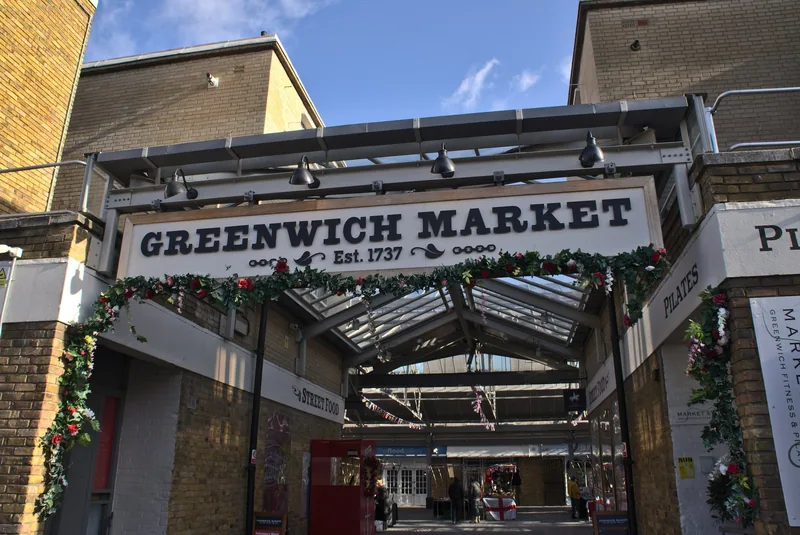
Greenwich Market is a covered market in the centre of Greenwich, south-east London, with more than 120 shops and stalls selling crafts, art, antiques and street food. It is free to enter and open every day from 10:00 to 17:30, and it fits neatly into a day spent at the Cutty Sark, the Royal Observatory and Greenwich Park.
Think of it as a small, walkable market square rather than a huge shopping destination. The main hall sits under a glazed roof from the early 1900s, with permanent shops, cafés and pubs around its edges and cobbled lanes leading in from four streets. On different days of the week the stalls change: some days lean towards arts and crafts, others towards antiques and collectables.
Most visitors come because they are already in Greenwich for the museums and the river, and the market is only a few minutes' walk from all of them. It is at its best when you want to browse, eat lunch and pick up a gift made by the person selling it, rather than hunt for bargains.
Greenwich Market in brief
- Opening hours
- Daily 10:00-17:30, including bank holidays
- Closed
- Christmas Day and the first six Mondays of the year
- Entry
- Free
- Arts and crafts days
- Monday, Wednesday, Friday, Saturday and Sunday
- Antiques and collectables days
- Tuesday, Thursday and Friday
- Street food
- Cutty Sark Street Food Market, Friday to Sunday (2026 season until 29 November)
- Payment
- The market says all shops and stalls accept credit and debit cards
- Nearest station
- Cutty Sark for Maritime Greenwich (DLR), across the road
- Address
- Greenwich Market, London SE10 9HZ
What you can buy at Greenwich Market
The market describes its mix as arts, crafts, fashion, antiques, jewellery and handmade gifts, and that matches what you find on a typical visit. Many traders make what they sell. You will see ceramics, prints and photography of London, knitwear, leather goods, candles and soaps, children's clothes, glasswork and small pieces of jewellery. Because makers stand behind their own tables, you can ask how something was made, and many are happy to talk about it.
Around the hall are permanent shops that open whatever the stall day. They include clothing and accessory boutiques, a gallery or two, sweet shops, cafés and places to eat. These give the market a steady base, so even on a quieter weekday there is enough to fill an hour.
Prices are those of a craft market, not a discount market. A hand-thrown mug or an original print will cost more than a mass-produced souvenir from a stall near Westminster, and that is the point: you are paying for something made in small numbers, often locally. If you want ideas for gifts that are worth the money, our guide to London souvenirs worth buying covers the wider picture, including cheaper options.
Crafts days and antiques days: when to go
The day you choose changes what you see. According to the market, the Arts and Crafts Market runs on Mondays, Wednesdays, Fridays and at weekends, while the Antiques and Collectables Market runs on Tuesdays, Thursdays and Fridays. Friday is the only day that officially combines both, which makes it a good choice if you want variety without the weekend crowds.
| Day | Main stall theme | Street food in Cutty Sark Gardens |
|---|---|---|
| Monday | Arts and crafts (closed on the first six Mondays of the year) | No |
| Tuesday | Antiques and collectables | No |
| Wednesday | Arts and crafts | No |
| Thursday | Antiques and collectables | No |
| Friday | Arts and crafts, plus antiques and collectables | Yes |
| Saturday | Arts and crafts | Yes |
| Sunday | Arts and crafts | Yes |
Weekends are the liveliest and the most crowded. The market itself warns that some areas become crowded at peak times on weekends, which matters if you are pushing a buggy or using a wheelchair. For a calmer browse, arrive soon after 10:00 or come on a weekday.
Traders change over time and individual stalls do not appear every week. If you are going for one particular maker, check the stall guide on the market's website, which can be filtered by day, before you travel.
Collectors should aim for Tuesday, Thursday or Friday. The antiques and collectables stalls are not there at weekends, so a Saturday visit will show you crafts and food but very little in the way of old maps, coins, vintage cameras or second-hand books.
Antiques, vintage and collectables
On antiques days the stalls fill with smaller items that fit in a suitcase: vintage jewellery, silverware, old postcards and prints, glass, toys, militaria, cameras and curios. The market says its dedicated antiques and vintage section also covers furniture and artwork, but for most visitors the realistic buys are small pieces.
Prices are set by each trader, and there is no official price list. Polite questions about age, origin and condition are normal, and so is asking whether a trader can do a better price if you are buying several items. Check the item carefully before paying, because a market sale is not the same as buying from a shop with a returns desk.
If old clothes and second-hand finds are your main interest, Greenwich is only one stop. Our guide to vintage and second-hand shopping in London is the place to start, and Portobello Road in Notting Hill remains the bigger antiques market, especially on Saturdays.
Street food and places to eat
Food is a large part of the appeal. Inside and around the main hall you will find food stalls and small counters with dishes from many parts of the world, as well as sweet stalls, bakeries and cafés. The market's own FAQ mentions Asian, Mediterranean, African and European food, with vegetarian and vegan options.
From Friday to Sunday there is also the Cutty Sark Street Food Market, a separate open-air group of stalls in Cutty Sark Gardens by the river. The market lists its 2026 season as running until 29 November, with longer hours at weekends than on Fridays. Stalls rotate, so do not expect the same trader every time.
For a sit-down meal, the pubs and restaurants on the streets around the market are the obvious choice, and the riverside is close by if you want to eat on a bench with a view of the Thames. If markets are one of the main reasons for your trip, our round-up of London's food markets has the other big ones.
Eat before 12:30 at weekends. As at most London food markets, the stalls in and around the hall tend to be busiest around lunchtime on Saturdays and Sundays. An early lunch, or a late one after 14:00, usually means less waiting and a better chance of somewhere to sit.
A short history of the market
Trading in Greenwich goes back centuries. According to the market's own history, a Royal Charter granted in 1700 to the Commissioners of the Royal Hospital for Seamen allowed them to set up a properly regulated market, and Greenwich Market opened in 1737. At first it sold meat, fruit and vegetables.
The roof you see today dates from improvements made in 1902, when the old timber roof was replaced with glazed roofs on steel trusses. Those roofs were restored in 2016 and are part of the reason the market is Grade II listed. By the 1980s the market had shrunk to a weekly event and reinvented itself around antiques and arts and crafts, which is the character it has kept.
The market lies inside the Maritime Greenwich World Heritage Site, inscribed by UNESCO in 1997, alongside the Old Royal Naval College, the Queen's House, the Royal Observatory and Greenwich Park. It is one of the few London markets where the setting is as much of a draw as the stalls.
Getting to Greenwich Market
Greenwich is east of central London on the south bank of the Thames. You have four good options, and the boat is the most enjoyable if the weather is kind.
- DLR: Cutty Sark for Maritime Greenwich station is across the road from the market. The DLR connects with the Jubilee line and the Elizabeth line at Canary Wharf, and with the Tube at Bank. Tube fares and daily caps apply, and every DLR station is step-free. Our guide to the DLR and the Overground explains how it works.
- National Rail: trains run from London Bridge (and Cannon Street) to Greenwich station, about a 10-minute walk from the market. The market says the train from London Bridge takes about 8 minutes. Contactless and Oyster work on this route.
- River Bus: Uber Boat by Thames Clippers stops at Greenwich Pier, about five minutes' walk away, on the main RB1 route from Westminster, the London Eye and Tower. Contactless and Oyster are accepted, but river fares do not count towards your daily cap. See our guide to the Thames Clippers river bus before you board.
- Bus: the market lists routes 108, 129, 177, 188, 286 and 386 as stopping right outside. A single bus fare is £1.75 with contactless or Oyster (rising to £1.85 on 1 November 2026). With the Hopper fare, any further bus journeys within one hour of touching in cost nothing extra; our guide to London buses has more.
Driving is not a good idea. The roads around the town centre are busy and parking near the market is limited to pay-and-display car parks. The market itself recommends public transport.
Combining the market with a day in Greenwich
The market works best as part of a full day. A realistic plan starts at the river and ends on the hill.
In the morning, visit the Cutty Sark and the Royal Observatory. The Cutty Sark opens daily from 10:00 to 17:00 (last entry 16:15), and the Royal Observatory from 10:00 to 18:00 (last entry 17:00) until 2 November 2026, when it closes for a major transformation. Its Meridian Courtyard is due to reopen in summer 2027 and the rest of the site by spring 2028. The National Maritime Museum and the Queen's House are free to enter and open daily from 10:00 to 17:00; booking is recommended. Check current ticket prices for the paid sites on the Royal Museums Greenwich website.
Around midday, walk into the market for lunch and an hour of browsing. In the afternoon, climb through Greenwich Park to the Observatory for the view back over Canary Wharf and the City, or explore the rest of the town centre. Our Greenwich neighbourhood guide has more on the rest of the area, from the Old Royal Naval College to the park.
To make a loop of it, arrive by DLR and leave by boat, or the other way round. The river trip past Tower Bridge and the Docklands is one of the best-value views in London, and our page on Thames river cruises looks at the sightseeing boats as well. For something different on the way back, you could head to North Greenwich and cross the river on the IFS Cloud Cable Car.
Practical tips before you go
The market says all shops and stalls accept credit and debit cards, so you do not need to carry much cash. It is still worth having a card that works abroad without high fees; our guide to money and payments in London covers cards, cash and contactless.
There are no public toilets inside the market. The market points visitors to facilities in Greenwich Park and Cutty Sark Gardens, and some cafés have toilets for customers. Our page on public toilets in London explains where else to look.
The market is on one level and described by the operator as wheelchair accessible, though the cobbled lanes around it can be bumpy and the aisles get tight at weekends. Dogs on a lead are welcome in the market, although individual shops set their own rules.
The first six Mondays of the year are closed days. The market takes a break after Christmas, so a Monday visit in January or early February will find it shut. It is also closed on Christmas Day. At other times it opens daily, including on bank holidays.
How Greenwich compares with London's other markets
Greenwich is smaller and calmer than Camden Market, which is much larger, louder and more focused on street food and alternative fashion. It has more of a village feel than Old Spitalfields and Brick Lane in the East End, although Spitalfields is the closer comparison for handmade goods under a historic roof.
Choose Greenwich if you are already visiting the museums and want a relaxed browse with lunch. Choose Camden if you want energy and choice, and Portobello Road if antiques are the main goal. For food alone, Borough Market near London Bridge has the bigger range of produce and specialist traders.
Frequently asked questions
What days is Greenwich Market open?
Greenwich Market is open every day from 10:00 to 17:30, including bank holidays. It closes on Christmas Day and on the first six Mondays of the year, when traders take a break after the Christmas season.
Which day is best for antiques at Greenwich Market?
Go on a Tuesday, Thursday or Friday. Those are the Antiques and Collectables Market days. Friday also has arts and crafts stalls and the Cutty Sark street food, so it is the best all-round day if you can only visit once.
Is Greenwich Market free to visit?
Yes. There is no entry fee; you only pay for what you buy. The nearby National Maritime Museum and Queen's House are also free, while the Cutty Sark and the Royal Observatory charge for tickets.
Can I pay by card at Greenwich Market?
The market says that all of its shops and stalls accept credit and debit cards. Carrying a little cash does no harm, but you should not need it for most purchases, including food.
How do I get from central London to Greenwich Market?
The quickest options are the DLR to Cutty Sark for Maritime Greenwich, which is across the road, or a train from London Bridge to Greenwich. The Uber Boat river bus to Greenwich Pier is slower but far more scenic.
Sources
- Greenwich Market - Visit us: opening times and getting here (checked September 2026)
- Greenwich Market - Frequently asked questions (checked September 2026)
- Greenwich Market - Our story (checked September 2026)
- Royal Museums Greenwich - Plan your visit (checked September 2026)
- Transport for London - About the River Bus (checked September 2026)
- Transport for London - Bus and tram fares (checked September 2026)