
Borough Market is London's best-known food market, right next to London Bridge station in Southwark. It is free to enter and open six days a week (closed on Mondays except in December), and the easiest way to enjoy it is to come on a weekday morning, graze from several stalls and leave before the Saturday afternoon crush.
The market is a mix of three things: stalls selling produce such as cheese, bread, meat, fish, fruit and vegetables; street-food traders cooking meals to eat on the spot; and restaurants, bars and shops around the edges. Some people come to do their weekly shopping. Most visitors come for lunch, a coffee and a slow walk past the stalls.
Borough Market is run by a charitable trust with a board of volunteer trustees. It has around 1,000 years of history, and it has stood on its present site, under and around the railway viaducts south of London Bridge, since 1756.
Borough Market at a glance
- Address
- 8 Southwark Street, London SE1 1TL
- Entry
- Free and open to everyone
- Opening hours
- Closed Monday; Tuesday to Friday 10:00-17:00; Saturday 09:00-17:00; Sunday 10:00-16:00
- December
- Open seven days a week, with changes around Christmas
- Nearest station
- London Bridge (Jubilee and Northern lines, National Rail)
- Busiest time
- Saturday afternoons
- Toilets
- Free, including accessible toilets, during trading hours
Opening days and hours for 2026
According to the market's website (checked 18 September 2026), Borough Market is closed on Mondays and open from 10:00 to 17:00 Tuesday to Friday, 09:00 to 17:00 on Saturday and 10:00 to 16:00 on Sunday. Sunday opening is fairly new: the market began opening on Sundays in 2021.
The market says that not all traders are present every day, but there is still plenty of choice throughout the week. If you have your heart set on one particular stall, check its days on the market's trader directory before you go.
Hours change around bank holidays and in December. In 2026 the market opened from 10:00 to 17:00 on the Monday bank holidays in May and August. From Monday 30 November it opens seven days a week for Christmas shopping, with these exceptions announced for the 2026 festive period:
| Date | Opening |
|---|---|
| Mondays to Fridays in December | 10:00-17:00 |
| Wednesday 23 December | 10:00-18:00 |
| Christmas Eve (Thursday 24 December) | 08:00-15:00 |
| Christmas Day, Boxing Day, Sunday 27 December | Closed |
| Thursday 31 December | 10:00-15:00 |
| New Year's Day 2027 | Closed |
Normal hours return on Saturday 2 January 2027. The market notes that hours may still change, so check its website before a special trip. Our guide to Christmas in London covers the rest of the festive season.
How the market is laid out
Borough Market is not one big hall but a cluster of covered spaces, open lanes and railway arches. The market describes three main areas:
- Three Crown Square: larger producers and merchants, including many of the fruit, vegetable, meat and cheese stalls.
- Green Market: small, specialist produce traders.
- Borough Market Kitchen: the street-food traders, with dishes to eat straight away.
Around these areas are restaurants, bars and shops, some of them in the old buildings along Stoney Street and Park Street. The Borough Market Store, just inside the main entrance, is the place to ask for information. The market publishes a map on its website, which is worth a quick look because the lanes can be confusing the first time.
What to eat and buy
We are not going to name one stall as the place to eat, because traders change and much of the pleasure is finding your own favourite. Instead, here is what the market is known for and how to approach it.
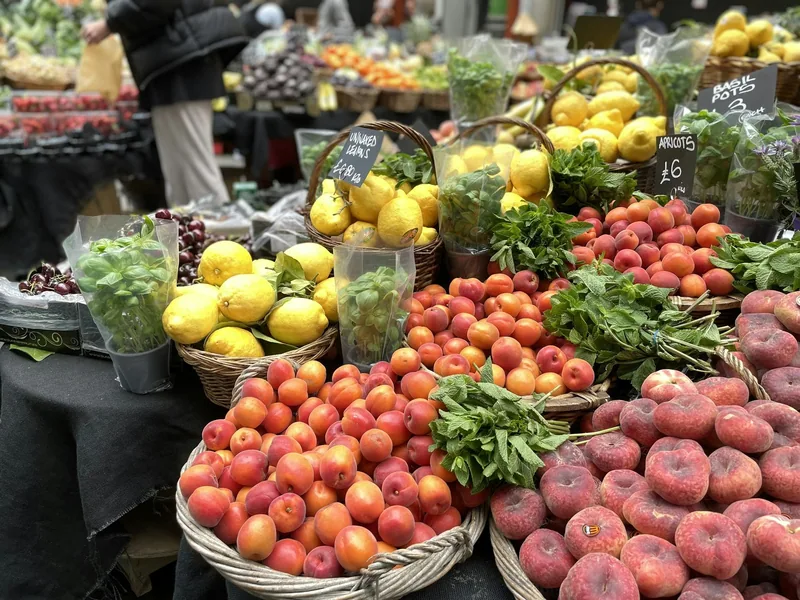
Produce to taste. British cheeses, charcuterie, fresh bread, fruit and vegetables are the heart of the market. Cheese and bread stalls often offer small tastes, which is the best way to discover the difference between a farmhouse Cheddar and a supermarket one.
Street food. Borough Market Kitchen has hot dishes from many countries. Expect grilled meats, sandwiches, stews, curries, paella-style pans, noodles and a good choice of vegetarian food. Queues are a fair sign of popularity, but long queues at noon also mean long waits.
Seafood and British classics. Fishmongers and seafood stalls sell oysters and cooked fish, and several traders sell British favourites such as pies and Scotch eggs. Our guide to traditional British food explains what these dishes are.
Sweet things and coffee. Bakeries, chocolate makers and doughnut stalls are among the busiest. The market is also a good coffee stop; for more places to find a good cup nearby, see our guide to coffee in London.
Split up and share at Borough. Queues form stall by stall, so a group can divide, with each person buying from a different trader, and meet up again to share. You taste three or four things in the time it takes to queue for one.
How to avoid the crowds
The market itself says that visitor numbers can be high at peak times, "particularly Saturday afternoons". The lanes are between about 1.5 and 4 metres wide, so when the market is full, moving through it becomes slow.
- Go on a weekday morning. Tuesday to Friday before about 11:30 is the calmest time, and most traders are set up by then.
- On Saturday, arrive at opening. The market opens at 09:00 on Saturdays, an hour earlier than on other days. The first two hours are much more comfortable than the afternoon.
- Eat lunch early or late. On weekdays, people from the surrounding offices arrive at lunchtime. An early lunch at 11:30 or a late one after 14:00 means shorter queues.
- Carry little. A small bag and no suitcase make the lanes much easier.
Busy lanes attract pickpockets. The crowded passages and queues at popular stalls are the kind of place where bags and phones go missing. Keep bags zipped and in front of you, and do not leave a phone on a counter while you pay. Our guide to staying safe in London has more advice.
Getting there and accessibility
The market is right next to London Bridge station, which is served by the Jubilee and Northern lines and by National Rail trains. Borough station on the Northern line is also a short walk away. If you are new to the Underground, our guide to the Tube explains how to pay and touch in. Buses 17, 21, 35, 47, 133, 343 and 381 stop within a five-minute walk.
There is no parking at the market, and the area is inside the Congestion Charge zone. Bike racks are in the Green Market and on Stoney Street, but bikes, scooters and roller skates must not be ridden through the market.
The market's public areas are on a single ground-floor level, with no stairs or lifts to use. Surfaces vary, and there are cobbles in places, so wheelchair users and people with buggies may find some areas harder to cross, especially on crowded days. Fully fitted accessible toilets are available in four locations during trading hours, without a RADAR key. For step-free routes to London Bridge, see our guide to step-free transport in London.
Toilets, dogs, smoking and other rules
Public toilets, including accessible ones, are open during trading hours in Three Crown Square, Borough Market Kitchen and the Market Hall. This is useful to know, because free toilets are scarce in this part of London; our guide to public toilets in London covers the rest of the city.
Dogs are allowed if they are kept on a lead or carried. The market advises avoiding very busy times with a dog, and some restaurants, bars and shops do not allow pets inside. The whole market is a smoke-free zone. If you lose something, ask a member of the security team; lost property found on site is kept for 30 days.
Official food tours
The market lists two official tours on its website. A tasting tour led by the food writer and TV cook Celia Brooks runs on selected Friday mornings from 10:00 to 13:00, with tastings of food and wine; booking in advance is essential, and private tours can be arranged on weekdays. Totally Tailored runs a private behind-the-scenes tour of about two and a half hours with trader talks and tastings. Both are booked through the operators' own websites, linked from the market's tours page.
A tour is worth it if you want the stories behind the traders and the history, or if you are nervous about choosing in a crowded market. If you just want lunch, you do not need one. Our overview of walking tours in London lists other guided options.
A thousand years in Southwark
The market's own timeline shows how long food has been traded here, at the southern end of the only bridge across the Thames for many centuries. In the 1270s the City of London banned its citizens from buying food in Southwark. In 1550 the City took over the market and extended trading from two days a week to four. A fire swept along Borough High Street in 1676, destroying the market house.
In 1754 Parliament moved to shut the market because of the congestion it caused on the high street. Local parishioners then founded a new market in 1756 on a site just off the street, where it still stands. From 1862 the railway viaduct cut through the market, and the growth of the railways turned Borough into a major wholesale fruit and vegetable hub. Supermarkets put its future in doubt in the 1980s and 1990s, until a food lovers' fair in 1998 set it on the road to becoming the retail market it is today.
What to see nearby
Borough Market sits in one of the most interesting corners of London, and it is easy to build a full day around it. Our guide to Borough and Bermondsey covers the area in more depth.
- Southwark Cathedral stands right next to the market and is worth a look inside.
- The George Inn on Borough High Street is the last galleried coaching inn in London; it is one of the pubs in our guide to historic pubs in London.
- The Shard rises above London Bridge station, a few minutes' walk away.
- The riverside west of the market leads past a replica of the Golden Hinde, Francis Drake's ship, to Shakespeare's Globe and Tate Modern, and on along the South Bank.
- Across the river, the Tower of London is about 15 to 20 minutes' walk via London Bridge or along the south bank to Tower Bridge.
For more markets in the area, including Maltby Street's weekend street food under the railway arches, see our guide to London's best food markets.
Frequently asked questions
Is Borough Market open on Mondays?
No, Borough Market is closed on Mondays for most of the year. It opens seven days a week in December, and in 2026 it also opened from 10:00 to 17:00 on the May and August bank holiday Mondays. Check the market's website for the current dates.
What is the best day to visit Borough Market?
A weekday morning, Tuesday to Friday, is the calmest time to visit, with most traders present. If you can only go at the weekend, arrive when the market opens at 09:00 on Saturday. Saturday afternoon is the busiest time of the week.
Is Borough Market free to enter?
Yes. Access to Borough Market is free and open to everyone. You pay only for what you buy from the stalls, restaurants and bars. The official tours are paid and must be booked separately.
Are there toilets at Borough Market?
Yes. Free public toilets, including accessible toilets, are open during trading hours in Three Crown Square, Borough Market Kitchen and the Market Hall. The accessible toilets do not need a RADAR key.
How do I get to Borough Market?
The nearest station is London Bridge, on the Jubilee and Northern lines and National Rail, right next to the market. Borough station on the Northern line is also close, and several bus routes stop within five minutes' walk.
Sources
- Borough Market - Plan your visit (checked September 2026)
- Borough Market - Frequently asked questions (checked September 2026)
- Borough Market - Bank holiday opening times 2026 (checked September 2026)
- Borough Market - Our story (checked September 2026)
- Borough Market - Official tours (checked September 2026)