
You can eat well in London on a small budget if you eat your main meal at lunchtime, use street-food markets, bakeries and supermarket meal deals, and head for the neighbourhoods where immigrant communities cook for each other rather than for tourists. The most expensive food in the city is usually the most convenient food in the busiest tourist streets.
London has a reputation as an expensive place to eat, and a sit-down dinner with drinks in the West End can easily cost more than a hotel breakfast and lunch combined. But the city also feeds millions of office workers, students and shift workers every day, and most of them do not spend much. If you eat where they eat, and at the times they eat, your food budget stretches a long way.
This guide explains where the good-value food is, how the main types of cheap meal work, which extra costs catch visitors out, and how to spot a place that is cheap for a reason. It does not list prices for individual businesses, because they change often. Where we mention a named place, it has been trading for many years, and it is one choice among many.
Budget eating in brief
- Cheapest filling meals
- Supermarket meal deals, bakery counters, street-food stalls, cafés serving breakfast
- Best time for a bargain
- Weekday lunchtime, when markets and set menus target office workers
- Best areas to look
- Whitechapel and Brick Lane, Chinatown, Kingsland Road, Tooting, Southall, Edgware Road
- Free extras
- Tap water on request in licensed premises; picnic space in the parks
- Watch for
- Discretionary service charges added to the bill; prices in tourist hotspots
- Hygiene check
- Food Standards Agency ratings from 0 to 5, searchable online
What counts as a cheap meal in London
Cheap is relative, and London prices are higher than in most of Britain. It helps to think in levels. At the bottom is food you buy and carry: a sandwich, a pastry or a boxed salad from a supermarket or bakery chain, eaten in a park or on a bench. One step up is street food from a market stall, usually a generous single dish served in a paper tray. Then come cafés, noodle bars, kebab shops and curry houses where you sit down and order at the counter or from a short menu.
Above that you reach restaurants with table service. Here the price of the food is only part of the bill, because drinks, sides and a service charge push it up. The biggest single saving most visitors can make is simply to eat their restaurant meal at lunchtime, when many kitchens offer a shorter, cheaper set menu, and to keep the evening meal simple.
Prices in shops, cafés and restaurants already include VAT, so the number on the menu is the number you pay, apart from any service charge. Our guide to what a London trip really costs puts food into the context of a whole holiday budget.
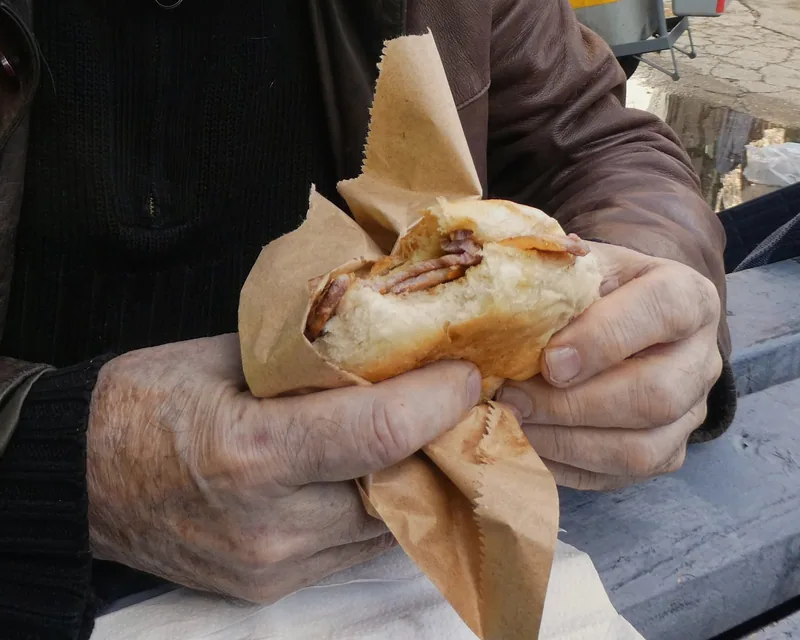
Photo: Acabashi · CC BY-SA 4.0 · Wikimedia Commons · resized
Supermarket meal deals and picnic lunches
The British "meal deal" is one of the best-value lunches in the country. Most large supermarket chains and some pharmacy chains sell a set combination of a sandwich, wrap or salad, a snack and a drink for one fixed price. The price is usually lower than buying the three items separately, and some chains charge less if you have their loyalty card. Look for the signs in the chilled section near the front of central London branches.
Supermarkets are also the cheapest place to buy water, fruit and breakfast food if your room has a fridge. The smaller "local" or "express" branches in central London often charge a little more than the big out-of-town stores, but they are still far cheaper than kiosks at stations and attractions.
Carrying food lets you eat in some of the best dining rooms in the city, which happen to be free: the Royal Parks. Hyde Park, Regent's Park and St James's Park all have benches, lawns and deckchairs (which you may be asked to pay for). Our list of free things to do in London suggests where to combine a picnic with a free museum or viewpoint.
A meal deal and a park bench beat a tourist-street café. Near the big sights, a sandwich and coffee sitting down can cost several times what the same food costs from a supermarket fridge two streets away. Buy lunch before you reach the attraction and eat it outside.
Street-food markets and weekday lunch markets
London's street-food markets are the easiest way to eat something freshly cooked for a moderate price. Stalls usually sell one speciality each, which keeps quality up and waiting times short. You can eat standing, at shared tables or on nearby steps, and there is no service charge.
Two long-running street markets on the northern edge of the City are built around the office lunch hour:
- Leather Lane Market (near Chancery Lane and Farringdon stations) is run by Camden Council, which describes it as a lunch market with street food from around the world. It trades Monday to Friday and is busiest between 10am and 4pm, depending on the weather. Street trading here goes back to the aftermath of the Great Fire of 1666.
- Whitecross Street Market, between Old Street and Fortune Street, is run by Islington Council and has become known for street food. The council lists opening hours of 11am to 2pm Monday to Thursday and 9am to 6pm on Friday.
Both are weekday markets, so do not plan a Saturday around them. At weekends the big destination markets take over. Borough Market by London Bridge is the best known, but it is not the cheapest; it is better value if you share several small dishes than if you buy a full meal at one stall. The food courts of Camden Market and the covered market at Spitalfields are busy and varied. Our overview of London's food markets compares them by day, area and atmosphere.
Cafés, bakeries and the traditional "caff"
For breakfast, the cheapest proper meal is often found in an old-fashioned café, known in London slang as a "caff" or a "greasy spoon". These are small independent places with plastic menus, mugs of tea and plates of eggs, bacon, sausages, beans and toast. They open early for builders and office staff and often close in the middle of the afternoon. A cooked breakfast here can keep you going until the evening, which saves the cost of lunch. Read more in our guide to the full English breakfast.
Bakery chains are everywhere in central London and sell sausage rolls, pasties, sandwiches and sweet buns at prices well below café food. Independent bakeries tend to cost more but are often better. Late in the day, some bakeries and cafés reduce the price of food that would otherwise be thrown away, so an early-evening visit can pay off.
Coffee is one area where a small choice makes a big difference to a daily budget. A filter coffee usually costs less than an espresso-based drink, and many chains charge extra for plant milks and syrups. Our guide to coffee in London explains the options.
Set lunches and pre-theatre menus
Many mid-range and even upmarket restaurants offer a set lunch: two or three courses from a short menu for a fixed price that is much lower than ordering from the full menu in the evening. Some also offer a "pre-theatre" menu in the early evening, aimed at people who must finish eating before a show starts. This is the cheapest way to try a restaurant that would be out of reach for dinner.
These menus change often and are not always advertised in the window, so look at the restaurant's own website before you go, and ask when you book whether the set menu is available on your day. Drinks, side dishes and the service charge are usually extra, and that is where the bill creeps up. If you are going to a show, combine a set menu with the tips in our guide to cheap theatre tickets and you can have a full West End evening for a fraction of the usual cost.
Neighbourhoods where good-value food is concentrated
The best cheap food in London is cooked by and for its migrant communities. In these areas restaurants compete for regular local customers, not for passing tourists, and portions and prices reflect that.
| Area | What it is known for | Nearest stations |
|---|---|---|
| Whitechapel and Brick Lane | Bangladeshi and Pakistani curry houses and grills, bagel bakeries | Whitechapel, Aldgate East, Shoreditch High Street |
| Chinatown (Soho) | Cantonese roast meats, noodle bars, dim sum, bakeries | Leicester Square, Piccadilly Circus |
| Kingsland Road (Shoreditch to Haggerston) | A long run of Vietnamese cafés and restaurants | Hoxton, Haggerston |
| Edgware Road | Lebanese and other Middle Eastern grills, juice bars and cafés | Edgware Road, Marble Arch |
| Tooting | South Indian, Sri Lankan and Pakistani restaurants | Tooting Broadway, Tooting Bec |
| Southall | Punjabi restaurants, sweet shops and street snacks | Southall (Elizabeth line) |
Two of these areas have their own guides: Brick Lane and London's curry scene, which also covers Tooting and Southall, and Chinatown, which is right in the West End and ideal for a quick, filling meal before or after a show.
The outer areas take time to reach, but the journey is cheaper than you might expect if you already use pay as you go. Tube and rail journeys are covered by daily caps (£8.90 for Zones 1-2 and £16.30 for Zones 1-6 in September 2026), so an extra trip out for dinner may cost you nothing once you have reached the cap. Our explanation of caps on Oyster and contactless shows how it works.
Pub food and the free tap water rule
Pubs are not always cheap, but many serve straightforward meals such as pies, burgers, fish and chips and, on Sundays, roast dinners. Chain pubs in particular price their food for a mass market. The usual system is to find a table, note its number and order food and drink at the bar. Our guide to how British pubs work explains the customs.
One saving applies to every pub, bar and restaurant licensed to sell alcohol. The mandatory licensing conditions in England require them to provide free tap water on request to customers, where it is reasonably available. You do not need to buy bottled water with your meal. Ask for "tap water, please" and you should get a jug or glass without charge.
Ask for tap water by name. If you only ask for "water", some servers will bring bottled still or sparkling water and add it to the bill. Saying "tap water" makes clear you want the free option that licensed premises must provide.
Service charges, tips and other extras on the bill
The price on the menu is not always the final price. In many London restaurants with table service, a service charge is added to the bill before it reaches you. It is often around 12.5% in London restaurants, but that is common practice, not a legal rule. If the menu or bill says the charge is discretionary or optional, you are not obliged to pay it. Since 1 October 2024, employers in Britain must pass on all tips and service charges to their staff without deductions.
At counter-service places, markets, bakeries and most cafés, there is no service charge and tipping is not expected. Our guide to tipping in London covers taxis, hotels and bars as well.
Most places accept contactless cards and phones, and a few are card-only. Street-food stalls almost all take cards now, but a small amount of cash is still useful for the odd market trader. The money guide explains cards, cash machines and exchange rates.
How to tell cheap from simply poor
A low price is not a bargain if the food is bad or unsafe. In England, local council officers inspect food businesses and give them a food hygiene rating from 5 (very good) to 0 (urgent improvement required). Businesses in England do not have to display the green-and-black sticker, but many do, usually in the window or door. You can look up any rating on the Food Standards Agency's food hygiene ratings site. The rating covers hygiene only, not taste or service.
Other signs are simpler. A busy place with local customers and a short, specific menu is usually a better bet than a place with a huge laminated menu of international dishes and staff inviting you in from the street. Around Leicester Square, Piccadilly Circus and the main streets near the big museums, prices are highest and quality is the most variable. Walk five minutes away from the main tourist flow and the choice improves.
Menus without prices in the window are a warning sign. In the busiest tourist streets, a restaurant that will not show its prices outside, or where staff push you to sit down quickly, may add expensive extras. Read the full menu and check for a service charge before you order.
A day of budget eating, step by step
Here is one way to structure a day around good-value food, based on how Londoners themselves eat. Adjust it to your plans and diet.
- Breakfast: a cooked breakfast in a local café, or breakfast bought the night before from a supermarket if your room has a fridge.
- Mid-morning: filter coffee and a pastry from a bakery rather than a café next to an attraction.
- Lunch: a street-food market on a weekday, or a set lunch menu if you want to sit down in a restaurant.
- Afternoon: fill your water bottle and carry fruit or a snack to avoid kiosk prices.
- Dinner: a curry house, noodle bar or Vietnamese café in one of the neighbourhoods above, with tap water or a soft drink.
Families save most by avoiding paid drinks and by sharing large dishes, which is easy in Chinese, Indian and Middle Eastern restaurants. Children can usually share adult portions in these places rather than ordering from a separate menu. Our guide to saving money in London has more ideas for keeping transport and attraction costs down as well.
Eating cheaply on a special diet
Budget eating is easy for vegetarians, because many of the cheapest cuisines in London, especially South Indian and Gujarati cooking, are largely vegetarian. For more detail, see our guide to vegan and vegetarian London. If you need halal or gluten-free food, the same neighbourhoods are a good start, but always ask about ingredients.
Frequently asked questions
What is the cheapest way to eat lunch in London?
A supermarket meal deal, which combines a sandwich or salad, a snack and a drink for one set price, is usually the cheapest filling lunch. On weekdays, street-food markets such as Leather Lane and Whitecross Street are the cheapest way to get a hot, freshly cooked meal.
Is tap water free in London restaurants?
Yes, in premises licensed to sell alcohol. The mandatory licensing conditions in England require pubs, bars and licensed restaurants to provide free tap water on request where it is reasonably available. Ask specifically for tap water so you are not brought bottled water by mistake.
Do I have to pay the service charge in a London restaurant?
If the menu or bill describes the service charge as discretionary or optional, it is not compulsory. It is often around 12.5%, but that is common practice rather than a legal rule. Check the menu before ordering, and remember that counter-service cafés and market stalls do not add one.
Which area of London has the best cheap food?
There is no single best area, but Whitechapel and Brick Lane, Chinatown, Kingsland Road, Edgware Road, Tooting and Southall all have many good-value restaurants aimed at local communities. Chinatown is the most convenient for visitors staying in or near the West End.
How can I check if a cheap restaurant is clean?
Look up its food hygiene rating on the Food Standards Agency website. Ratings run from 5 (very good) to 0 (urgent improvement required) and are based on council inspections. Businesses in England do not have to display the sticker, so a missing sticker does not mean a low rating.
Sources
- legislation.gov.uk - The Licensing Act 2003 (Mandatory Conditions) Order 2014, Schedule (checked September 2026)
- Food Standards Agency - Food Hygiene Rating Scheme (checked September 2026)
- Camden Council - Markets in Camden (Leather Lane Market) (checked September 2026)
- Islington Council - Markets (Whitecross Street Market) (checked September 2026)
- GOV.UK - Tips at work (checked September 2026)
- Transport for London - Capping (checked September 2026)