
Tate Modern is Britain's national gallery of modern and contemporary art, in a former power station on the south bank of the Thames opposite St Paul's Cathedral. The collection displays, the Turbine Hall and the view from the Level 10 café are all free; only the big temporary exhibitions charge, from about £25 for an adult.
Modern art here means roughly 1900 to the present: Picasso, Matisse, Duchamp, Rothko, Warhol and Yayoi Kusama, but also photography, film, performance and room-sized installations by artists from every continent. You do not need to know anything about art to enjoy it. Much of the pleasure comes from the building itself, the huge brick chimney, the cathedral-sized entrance hall and the river views.
The gallery opened in 2000 inside the old Bankside Power Station and was extended in 2016 with the twisting brick tower now called the Blavatnik Building. The original building is the Natalie Bell Building. Keep those two names in mind, because every room and lift in the gallery is signed by them.
Tate Modern: the essentials
- Price
- Free; paid exhibitions (for example Frida, £25 adult)
- Booking
- Not needed for the collection; recommended for exhibitions
- Hours
- Sunday-Thursday 10:00-18:00; Friday and Saturday 10:00-21:00; last entry 30 minutes before closing
- Address
- Bankside, London SE1 9TG
- Nearest stations
- Blackfriars (rail and Tube), about 300 m from its south exit; Southwark (Jubilee line), about 600 m
- By river
- Bankside Pier, next to the gallery
- Bags
- Nothing larger than cabin-bag size (55 x 40 x 20 cm); paid lockers only
The Turbine Hall and what fills it each year
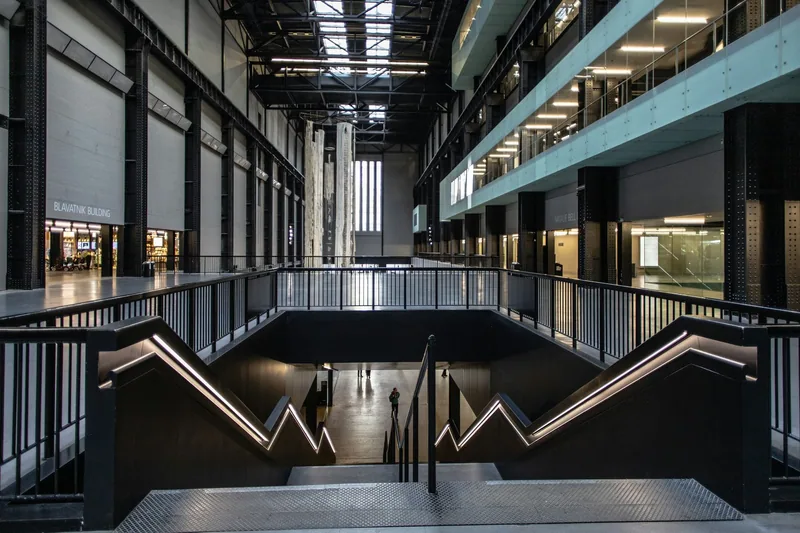
You enter most naturally down the long ramp from the west side into the Turbine Hall, the vast space where the power station's generators once stood. Photographs never quite capture the scale, and many visitors simply stand at the top of the ramp and stare.
Every year since 2000 a single artist has been commissioned to make a new work for the hall, and it is free to see. Past installations became famous in their own right: Olafur Eliasson's The Weather Project (2003-2004) hung a giant glowing sun under the roof, and in 2006 Carsten Höller installed five spiral slides that visitors could ride. What is on show changes each year, so check the Tate Modern visit page to see the current commission before you go.
During school holidays the Turbine Hall also hosts free UNIQLO Tate Play activities for families. The underground Tanks are former oil tanks, now used for performance, film and video art.
The free collection displays, floor by floor
Tate Modern does not hang its art in date order. The free displays are grouped into themes, each spread over several rooms, and the selection rotates through the year. In September 2026 the main themes were:
- In the Studio (Natalie Bell Building, Level 2): how artists work and make things.
- Artist and Society (Level 2): art that responds to politics and social change.
- Materials and Objects (Natalie Bell Building, Level 4): artists using unusual materials and everyday things.
- Media Networks (Level 4): art made in response to mass media.
- Performer and Participant (Blavatnik Building): work from the 1960s to the 1990s that invites the viewer in.
- The Tanks: live art, film and video.
Ten works the gallery itself picks out
Tate publishes its own top ten, with room numbers. These were the locations in September 2026:
| Work | Where to find it |
|---|---|
| Mark Rothko, Red on Maroon (1959) | Room 10, Natalie Bell Building Level 2 |
| Andy Warhol, Marilyn Diptych (1962) | Room 14, Natalie Bell Building Level 2 (in a conservation studio display) |
| Joan Mitchell, Iva (1973) | Room 9, Natalie Bell Building Level 2 |
| Arahmaiani, Burning Country (1998-2020) | Room 10, Natalie Bell Building Level 2 |
| Marcel Duchamp, Fountain (1917, replica 1964) | Room 7, Natalie Bell Building Level 4 |
| Meschac Gaba, Art and Religion Room | Room 9, Natalie Bell Building Level 4 |
| Nalini Malani, In Search of Vanished Blood | Room 5, Natalie Bell Building Level 4 |
| Guerrilla Girls, Do Women Have to Be Naked to Get into the Met. Museum? | Room 5, Natalie Bell Building Level 4 |
| Cildo Meireles, Babel (2001) | Room 6, Natalie Bell Building Level 4 |
| Pipilotti Rist, Lungenflügel (2009) | Room 9, Blavatnik Building Level 3 |
If you only have an hour, go straight up to Level 2 for the Rothko room, where dark red canvases first painted for a restaurant in New York's Seagram Building fill the walls, then take the escalator to Level 4 for Duchamp's urinal and Meireles' Babel, a tower of hundreds of old radios all tuned to different stations. Finish in the Blavatnik Building and ride the lift to the top for the view.
Free tours leave from Level 2 three times a day. Volunteer guides run free 45-minute tours of the collection most days at 12:00, 13:00 and 14:00, starting from the meeting point on Level 2 of the Natalie Bell Building. Tate suggests calling +44 (0)20 7887 8888, option 1, to check that they are running on the day.
The free view from Level 10
Take the lift to Level 10 of the Blavatnik Building, where a café looks out across the Thames. From here you see St Paul's Cathedral straight ahead, the Millennium Bridge below, and a wide sweep of the City skyline. Entry costs nothing, and Tate describes it as one of the best free views in London; you only pay if you buy a coffee.
Go in the late afternoon for the best light on St Paul's, or on a Friday or Saturday evening when the gallery is open until 21:00 and the city lights come on. There is also a restaurant and bar at the top of the gallery, which you pay for. For other places to see London from above without a ticket, see our round-up of the best free viewpoints in London.
Paid exhibitions in autumn 2026 and who gets in cheaper
The large temporary exhibitions are where Tate Modern charges. In September 2026 three were running:
- Frida: The Making of an Icon, about Frida Kahlo, until 3 January 2027. Adult ticket £25, with concessions.
- Julio Le Parc: Light. Colour. Action., seven decades of the Argentinian artist's participatory work, until 3 May 2027.
- Ana Mendieta, until 17 January 2027.
Check the Tate website for prices of each show, as they differ. Booking ahead is recommended, especially for Frida at weekends. Several discounts make exhibitions much cheaper for families and young people:
- Up to four children aged 11 and under go free with each parent or guardian.
- Family tickets for children aged 12-18 cost £5.
- Visitors aged 16-25 can join Tate Collective for £5 exhibition tickets.
- Disabled visitors pay a concession rate, and a companion goes free.
A family of two adults with two children under 12 therefore pays £50 for Frida at the full adult price. Tate Members get into every exhibition free, which can pay for itself if you plan to see several shows at Tate Modern and Tate Britain in a year.
Opening hours, late nights and the quietest times
The gallery opens at 10:00 every day. It closes at 18:00 from Sunday to Thursday and at 21:00 on Fridays and Saturdays, with last entry 30 minutes before closing. The weekend evenings are often the calmest time to see the collection, as day-trippers have gone home.
Tate Modern also runs occasional Lates with music, talks and bars; the next one is on 25 September 2026 from 18:00 to 22:00. Check the programme and whether you need a ticket on the Tate website. For other evening museum openings, including the National Gallery's Friday nights, see our guide to late openings at London museums, and for more ideas after dark, our page on London at night.
The busiest times are weekend afternoons and rainy days in school holidays, when the Turbine Hall fills with families. On weekdays in term time the first hour after opening is noticeably quieter.
Bags, lockers and security
Bags are checked on arrival, so allow a few extra minutes. Nothing larger than a cabin bag (55 x 40 x 20 cm) is allowed in the building, and the cloakroom on Level 0 of the Natalie Bell Building has closed. Instead there are paid lockers: standard £4, large £6 and jumbo £8. Electric skateboards, scooters and folding bikes, and their batteries, are not allowed inside.
If you are carrying a suitcase, Tate points to the left luggage facilities at London Bridge station. Our guide to left luggage in London lists other options.
Wheeled suitcases will be turned away at Bankside. Tate Modern has no cloakroom for large bags any more, and its biggest locker is 58 x 44 x 66 cm. If you are coming straight from Eurostar or an airport, drop your luggage somewhere else first.
Getting to Bankside
Blackfriars is the most convenient station: its south exit on the riverbank is about 300 metres from the gallery, and it is served by Thameslink and Southeastern trains and by the District and Circle lines. Southwark on the Jubilee line is about 600 metres away, and St Paul's on the Central line about 1,100 metres, across the Millennium Bridge. Buses 40, 63 and 100 stop on Blackfriars Bridge Road.
The river is a good way to arrive. Uber Boat by Thames Clippers boats call at Bankside Pier, next to the gallery, and you can pay with contactless or Oyster, although river fares do not count towards the daily cap; our guide to the Thames river bus explains fares. The same boats connect Bankside with Millbank Pier for Tate Britain, stopping at Embankment, the London Eye and Westminster on the way.
Building a day on Bankside
Tate Modern sits on one of the most pleasant stretches of riverside in London. Cross the Millennium Bridge and you are at St Paul's Cathedral within ten minutes. Next door to the gallery is Shakespeare's Globe, where standing tickets in the yard can cost as little as £5.
Walk east along the river for about 15 minutes and you reach Borough Market, the best place nearby for lunch. Walk west and you follow the South Bank past the Oxo Tower and the Southbank Centre to the London Eye. The riverside path between Tower Bridge and Westminster is described in our walking guide to London's bridges.
Tate Modern is one of the national museums with free permanent collections; see our full list of free museums in London, and our tips for seeing London on a budget.
Is it worth visiting if you do not like modern art?
Probably yes, for an hour. The Turbine Hall, the building and the Level 10 view are enjoyable whatever you think of the art, and it costs nothing to find out. If you prefer older paintings, you will be happier at the National Gallery or Tate Britain, but Tate Modern is a very easy stop on a South Bank walk.
Frequently asked questions
Is Tate Modern free to enter?
Yes. The collection displays, the Turbine Hall commission and the Level 10 view are all free, and you do not need to book. Only the temporary exhibitions charge; in autumn 2026 the Frida Kahlo exhibition costs £25 for an adult, with up to four children aged 11 and under free per parent.
What are Tate Modern's opening hours?
Tate Modern opens daily at 10:00. It closes at 18:00 from Sunday to Thursday and at 21:00 on Fridays and Saturdays. Last entry is 30 minutes before closing. Check the Tate website for holiday closures before you travel.
Can you go to the top of Tate Modern for free?
Yes. Take the lift to Level 10 of the Blavatnik Building, where a café has panoramic views over the Thames to St Paul's Cathedral and the Millennium Bridge. There is no charge to go up; you pay only if you buy food or drink.
Which station is nearest to Tate Modern?
Blackfriars is the nearest, about 300 metres from its south exit, with Thameslink trains and the District and Circle lines. Southwark on the Jubilee line is about 600 metres away. You can also arrive by Uber Boat at Bankside Pier, right beside the gallery.
Can I bring a suitcase to Tate Modern?
No. Bags larger than cabin size (55 x 40 x 20 cm) are not allowed, and the gallery no longer has a cloakroom. Smaller bags can go in paid lockers costing £4 to £8. Tate suggests the left luggage facilities at London Bridge station for larger bags.
Sources
- Tate - Visit Tate Modern (checked September 2026)
- Tate - 5 free things to do at Tate Modern (checked September 2026)
- Tate - See great art for free at Tate Modern (checked September 2026)
- Tate - Frida: The Making of an Icon (checked September 2026)
- Tate - Tate Modern Lates (checked September 2026)
- Uber Boat by Thames Clippers - Bankside Pier (checked September 2026)