
Petticoat Lane Market runs on Sunday only, from 9am to 3pm. A smaller weekday market trades on Wentworth Street, Monday to Friday from 8am to 4pm, with street-food stalls around the junctions of Goulston Street, Wentworth Street and Bell Lane. There is no street called Petticoat Lane: the Victorians renamed it Middlesex Street because they thought the old name indecent.
The Sunday market spreads across Middlesex Street, Cobb Street, Leyden Street, New Goulston Street, Old Castle Street, Strype Street, Toynbee Street, Goulston Street and Wentworth Street. Tower Hamlets Council, which runs it, traces the textile trade here to the 1750s, when Huguenot refugees settled in the East End, and then to the Eastern European Jewish families who took the trade on from the late nineteenth century.
Around the corner, the City of London keeps a completely different set of markets: Leadenhall's Victorian arcade, which is open all the time and sells almost nothing, and the weekday lunch markets that exist for office workers and vanish at two o'clock. This page covers both sides of the boundary, because a visitor crossing Bishopsgate does not notice that they have changed borough but will certainly notice that everything has changed day. Our guide to how the City of London works explains why the two halves behave so differently.
Markets on the City fringe, by day
- Petticoat Lane (Middlesex Street and around)
- Sunday, 9am to 3pm
- Wentworth Street weekday market
- Monday to Friday, 8am to 4pm
- Whitechapel Market
- Monday to Saturday, 8am to 6pm
- Whitecross Street Market
- Monday to Thursday 11am to 2pm; Friday 9am to 6pm
- Leadenhall Market
- Public areas open 24 hours; shop hours vary and most close at the weekend
- Nearest stations
- Aldgate (Circle, Metropolitan) and Aldgate East (District, Hammersmith & City), neither step-free; Liverpool Street about 8 minutes
- Free parking
- One hour in marked bays on market days, booked through RingGo
- Cost
- Nothing to walk in
Sunday on Petticoat Lane: what is really on the stalls
Clothing, and a great deal of it. The council's own description is fashion, textiles and leather goods, and that is accurate: rails of jackets and coats, tracksuits, trainers, jeans, dresses at £15, handbags, belts, socks by the bundle, luggage, towels and bedding. Behind the stalls are fabric shops, including Asian and African cloth specialists, and several of those open on Sunday when almost nothing else in the City does.
It is a bargain market, not a vintage or craft market, and the quality range is wide. Some stalls are selling end-of-line branded stock at a genuine discount; others are selling cheap new clothing that will not survive many washes. The way to tell is to handle the seam and the zip, which nobody minds you doing.
The market is at its fullest between about 10.30am and 1pm. By half past two the far ends of the streets are already clearing, and at three it is over. That is earlier than most visitors expect of a Sunday market, and it is the single most common way to waste an East End Sunday.
Petticoat Lane does not appear on a street map, and that catches people out. Search for Middlesex Street, E1, or for Wentworth Street. If you come out of Liverpool Street station and walk south-east down Middlesex Street you will find it; if you look for a street sign saying Petticoat Lane you will not.
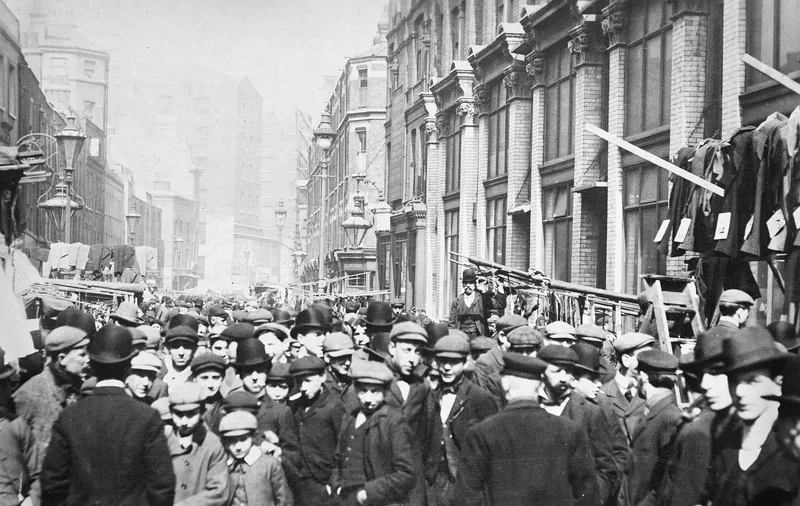
Weekdays on Wentworth Street, which is a different market
The weekday licence covers Wentworth Street only, 8am to 4pm from Monday to Friday. Tower Hamlets describes cheap fashion along the street and a cluster of street-food sellers at the Goulston Street, Wentworth Street and Bell Lane junctions, and calls them very reasonably priced with healthy options among them.
This is the market to use if you are in the City on a weekday and want a hot lunch for less than a sandwich chain charges. It is about eight minutes' walk east of Liverpool Street, which puts it within the lunch hour of anyone working in the eastern City and well within reach of anyone visiting the Tower or Spitalfields.
The weekday market and the Sunday market are not the same trade and do not feel the same. Weekdays are quiet, with a working-street feel and stalls run largely for local residents and office workers. Sunday is loud, crowded and shouted, and covers eight streets rather than one.
Leadenhall Market: beautiful, and not really a market
Leadenhall Market, ten minutes south-west across Bishopsgate, is a covered Victorian arcade of cream, maroon and green ironwork, and one of the handsomest interiors in the City. Its public areas are open 24 hours a day. Scaffolding has been up for maintenance, but the market remains fully open.
Be clear about what it is, though. There are no market stalls. The units are shops, bars and restaurants, they keep office-district hours, and most of them shut at the weekend. Arriving on a Sunday afternoon gives you an empty, photogenic and completely dead arcade, which is either exactly what you wanted or a disappointment depending on what you were told. Our page on Leadenhall Market has the detail.
The City's real markets are the lunchtime ones. Whitecross Street, at the northern edge by the Barbican, runs Monday to Thursday from 11am to 2pm and then properly on Friday from 9am to 6pm, and Islington Council calls it one of the oldest markets in London. It is the best street food within walking distance of the Barbican, and the Friday version is worth timing a day around.
The City's markets are the mirror image of the East End's. Everything inside the Square Mile runs Monday to Friday and dies at the weekend; everything on the fringe runs at the weekend and is quiet midweek. Cross Bishopsgate and you swap one rhythm for the other in four minutes. Our table of markets by day sets the whole city out that way.
Whitechapel Market, the one that runs six days
If your trip has no Sunday in it and you still want a full street market in the East End, Whitechapel Market is the answer. It runs along Whitechapel Road, Monday to Saturday from 8am to 6pm, and it is the longest-hours market in the area.
The goods are different again: fresh fruit, South Asian vegetables and spices, cultural dress, jewellery, luggage, household goods. It is a market for the neighbourhood, which our guide to Whitechapel and the East End describes, and it is the practical stop for anyone who wants a market on a Tuesday rather than a Sunday.
Whitechapel station is on the District and Hammersmith & City lines, the Overground and the Elizabeth line, and every Elizabeth line station is step-free from street to platform, which makes it the easiest of the markets on this page to reach with a wheelchair or a pushchair.
Doing Petticoat Lane with the other Sunday markets
Petticoat Lane is one of four East End markets that run on a Sunday morning, and they are all within twenty-five minutes' walk of each other. The order matters, because they finish at different times.
- 8am, Columbia Road. The flower market opens at 8am and finishes at 2pm; go first, as our Columbia Road guide explains.
- 10am, Brick Lane. Sunday trading from 10am to 3pm, covered with Old Spitalfields in our guide to Spitalfields and the Brick Lane markets.
- 11.30am, Petticoat Lane. Ten minutes south, at its fullest, and closing at three.
- 1.30pm, Old Spitalfields. Indoors, so it is the right place to be if it rains, and the only one with a roof.
Two of those pages already carry the Petticoat Lane hours, which is deliberate: they are the same facts and paraphrasing them would only make them worse. What this page adds is the rest of the week, the City side of the boundary, and the reason the Sunday market is where it is.
The food history around the corner
The Jewish trade that made Petticoat Lane a clothing market also left a food trade, most of which has gone. What survives is covered in our guide to salt beef, bagels and Jewish London, which names the shops that are actually still open and says plainly which famous ones are not.
The other food history of these streets is Bengali, and it begins four minutes north on Brick Lane. Choosing a restaurant there is not as simple as walking down the street, and our guide to curry on Brick Lane sets out how to do it.
For the clothing side, the vintage trade that the East End is now better known for than Petticoat Lane's new stock is set out in vintage and second-hand shopping in London. Petticoat Lane is not part of it, and it is worth knowing that before you go looking for a leather jacket from 1975.
Getting there, and where not to drive
Aldgate (Circle and Metropolitan lines) and Aldgate East (District and Hammersmith & City) are the closest stations to Petticoat Lane; neither has a lift in TfL's station data, so neither is step-free. Liverpool Street, about eight minutes north-west, is the better arrival point and has lifts; our guide to eating near Liverpool Street covers the food between the station and the market. Many buses run along Bishopsgate and Commercial Street.
Tower Hamlets offers one hour of free parking in marked bays on market days, booked through the RingGo app or by calling the number on the sign plate, with 32 spaces at Petticoat Lane. Even so, driving into this corner of London is a poor idea: the Congestion Charge applies from 12 noon to 6pm on Sundays as well as on weekdays, at £18 a day. Our page on the Congestion Charge and ULEZ has the rules.
Frequently asked questions
What day is Petticoat Lane Market on?
Sunday, from 9am to 3pm, for the full market across Middlesex Street and the streets around it. A smaller weekday market trades on Wentworth Street from Monday to Friday, 8am to 4pm, with street-food stalls at the Goulston Street and Bell Lane junctions.
Where is Petticoat Lane?
There is no longer a street of that name. The market's main line is Middlesex Street, E1, renamed by the Victorians, and it spreads into Cobb Street, Leyden Street, New Goulston Street, Old Castle Street, Strype Street, Toynbee Street, Goulston Street and Wentworth Street.
Is Petticoat Lane Market worth visiting?
It is worth an hour on a Sunday if you are already doing the East End markets, and it is genuinely cheap for clothing, luggage and fabric. It is not the place for vintage, crafts or souvenirs, and it has less to photograph than Columbia Road or Spitalfields.
Is Leadenhall Market open on Sunday?
The arcade itself is open at all hours, because it is a public thoroughfare, but almost all the shops, bars and restaurants inside it close at the weekend. Go on a weekday if you want it alive, or early on a Sunday if you want it empty for photographs.
Which East End market is open on a weekday?
Whitechapel Market, Monday to Saturday from 8am to 6pm, is the fullest weekday street market in the area. Wentworth Street runs Monday to Friday until 4pm, and Whitecross Street on the City's northern edge is a two-hour lunchtime market from Monday to Thursday and a full day on Friday.
Sources
- London Borough of Tower Hamlets - Markets in Tower Hamlets (checked September 2026)
- Islington Council - Markets (Whitecross Street) (checked September 2026)
- Leadenhall Market - Visit (checked September 2026)
- Transport for London - Congestion Charge (checked September 2026)
- Transport for London - detailed station data (lifts and step-free routes) (checked September 2026)