
Berwick Street Market trades Monday to Saturday from 8am to 6pm, and Soho now has a second market that almost nobody knows about: Rupert Street, five minutes south, which Westminster City Council licenses from 3pm to 10pm, also Monday to Saturday. Between them they cover the whole Soho day. Neither opens on a Sunday.
Berwick Street was founded in 1778, which makes it one of the oldest markets in London still trading on its original street. Westminster, which licenses it, describes it as Soho's main lunchtime food destination, and the licensed goods are fruit and vegetables, flowers, coffee, dairy products and international takeaway food.
What is left of the old fruit market is a short double row of pitches in the middle of the road, roughly between Broadwick Street and Peter Street. It is smaller than it was, and this page is honest about that. It also covers the record shops, the fabric shops and the comics shop that give the street its real character, and it says which of them are covered in more detail elsewhere on the site.
Soho's two markets
- Berwick Street Market
- Monday to Saturday, 8am to 6pm. Closed Sunday
- Rupert Street Market
- Monday to Saturday, 3pm to 10pm. Closed Sunday
- Founded
- Berwick Street, 1778
- Best hour for food
- 12pm to 1.30pm on Berwick Street; after 6pm on Rupert Street
- Licensed by
- Westminster City Council
- Nearest stations
- Oxford Circus and Tottenham Court Road, both about 6 minutes; Piccadilly Circus about 7 minutes
- Cost
- Nothing to walk down either street
- Market plate
- About £9 to £14, according to our survey of the Oxford Street area in September 2026
What is actually on the Berwick Street stalls now
Fewer pitches than the photographs in older guidebooks suggest, and a different balance. The produce stalls are still there, and they still sell by the bowl: tomatoes, avocados, salad, soft fruit, bunches of herbs. There is usually a flower pitch and a coffee cart. The rest of the row is hot food, cooked to order and sold in a box to be eaten standing up or carried to a square.
That shift is not decline exactly; it is the market following its customers. Very few of the flats above these shops now hold a household doing a weekly vegetable shop on foot, while the offices around Soho Square and Great Marlborough Street empty into the street at lunchtime every weekday. A market that sold potatoes to households became a market that sells lunch to offices.
The practical consequence is a narrow good hour. Come at 12 noon and every stall is cooking; come at 4.30pm and the food pitches are closing while the produce stalls hang on to the end of the licence at six. Saturday is quieter than a weekday, because the offices are shut, which makes it the pleasant day to walk the street and the poor day to eat on it.
Rupert Street is where Soho's market week now ends, not Berwick Street. Westminster licenses Rupert Street from 3pm to 10pm, Monday to Saturday, and runs it on themed days: general market on Monday and Tuesday, artisan food and drink on Wednesday, world street food on Thursday, vintage clothing on Friday, and arts, crafts and jewellery on Saturday. The council notes the themes may change with trader interest, so treat them as the plan rather than a guarantee.
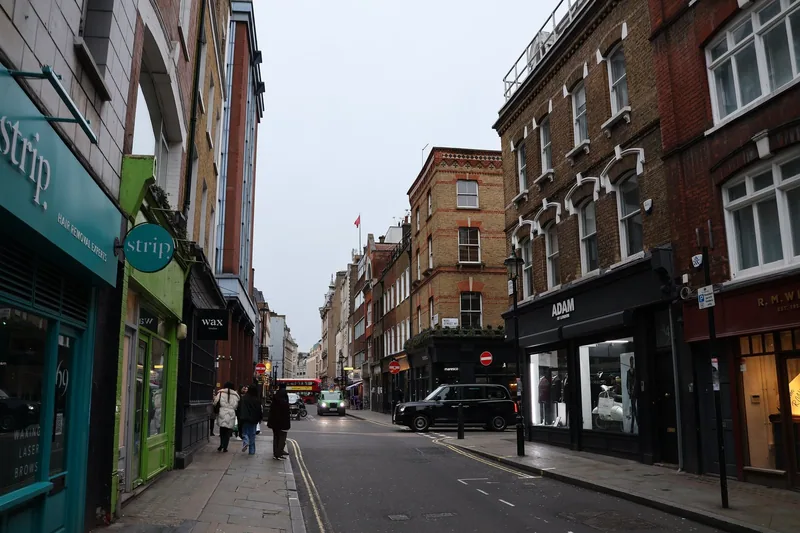
Photo: DiscoA340 · CC BY-SA 4.0 · Wikimedia Commons · resized
Rupert Street, day by day
Rupert Street runs south from Brewer Street towards Shaftesbury Avenue, in the block behind the Piccadilly Circus end of Soho. It has always been a market street and for years it was the quiet, half-empty one. The evening licence and the themed days are Westminster's attempt to change that.
| Day | What the licence is for | Worth the walk if |
|---|---|---|
| Monday and Tuesday | General market, about 60 per cent food | You want dinner before a show without a booking |
| Wednesday | Artisan food, drink and gifts | You are looking for something to take home |
| Thursday | World street food, trucks and stalls | You are eating with a group who cannot agree |
| Friday | Vintage fashion and clothing | You would otherwise go east for vintage |
| Saturday | Arts, crafts and jewellery | You want a present that is not from a chain |
Because it starts at three and runs to ten, Rupert Street is the only market in central London that is any use to someone with a theatre ticket. It is four minutes from most of Shaftesbury Avenue and Coventry Street, which makes it a real alternative to the queues described in our guide to eating before a West End show.
The record shops, and who owns which street
Berwick Street was the centre of the London record trade, and two of the important shops are still a few doors apart on it. We do not repeat their opening hours and stock here because our guide to record shops in London covers them properly, along with Denmark Street and which shops will ship a heavy box home for you.
What belongs on this page is the geography. The record shops sit on the same 150 metres as the market stalls, which is why a morning here works: dig for an hour, eat from a stall, then walk two minutes west into the lanes covered in Carnaby Street and Soho shopping.
One shop on the street belongs to a different subject altogether. Gosh! Comics, at 1 Berwick Street, is the best comics shop in central London; it is covered in our guide to comic, game and hobby shops, and again in the context of original cartoon art in the Cartoon Museum.
The fabric shops, which are the last of the tailoring trade
Soho supplied the West End tailoring and theatrical costume trades for well over a century, and the fabric shops on and around Berwick Street are what survives of it. They are the most genuinely unusual shops on the street, and the least visited.
Expect dress and furnishing fabric sold by the metre from bolts stacked to the ceiling, plus linings, trimmings, buttons, zips and interfacing. Prices run from a few pounds a metre for cotton to a great deal more for silk, and the staff will cut any length you ask for. If you sew, this is a reason to come to Soho; if you do not, walk in anyway for the smell of the place.
Two practical notes. Fabric is heavy and takes hold luggage space, so buy on the last day of your trip rather than the first, and remember there is no VAT refund on goods you carry home from Great Britain: our page on tax-free shopping explains why. Several of the shops keep shorter Saturday hours and none opens on Sunday.
Eating: whose page this is, and whose it is not
The restaurants around Berwick Street are not this page's business. Our guide to where to eat near Oxford Street owns that block, names the restaurants with their hygiene ratings, and gives what a meal costs; it also works out a market lunch for a family of four. We are not going to hold the same list twice.
What this page adds is the timing. The market stalls are the cheapest hot food within ten minutes of Oxford Circus, and they are gone before the evening. The delicatessens on Old Compton Street and Brewer Street are the better answer if you want something to carry rather than eat, and our survey of cheap eats shows where a market box sits against the alternatives.
If you want to sit in daylight with whatever you have bought, Soho Square is five minutes north-east and Golden Square three minutes west. Both have benches and neither has a gate that shuts early.
Getting there, and the Sunday problem
Every station is about the same distance. Oxford Circus (Bakerloo, Central and Victoria lines) is roughly six minutes north; Tottenham Court Road (Central and Elizabeth lines) about six minutes east and step-free; Piccadilly Circus about seven minutes south. Buses along Oxford Street and Regent Street drop you within five minutes, and our guide to Soho has the wider orientation. If you are shopping the whole quarter in a day, Regent Street is the boundary on the west and Covent Garden and Seven Dials the boundary on the east.
The Sunday problem is real and worth stating twice. Neither market trades on Sunday, most of the fabric shops are shut, and the record shops keep reduced hours. Sunday in Soho is for restaurants and for walking, not for shopping. Our table of London markets by day shows which markets do run on a Sunday, and they are all east or west of here.
Oxford Street is being rebuilt, and the works reach the top of Berwick Street. Traffic is due to be removed between Orchard Street and Great Portland Street from late October 2026, and bus stops and crossings north of Soho will move while that happens. Check TfL's live travel pages for your journey on the day rather than assuming last year's stop is still there.
Frequently asked questions
What days is Berwick Street Market open?
Monday to Saturday, 8am to 6pm, according to Westminster City Council's own market listing. It does not trade on Sunday. The hot-food stalls are busiest between noon and 1.30pm and several pack up during the afternoon.
Is Berwick Street Market still worth visiting?
For an hour, yes, if you combine it with the record shops and the fabric shops on the same 150 metres. It is much smaller than it was, so a journey across London purely for the stalls is not worth making. As a lunch stop while you are shopping on Oxford Street or Carnaby Street, it is the best value in the area.
What is Rupert Street Market?
Soho's other licensed street market, running Monday to Saturday from 3pm to 10pm with a different theme each day, from general trading at the start of the week to vintage clothing on Friday and crafts on Saturday. It is the only central London market useful to someone going to the theatre.
Where was the Oasis album cover photographed?
On Berwick Street. People stand in the middle of the road to take the same picture, which is why the traders are unusually relaxed about being photographed. The shops and stalls are used to it; just do not stand in front of a stall at lunchtime.
Can you buy fabric in Soho?
Yes. The fabric shops on and around Berwick Street are the remains of the trade that supplied West End tailors and theatre costume departments, and they sell dress and furnishing cloth by the metre. Most open Monday to Saturday with shorter Saturday hours and close on Sunday.
Sources
- Westminster City Council - Berwick Street W1 (checked September 2026)
- Westminster City Council - Rupert Street W1 (checked September 2026)
- GOV.UK - Tax-free shopping (checked September 2026)
- Transport for London - live travel news (checked September 2026)