
Chapel Market trades Tuesday to Saturday from 9am to 6pm and on Sunday from 8.30am to 4pm. It is closed on Monday. That is the fact that decides whether a shopping day in Islington works, because Chapel Market, Camden Passage and Upper Street all keep different hours and only two of the three are worth a Monday.
Chapel Market runs for about 250 metres west from Liverpool Road, a two-minute walk from Angel station. Islington Council, which licenses it, says traders have served the area for more than 150 years, and the market has kept the shape it had then: fruit and vegetables, fish, eggs, cheap socks and underwear, phone cases, bedding, batteries and a van selling flowers.
Within five minutes' walk you can also reach the antique stalls of Camden Passage and the shops of Upper Street, which is the reason this corner of London rewards a slow morning. Our guide to Islington covers the streets, the theatres and the canal; this page is about the shopping, in the order that makes it fit together.
Shopping in Islington at a glance
- Chapel Market
- Tuesday to Saturday 9am to 6pm; Sunday 8.30am to 4pm; closed Monday
- Islington Farmers' Market
- Sundays 10am to 2pm, on Chapel Market
- Camden Passage stalls
- Main days Wednesday and Saturday, about 8am to 5pm (see below)
- Upper Street shops
- Ordinary high-street hours, seven days
- Nearest station
- Angel (Northern line, Bank branch), Zone 1. No lifts, not step-free
- Where
- Chapel Market, N1, running west off Liverpool Road
- Worst day for all three
- Monday
- Cost
- Nothing to walk in anywhere on this page
Chapel Market: a market that still sells things people need
Walk down Chapel Market on a Friday and the produce stalls are the first thing you meet: bowls of tomatoes, boxes of bananas, trays of mushrooms, all sold by the bowl or the box rather than the item, at prices the supermarket at the end of the street cannot match. Behind them come the fish stall, a butcher, an egg and cheese pitch, and the household stalls: tea towels, phone chargers, bin bags, school socks.
It is not a food-tourism market and it does not pretend to be. There is no artisan bakery stall, no coffee cart with a queue, no sourdough. What there is instead is a working street where people who live in the flats behind it do their weekly shop, and the pleasure of it is watching that happen rather than buying a souvenir.
The market is at its best between 10am and 2pm on a Friday or Saturday, when every pitch is out. Sunday is the odd day: it starts half an hour earlier, finishes two hours sooner, and carries the Islington Farmers' Market, which is a different thing altogether.
Chapel Market is the only London street market on this site that is shut on Monday but open on Sunday. Most street markets do the reverse. If you are in London for a single Monday, spend it on Upper Street and Camden Passage's permanent shops instead, and see our table of markets by day for what else is trading.
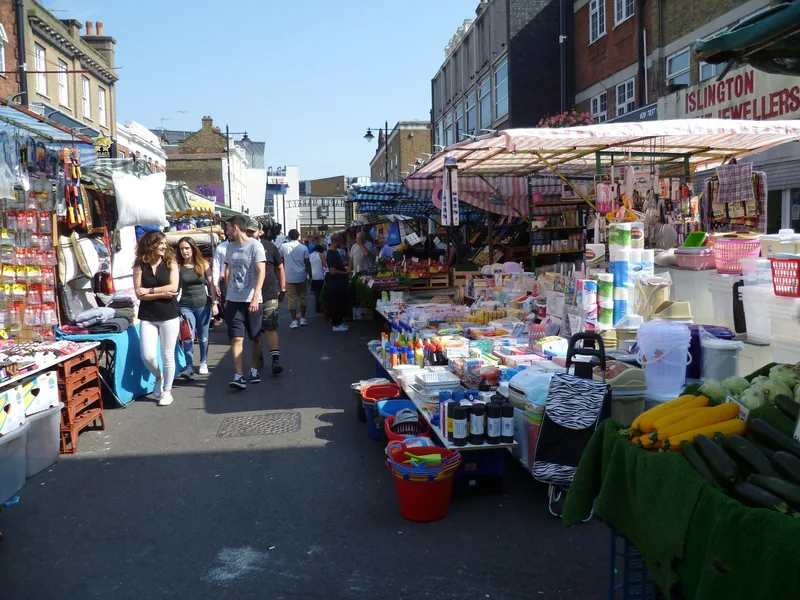
Photo: Philafrenzy · CC BY-SA 4.0 · Wikimedia Commons · resized
Sunday: the farmers' market on top of the street market
Every Sunday from 10am to 2pm, London Farmers' Markets runs the Islington Farmers' Market on Chapel Market. Its rule is that produce comes from farms within about 100 miles of London, which in practice means Kent and Essex meat, Sussex cheese, vegetables, bread and apples in season.
This is the one part of the Islington market week that is genuinely a destination rather than a local shop, and it is also the only part where you will pay more than supermarket prices rather than less. Bring your own bag and, if you are buying cheese or meat, a container: the organisers ask for both.
Because it shares the street with the ordinary Sunday market, the two blur into each other. The farmers' stalls are at the Liverpool Road end; the household stalls sit further west. Neither runs past four.
Camden Passage: what the council says and what the traders say
Camden Passage is a narrow pedestrian lane behind Upper Street, two minutes from Angel. Three separate patches of outdoor stalls trade along it, and behind them sits a fixed row of dealers' shops and cafes that keep their own hours. It is covered in detail in our guide to London's antiques markets, which explains how to judge and pay for what is on the stalls.
What is worth adding here is that the two official sources disagree about the days. Islington Council lists the main market days as Wednesday and Saturday, roughly 8am to about 5pm, and says stalls "may also operate" on Thursdays, Fridays and Sundays, subject to change at short notice. The traders' own site is more expansive about the extra days. Treat Wednesday and Saturday as certain and everything else as a bonus, and never build a whole journey around a Thursday.
Whichever day you come, the shops behind the stalls keep ordinary retail hours and are shut on Monday and Tuesday more often than not. The one day everything outdoors is definitely closed is Tuesday.
Upper Street, and what is actually worth carrying home
Upper Street runs from Angel up to Highbury Corner, and the shopping half is the first ten minutes. It is a mixed street: chain fashion at the southern end, then a run of independent shops selling homeware, ceramics, cards, cookware and children's clothes, with restaurants filling the gaps.
The useful thing about it for a visitor is scale. Almost nothing here is a flagship, so the shops are small enough to walk into, look at one shelf and leave. Compared with Oxford Street it is quieter on a Saturday by a wide margin, and compared with Covent Garden the prices are lower for the same sort of object.
Islington also has one of the densest runs of charity shops in inner London, along Upper Street and around Highbury Corner, which our guide to charity shops explains how to work through. Between those and Camden Passage, second-hand is the thing this neighbourhood does better than new; see also our survey of vintage and second-hand shopping.
Prices, paying and what a morning costs
Chapel Market's produce stalls take cards, but the smaller household pitches and the flower van often prefer cash, so carry £10 or £20 in small notes. Prices are called out rather than negotiated, and the bowl or the box is the unit: asking for three tomatoes from a £2 bowl is not how it works.
A rough sense of spending, as our estimate in September 2026 rather than a fixed price list: a week's fruit and vegetables for two from the produce stalls comes to a fraction of a supermarket shop; a farmers' market lunch of bread, cheese and fruit for two is a middling restaurant starter's worth of money; and Camden Passage's small silver and jewellery starts in the tens of pounds and climbs steeply. For the wider question of what a London day costs, see what a day in London costs.
Angel station has no lifts and is not step-free. TfL's own station dataset lists no lift and no ramped route there, so wheelchair users and anyone with a heavy suitcase should come by bus along Upper Street or City Road instead. Once you are at street level, the market, Camden Passage and the first stretch of Upper Street are all flat and within four minutes' walk. Our guide to step-free travel in London explains how to plan around stations like this.
A shopping route that uses all three
The three parts are close enough that a route makes sense rather than a list. On a Wednesday or a Saturday:
- 9am, Chapel Market. Walk it before the pavement fills, buy fruit last so you are not carrying it.
- 10.30am, Camden Passage. Cross Upper Street. Stalls out, dealers willing to talk before the afternoon crowd.
- 12pm, Upper Street north. Independents and charity shops as far as Highbury Corner, about twenty minutes of walking with stops.
- 2pm, the canal. Drop down to the Regent's Canal towpath at City Road Basin and walk east; our guide to the Regent's Canal covers the route.
If you are combining Islington with more shopping, Camden Market is four stops away on the Northern line and is a completely different proposition, and the food markets guide lists where to go for lunch rather than groceries. For Christmas, the December hours and Sunday trading rules that apply here are set out in Christmas shopping in London.
Frequently asked questions
Is Chapel Market open on Monday?
No. Islington Council lists trading from Tuesday to Saturday, 9am to 6pm, and Sunday from 8.30am to 4pm, with no Monday market. The shops and cafes along Chapel Market keep their own hours and some do open on Monday.
What is the difference between Chapel Market and Camden Passage?
They are two minutes apart and sell opposite things. Chapel Market is a food and household market for local shoppers, open six days a week. Camden Passage is an antiques and vintage lane whose outdoor stalls run mainly on Wednesday and Saturday, with permanent dealers' shops behind them.
Is Camden Passage the same as Camden Market?
No, and the names cause a great deal of confusion. Camden Passage is in Islington, behind Upper Street, near Angel station. Camden Market is in Camden Town, four stops north on the Northern line, and is much larger and much busier.
What time is Islington Farmers' Market?
Sundays from 10am to 2pm, on Chapel Market, run by London Farmers' Markets with produce from farms within about 100 miles of London. Bring a bag and a container if you are buying loose cheese or meat.
Is Chapel Market worth visiting?
Worth half an hour if you are already at Angel, and worth an hour if you are self-catering and want cheap produce. It is not a market to cross London for. What makes the trip worthwhile is the combination with Camden Passage and Upper Street, all inside a ten-minute walk.
Sources
- Islington Council - Markets (checked September 2026)
- London Farmers' Markets - Islington (checked September 2026)
- Transport for London - Step-free access (checked September 2026)
- Transport for London - detailed station data (lifts and step-free routes) (checked September 2026)
- Sunday Trading Act 1994, Schedule 1 (checked September 2026)