
The City of London is not London. It is its own local authority, 1.12 square miles in the middle of the capital, and it has a head of government called the Lord Mayor, its own police force, and a voting system in which businesses, not just residents, appoint the electorate. Everything else that people call London is somebody else's council.
For a visitor this matters less than the guidebooks pretend and more than you would think. It explains why there are two mayors in the news, why the police uniforms change when you cross Chancery Lane, and why a square mile of the capital empties out completely at the weekend. Our guide to the City as a place to walk around covers what to see; this page explains what the City actually is.
The short version: the Romans founded a walled town here, it governed itself before Parliament existed, and when the rest of modern London was built around it in the 19th and 20th centuries, the City simply kept its old arrangements. It is a survival, not a plan.
The Square Mile by the numbers
- Area
- 1.12 square miles, running from Temple eastwards as far as the Tower
- Residents
- About 8,600
- Workers
- About 678,000
- Visitors
- Around 4 million a year
- Governing body
- The City of London Corporation, based at Guildhall
- Main decision-making body
- The Court of Common Council
- Head
- The Lord Mayor, elected for one year, taking office each November
- Police
- The City of London Police, over 1,000 officers and staff
- Compare with
- Greater London: 607 square miles, over 8.5 million people, 32 boroughs plus the City
Where the City starts and stops
The boundary runs roughly from Temple and Chancery Lane in the west to Aldgate and the Tower in the east, and from the north bank of the Thames up as far as Liverpool Street. It follows no logic you can see from a map of modern London, because it follows a medieval line that has barely moved.
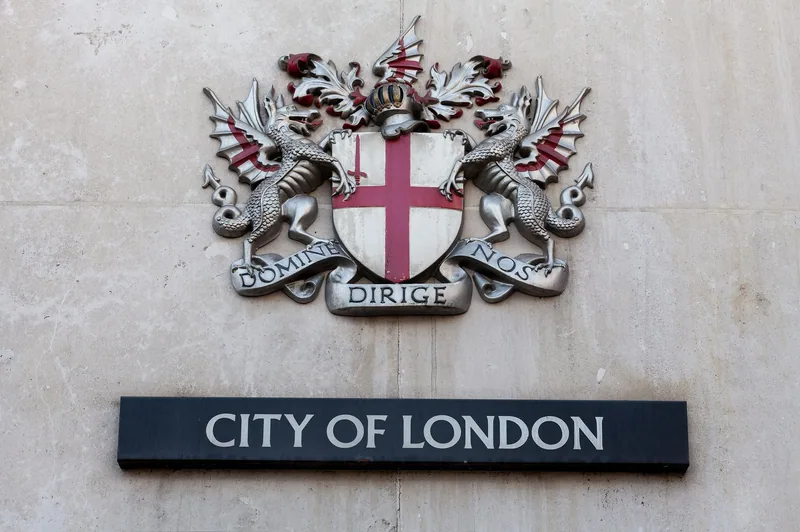
You can spot it on the ground. At the main entrances the City marks its boundary with cast-iron dragons holding a shield, and smaller versions sit on plinths at side streets. The best known is the one on the Victoria Embankment; there is another where Fleet Street becomes the Strand, beside the pillar that replaced the old Temple Bar gateway.
Street furniture changes too. The City uses its own bollards, its own litter bins, its own street name plates with the City arms on them, and its own blue-and-white police signage. Once you have noticed, you can walk the boundary without a map.
An EC postcode does not mean you are in the City. The EC postal district spills well past the boundary, so an address in EC1 may sit in Islington and be nothing to do with the Corporation. Postcodes were drawn for delivering letters, not for government. Our guide to how London postcodes work explains the wider system.
Two mayors, and which one does what
London has a Mayor of London and the City has a Lord Mayor, and they are not versions of the same job.
| Mayor of London | Lord Mayor of the City of London | |
|---|---|---|
| Who holds it (September 2026) | Sadiq Khan | Dame Susan Langley, the 697th Lord Mayor |
| Elected by | Everyone in Greater London, every four years | The City's own electorate, for one year at a time |
| Area | All 607 square miles of Greater London, including the City | The Square Mile |
| Responsible for | Transport, policing outside the City, planning, fire, economic development | Heading the Corporation and acting as an international ambassador for UK financial services |
| Official residence or base | City Hall | Mansion House |
Dame Susan Langley is the third woman to hold the office and the first to use the style "Lady Mayor". A new Lord Mayor takes over every November, so the name changes annually. The handover is the reason for the Lord Mayor's Show, the free procession that sets off from Mansion House on Saturday 14 November 2026.
One point of confusion worth clearing up: the Mayor of London's powers over transport and policing apply across Greater London, and the Congestion Charge and the Tube work exactly the same inside the Square Mile as outside it. The City's separateness is a matter of local government, not of fares. Our explanation of London's travel zones covers the fare side.
Its own police force
Cross into the Square Mile and you leave the Metropolitan Police behind. The City of London Police is a separate force with its own commissioner, set up under the City of London Police Act 1839 and answerable to the Corporation's Court of Common Council, which acts as its police authority.
It is small, with a little over 1,000 officers and staff, and it polices an area where 8,600 people live and roughly half a million travel in and out each day. It also does a national job: the force leads the country on fraud and economic crime, and runs Action Fraud, the UK's national reporting centre for fraud and cyber crime.
For a visitor the practical effect is simple. In an emergency, dial 999 anywhere and you will get the right force. To report something non-urgent that happened inside the Square Mile, contact the City of London Police rather than the Met, because the Met will send you back. Our guides to emergency numbers in London and how safe London is cover the rest.
If you are pickpocketed at Bank and report it at a Met station, you will be redirected. Note which side of the boundary it happened on. The City force covers the Square Mile only; everything a street away is the Metropolitan Police. See our guide to how pickpockets work in London for where the risk is highest.
The business vote, and how it is calculated
This is the part that surprises people most. In every other part of the United Kingdom, local elections are decided by the residents. In the City, where there are only about 8,600 of them, businesses and other organisations occupying premises also appoint voters. The Corporation now calls this the worker vote.
The number of voters an organisation may appoint depends on the size of its workforce in that building:
| Workforce in the building | Voters the organisation may appoint |
|---|---|
| Nine or fewer | One |
| Ten to 50 | One for every five |
| More than 50 | Ten, plus one more for every 50 above the first 50 |
Remainders are ignored. The count is per building, not per company, so a firm with three offices in the City appoints voters three times over. Anyone appointed must be 16 by 1 September of the qualifying year, must have worked for the organisation for more than 12 months, must be 18 to actually vote, and must be a British, Irish, Commonwealth, British Overseas Territories or qualifying EU citizen.
The Corporation's own guidance asks organisations not to register only their senior staff, and says the voters should reflect the workforce. Once appointed, each person casts a single secret ballot exactly like any other voter. Nobody gets more than one vote, however large their employer.
These voters appear on the Ward Lists, which are used only for the City's elections of Common Councillors and Aldermen. The ordinary Register of Electors, used for parliamentary and London-wide elections, is a separate document. The registration canvass runs from August to 30 November each year.
Aldermen, wards and the Court of Common Council
The City is divided into wards, and each ward elects Common Councillors and one Alderman. Together they make up the Court of Common Council, the Corporation's main decision-making body. Aldermen serve six-year terms and are not all elected at the same time, so by-elections happen in odd years. Members do not stand for political parties, which is unusual for a British council.
What the Corporation owns outside the Square Mile
The Corporation is far larger than its territory. It owns and manages more than 11,000 acres of green space across London and the home counties, most of which is nothing to do with the City at all:
- Hampstead Heath in north London, including the bathing ponds.
- Epping Forest, nearly 6,000 acres on the Essex border.
- The wholesale food markets at Billingsgate, Smithfield and New Spitalfields.
- The Heathrow Animal Reception Centre, where animals arriving by air are checked.
- Five bridges over the Thames, held through City Bridge Foundation, including Tower Bridge.
It is also the principal funder of the Barbican Centre and the Guildhall School of Music & Drama, a joint funder of the London Museum, and London's Port Health Authority. If you have swum in a Hampstead pond or walked in Epping Forest, you have used a service paid for by a council whose territory is three miles away.
What all this looks like to a visitor
Four things you will actually notice.
The traffic is strange. At Bank junction, general traffic and private hire vehicles are banned from crossing between 7am and 7pm on weekdays, and the Corporation is running an experiment allowing licensed black cabs through east to west. It is a Corporation decision, not a Transport for London one. We explain the junction and what stands round it in our guide to the Royal Exchange and Bank.
The weekend is a different city. Sandwich bars, pubs and many churches close on Saturday and Sunday because their customers are not there. That is a consequence of 8,600 residents and 678,000 workers, and it is the single most useful fact for planning a City day.
The institutions are open to you. Anyone can sit in the public gallery at the Old Bailey, which the Corporation owns and runs, subject to the strictest entry rules of any public building in London. Anyone can walk into the Guildhall, and into most of the City churches, for nothing.
The oddities are real, not staged. The Temple, tucked inside the City's western edge, is a gated legal quarter looked after by two of the Inns of Court, and it keeps its own gate times, as our guide to Temple Church and the legal quarter explains. The Tower of London sits just outside the boundary and always has. None of this was designed. It accumulated.
Frequently asked questions
What is the difference between the City of London and London?
No. The City of London is a local authority covering 1.12 square miles in the middle of the capital, with about 8,600 residents. Greater London covers 607 square miles and more than 8.5 million people across 32 boroughs plus the City. When Londoners say "the City" they mean the financial district, not the capital.
Why does the City of London have its own police force?
The City of London Police was established under the City of London Police Act 1839 and has remained separate from the Metropolitan Police ever since. It has over 1,000 officers and staff, is overseen by the Corporation's Court of Common Council, and leads nationally on fraud and economic crime, running Action Fraud.
Can businesses really vote in the City of London?
Businesses and other organisations cannot vote themselves, but they may appoint employees as voters in the City's ward elections. An organisation with nine or fewer staff in a building appoints one voter; up to 50 staff means one voter per five; above 50 it is ten plus one for each additional 50. Each appointed person casts a single secret ballot.
Who is the Lord Mayor of London?
The Lord Mayor of the City of London heads the City of London Corporation and is elected for one year, taking office each November. In September 2026 the holder was Dame Susan Langley, the 697th Lord Mayor. The Mayor of London, a separate and directly elected post covering all of Greater London, was Sadiq Khan.
Where are the boundaries of the City of London?
Roughly from Temple and Chancery Lane in the west to Aldgate and the Tower of London in the east, along the north bank of the Thames and up to Liverpool Street. Cast-iron dragon statues mark the main entry points, and the City uses its own street signs, bollards and police signage inside the line.
Sources
- City of London Corporation - Our role in London (checked September 2026)
- City of London Corporation - The Lord Mayor and the Mayor of London (checked September 2026)
- City of London Corporation - About the Police Authority (checked September 2026)
- City of London Corporation - Worker vote registration (checked September 2026)
- City of London Corporation - All Change at Bank project (checked September 2026)