
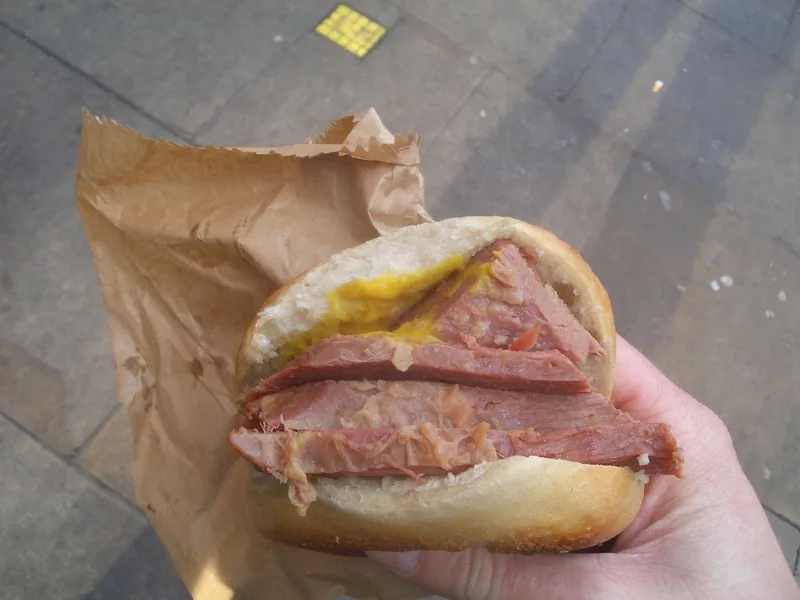
Salt beef is beef brisket cured in brine and spices, then simmered for hours and carved by hand. In London it is eaten hot in a beigel with English mustard and a sliced pickled cucumber, and the two places most visitors go for it are open around the clock on Brick Lane.
Jewish food arrived in London in two waves. Sephardi families from Spain, Portugal and the Netherlands settled near the City from the 1650s. Then, between roughly 1880 and 1914, tens of thousands of Yiddish-speaking families from the Russian Empire moved into the streets around Whitechapel and Spitalfields, bringing rye bread, pickled herring, chopped liver and the boiled-then-baked bread roll that London spells "beigel".
Almost all of those families later moved north and north-west, to Stamford Hill, Golders Green, Hendon and Edgware, and the food followed them. What is left in the East End is a very short list of survivors, which is exactly why they are worth a visit. For the wider picture of eating in this part of London, our guide to Brick Lane and the curry houses covers the street itself, and London's food markets covers the stalls.
Salt beef and beigels at a glance
- What to order first
- Hot salt beef beigel with mustard and pickled cucumber
- Price
- £7.50 at Brick Lane Beigel Bake; smoked salmon and cream cheese £4.50 (September 2026)
- Where
- 155 and 159 Brick Lane, London E1 6SB, a few doors apart
- Hours
- Both open 24 hours a day, every day
- Payment
- Card accepted; queues move fast, so know your order
- Nearest stations
- Shoreditch High Street (Windrush line), Aldgate East, Liverpool Street
- Kosher?
- No. The Brick Lane shops are Jewish in origin but not under kosher supervision
The two beigel shops on Brick Lane, and how to tell them apart
At the northern end of Brick Lane, past the curry houses, there are two beigel shops within about thirty metres of each other. Number 155 is The Beigel Shop, which has a yellow front and says on its own website that it was established in 1855 and opens 24 hours a day, 365 days a year. Number 159 is Brick Lane Beigel Bake, which has a white front, opened in 1974 and also never closes.
Londoners have loyalties to one or the other and will explain them at length. For a first visit the difference hardly matters: both boil and bake their beigels on the premises, both carve salt beef to order, and both have a queue at times when nothing else is open.
Prices at Beigel Bake in September 2026: a salt beef beigel is £7.50 and a smoked salmon and cream cheese beigel is £4.50. A plain beigel costs a few pence. Check the boards inside, because the range changes and neither shop publishes a full menu online.
Ordering is brisk. Say "salt beef, mustard and pickle" and have your card ready. Staff will ask whether you want mustard, and they mean hot English mustard, which is considerably stronger than most visitors expect. Ask for "a little" if you are unsure. There is nowhere to sit in either shop: people eat standing on the pavement or walk with it.
Three in the morning on Brick Lane is busy, not quiet. The queue at both shops peaks when the bars around Shoreditch empty, roughly between 01:00 and 04:00 at weekends. It is a good-natured crowd but a crowded pavement, so keep your phone and bag in front of you. Our guide to how pickpockets work in London explains where this matters most.
What salt beef is, and how it differs from pastrami
Salt beef starts as brisket, the cut from the front lower chest of the animal. It is cured in brine, usually for several days, with spices such as peppercorns, coriander seed and bay. It is then rinsed and simmered slowly until a fork goes through it. It is served hot and wet, sliced thickly across the grain, and the fat is left on.
Pastrami begins the same way, but the cured meat is coated in a dry rub and smoked before steaming, which gives it a dark peppery crust and a smoky flavour. New York took the pastrami road; London kept the boiled one. If you have eaten a pastrami sandwich in Manhattan and expect the same thing here, you will get something softer, saltier and less smoky.
The traditional accompaniments are simple and you should accept all of them. Mustard cuts the fat. A pickled cucumber, sliced lengthways, cuts it again. Some places offer a latke, a fried potato pancake, as a side. The beigel itself should be chewy rather than soft; a good one resists slightly when you bite.
Which salt beef bars are actually still open
This is a trade that has been closing down for fifty years, and a great many guides still list places that have gone. Monty's Deli, the Hoxton Street restaurant that many food writers recommended, closed its restaurant in 2019. Several of the West End salt beef bars that older Londoners remember have gone too.
What survives is mostly in the north-west suburbs. B&K Salt Beef Bar, a family business that cures and hand-carves its own brisket, lists two branches on its own website: 11 Lanson House, Whitchurch Lane, Edgware HA8 6NL, and 353 Uxbridge Road, Hatch End, Pinner HA5 4JN. Both are a long way out on the Metropolitan line or the Overground, so treat a trip there as a half-day outing rather than a lunch stop.
In central London, salt beef turns up as a menu item rather than as a specialist shop: some delis, a few pubs and the occasional market stall sell it. Ask whether the beef is cured on the premises. If the answer is vague, it is probably bought in.
Ring before you travel out to the suburbs. Independent Jewish food shops close on Friday afternoon for Shabbat, reopen on Sunday, and shut for a week or more around the autumn festivals and Passover. A phone call the day before saves a wasted journey on a line that takes 45 minutes each way.
Golders Green and the northern kosher belt
Golders Green Road in north-west London is where the everyday Jewish food shopping happens now: bakeries, butchers, fishmongers, restaurants and supermarkets along a single high street, with more in Hendon, Edgware and Stamford Hill.
Carmelli Kosher Bakery at 126–128 Golders Green Road NW11 8HB is the best known of the bakeries. It bakes challah, the plaited Sabbath loaf, along with rye, bagels and pastries. Note that its online orders are click-and-collect with 24 hours' notice for bread and 48 hours for cakes, so order in the shop if you are passing.
Golders Green station is on the Northern line, about 25 minutes from Leicester Square, and the shops are a two-minute walk from the bus station outside. If you are already heading to north London, it sits between Hampstead and the North Circular, so it combines easily with a walk on the Heath.
Kosher, kosher-style and what the difference means for you
"Kosher" means the food complies with Jewish dietary law and is supervised by a certifying authority. In Britain the main authorities are the London Beth Din's KLBD and Kedassia, and a certified shop or restaurant displays its certificate where customers can see it.
The rules that most affect a visitor are these: meat and dairy are never served together, so a kosher meat restaurant has no butter, cheese or milky coffee; pork and shellfish are not served at all; and certified premises close from Friday afternoon until Saturday night.
"Kosher-style" or "Jewish-style" means the food belongs to the tradition but is not supervised. The Brick Lane beigel shops are in this category. If you keep kosher, look for the certificate rather than the word on the sign. The same logic applies in reverse for other dietary rules, which our guides to halal eating in London and gluten-free eating go into.
Jewish London you can walk into
Bevis Marks Synagogue, in a courtyard off Bevis Marks in the City, has been in continuous use since 1701 and is the oldest synagogue in Britain. It is an austere, beautiful room of dark wood and brass candelabra, and it still has no electric light over the central area. Sandys Row Synagogue, a short walk away in Spitalfields, is the oldest Ashkenazi synagogue still in use in London. Both open to visitors at limited times around services, so check their own websites before you go; neither is a museum with fixed hours.
The Jewish Museum London closed its Camden building in 2023 and has not yet found a permanent home. Do not travel to Camden expecting to find it. Since June 2026 it has run a small interim exhibition space called Two Rooms at JW3, the Jewish community centre on Finchley Road. Check what is on before making the trip.
For the wider history of the streets these communities lived in, our guide to Whitechapel and the East End covers the area, and the Sunday market on Petticoat Lane and the halls at Old Spitalfields and the Brick Lane markets stand where the trade in second-hand clothes once was.
Fitting it into a day, and what it costs
A beigel is one of the cheapest hot meals in central London. Two adults and two children can eat a salt beef beigel each for around £30, which is less than a round of sandwiches at most stations. Our guide to eating cheaply in London has more in that price bracket.
The obvious pairing is a Sunday morning: markets around Brick Lane, a beigel standing up, then the City. The other is late at night, when the beigel shops are one of the few reliable options anywhere near Shoreditch. Our page on eating after midnight in London sets out how to get home afterwards, and the Night Tube runs on Friday and Saturday nights.
If you want the bread rather than the filling, the same boiling-then-baking method is behind a lot of what London bakes now; our guide to bakeries and pastries covers the newer wave. And for the other old East End trade that is disappearing at the same speed, see pie and mash and jellied eels.
Frequently asked questions
Is Brick Lane Beigel Bake really open 24 hours?
Yes. Both shops at 155 and 159 Brick Lane state on their own websites that they trade 24 hours a day, every day of the year. They are among the very few places in London where you can buy hot food at four in the morning without ordering a delivery.
How much is a salt beef beigel in London?
£7.50 at Brick Lane Beigel Bake in September 2026, with a smoked salmon and cream cheese beigel at £4.50. Sit-down salt beef in a restaurant costs considerably more. Prices are shown on boards in the shop and change without notice, so check when you order.
Is the food on Brick Lane kosher?
No. The beigel shops on Brick Lane grew out of the Jewish East End but are not under kosher supervision. If you need certified kosher food, look for a KLBD or Kedassia certificate, which most certified premises display near the counter, and expect to travel to Golders Green, Hendon, Edgware or Stamford Hill.
Can I still visit the Jewish Museum in London?
Not in Camden. The museum closed that building in 2023 and is looking for a permanent home. Since June 2026 it has run a small interim display, Two Rooms, at the JW3 centre on Finchley Road. Check the museum's own website for opening times before you travel.
What is the difference between salt beef and pastrami?
Both start with cured brisket. Salt beef is then simmered and served hot and moist, which is the London style. Pastrami is rubbed with spices, smoked and steamed, giving the dark peppery crust familiar from New York delis. London shops sell salt beef far more often than pastrami.
Sources
- Brick Lane Beigel Bake - prices and opening (checked September 2026)
- The Beigel Shop, 155 Brick Lane - about and opening hours (checked September 2026)
- B&K Salt Beef Bar - branches and contact details (checked September 2026)
- Carmelli Kosher Bakery, Golders Green - address and ordering (checked September 2026)
- S&P Sephardi Community - Bevis Marks Synagogue (checked September 2026)
- Jewish Museum London - current status (checked September 2026)