
Leather Lane Market trades Monday to Friday only. Traders are licensed from 7am to 7pm, but Camden Council says the market is "mostly active between 10am to 4pm", and the hot-food stalls are set up for one thing: the office lunch hour between 12 and 2. At the weekend the street is empty, and so is most of Clerkenwell.
Leather Lane runs north from Holborn Circus towards Clerkenwell Road, one street west of Hatton Garden. It is Camden's largest surviving street market, and street trading here began after the Great Fire of 1666, when traders from Cheapside followed the displaced Londoners camping in the open ground around Hatton Garden. It has traded continuously since the 1850s.
Around it sit three other kinds of shopping that have nothing to do with each other: Hatton Garden's jewellery trade, Clerkenwell's design showrooms, and Exmouth Market's row of lunch pitches. None of them is a shopping centre and none of them works on a Sunday. Our guide to Clerkenwell covers the priory gatehouse, Smithfield and the walking route; this page is about buying things.
The weekday shopping map
- Leather Lane Market
- Monday to Friday; busiest 12pm to 2pm; EC1N 7TJ
- Exmouth Market
- Monday to Friday, 9am to 6pm, hot food
- Whitecross Street Market
- Monday to Thursday 11am to 2pm; Friday 9am to 6pm
- Hatton Garden shops
- Monday to Saturday in most cases; many closed Sunday and some closed Saturday
- Nearest stations
- Chancery Lane (Central, no lifts) and Farringdon (Elizabeth line and Tube, step-free with eight lifts)
- Buses to Leather Lane
- 17, 44, 46, 55, 243, 341
- Worst day
- Sunday, when every market on this page is shut
- Typical market lunch
- Our estimate, September 2026: £8 to £12 for a hot box
The lunch hour, and what happens either side of it
Leather Lane is the clearest example in London of a market that exists for a workforce rather than for shoppers. Between about 11.45am and 2pm the street is a double row of hot-food stalls with queues down the middle of the road: grilled meat, curries, burritos, noodles, salt beef, falafel, pies, a paella pan, at least one stall doing raclette over potatoes.
Arrive at 10.30am and the stalls are still setting up but the non-food pitches are out, which is the better hour if you are here to look rather than eat. Arrive at 3pm and half the food stalls have sold out and gone. Arrive at 6pm and there is nothing but a street of closed shutters and a few pubs.
The non-food trade is the part visitors overlook: cut flowers, fruit and vegetables, cheap clothing, phone accessories and homeware, sold to the same office workers on their way to the station. It is not a market for gifts and there is nothing here you could not buy elsewhere, but the prices are local prices.
Join the second-longest queue, not the shortest. On Leather Lane the queue is the only reliable quality signal, because the traders change from year to year and a stall with no queue at 12.45pm on a Wednesday is telling you something. We name no stalls on this page for the same reason: a list of traders on a weekday market is out of date within a season.
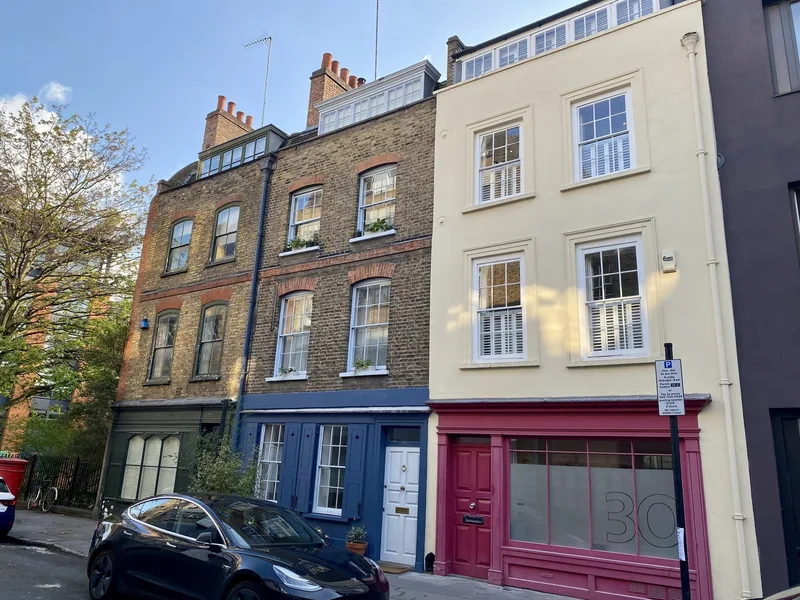
Photo: No Swan So Fine · CC BY-SA 4.0 · Wikimedia Commons · resized
Where else to eat within five minutes
Two other weekday markets are close enough to be alternatives rather than separate trips. Exmouth Market, eight minutes north-west, has more than 20 licensed pitches serving hot food, snacks and drinks, Monday to Friday from 9am to 6pm, on a pedestrianised street lined with permanent restaurants and cafes. It is the better choice if you want to sit down afterwards.
Whitecross Street Market, twelve minutes east towards the Barbican, is the odd one: Monday to Thursday it runs only from 11am to 2pm, and on Friday it opens properly from 9am to 6pm. Islington Council calls it one of the oldest markets in London, and Friday is the day to go.
That gives a practical rule for the area. Monday to Thursday, Leather Lane and Exmouth Market are the lunch options and Whitecross Street is a narrow two-hour window. On Friday all three are open and Whitecross Street is the best of them. For the wider picture, our guides to cheap eats in London and London's food markets put these in order of price.
Hatton Garden: how to walk into a jeweller without wasting anybody's time
Hatton Garden, one street east of Leather Lane, is the centre of the British jewellery trade and has been since the nineteenth century. It is not a shopping street in the ordinary sense. Behind the shopfronts are workshops, diamond dealers, setters and polishers, and a large share of the businesses on the street sell to the trade rather than to the public.
What that means in practice: the shops with a window display and a door you can push are retail; the buildings with an entryphone and a list of company names are not. Nobody minds you looking, but a walk-in customer asking about loose stones without a budget in mind will get a short conversation.
If you are buying an engagement ring or having something reset, this is the place in Britain to do it, and the reason is competition rather than price fixing: several dozen businesses within 300 metres all quote against each other. Bring a written note of what you want, ask for the price with VAT included, and ask what the certification is. There is no VAT refund for visitors taking goods home from Great Britain, which our page on tax-free shopping in the UK explains in full: the scheme was withdrawn in 2021 and has not come back.
At the northern end of Hatton Garden, an easily missed gateway leads into Ely Place and the medieval church of St Etheldreda, which we cover in Ely Place and St Etheldreda's. It is the best five-minute detour on this page.
Clerkenwell's design showrooms, and the week they open their doors
Clerkenwell holds one of the densest concentrations of architecture and design businesses in Europe, and the streets between Clerkenwell Green, St John Street and Old Street are lined with furniture and lighting showrooms. Most are trade showrooms: the door is open, the staff are polite, and they are not expecting to sell you a chair to take on a plane.
Go anyway, if furniture interests you. The showrooms are free, air-conditioned, and among the few places in London where you can sit on a £4,000 chair without anybody minding. The concentration peaks for a few days each May, when the area holds its own design week and showrooms and normally private buildings open to the public. That is a different event from the city-wide September programme described in our guide to the London Design Festival, so check which one your dates fall in.
The permanent shops worth a detour are different in kind: a handful of specialist bookshops, a clockmaker or two, tool and ironmongery shops left over from the trades, and the Order of St John's own site at St John's Gate, which we cover under the Museum of the Order of St John. The Charterhouse is five minutes north-east and has a free museum.
Antiques, silver and the difference between the two ends of Holborn
Clerkenwell is not an antiques district, but it sits between two that are. The London Silver Vaults, on Chancery Lane about eight minutes south of Leather Lane, is a basement of separate silver dealers, free to walk into on weekdays and closed on Sunday. Camden Passage, in Islington, is fifteen minutes north on the 341 bus. Both are covered in our guide to London's antiques markets.
If second-hand clothing rather than silver is the point, the charity shops of Clerkenwell and Farringdon are thin on the ground compared with Islington; our charity shop guide says where the good ones are. The nearest serious vintage trade is in the East End, twenty minutes away, and is covered in vintage and second-hand shopping.
Getting there, and the station that matters
Farringdon is the station to use. It is on the Circle, District, Hammersmith & City and Metropolitan lines, the Elizabeth line and Thameslink, and TfL's station data lists eight lifts, so it is step-free. Leather Lane is about eight minutes' walk south-west.
Chancery Lane, on the Central line, is closer to the southern end of Leather Lane, about three minutes, but it has no lifts and no ramped route in TfL's data, so it is not step-free. Buses 17, 44, 46, 55, 243 and 341 serve the market end directly.
The whole area is walkable from Holborn, King's Cross and the City. Our guide to Holborn covers the streets immediately south, and walking in London explains when a twenty-minute walk beats two changes on the Tube, which it usually does here.
Frequently asked questions
Is Leather Lane Market open on Saturday?
No. Camden Council lists the market as Monday to Friday only. Saturday and Sunday are both blank days on Leather Lane, and most of Clerkenwell's lunch trade closes with it. Come on a weekday, ideally between 11.30am and 2pm.
What time is Leather Lane Market busiest?
Between roughly 12pm and 2pm, when the offices empty. Camden says traders are licensed from 7am to 7pm but the market is mostly active from 10am to 4pm. The hot-food stalls often sell out and leave before 3pm.
Can tourists buy jewellery in Hatton Garden?
Yes, in the shops that have a shopfront and a street door. Many businesses on the street sell only to the trade and are reached by entryphone. Ask for prices including VAT, and be aware there is no VAT refund scheme for visitors taking goods out of Great Britain.
Which is better, Leather Lane or Exmouth Market?
Leather Lane for the number of stalls and the cheaper price, Exmouth Market if you want to sit down at a table afterwards. They are eight minutes apart, both Monday to Friday, so on a weekday you can look at one and eat at the other.
Is Leather Lane Market step-free?
The street itself is flat, though the aisle between the stalls narrows at lunchtime. Getting there is the harder part: Chancery Lane station has no lifts, so use Farringdon, which has eight and is step-free, or a bus.
Sources
- Camden Council - Visit Camden's markets (checked September 2026)
- Islington Council - Markets (Exmouth Street and Whitecross Street) (checked September 2026)
- Transport for London - detailed station data (lifts and step-free routes) (checked September 2026)
- GOV.UK - Tax-free shopping (checked September 2026)