
The reductions land in January, not on Boxing Day. The Office for National Statistics measures the price of clothing and footwear every month, and in the last two years its index barely moved in December and then fell by about 3.4% in January. If you are in London for a week over the new year, the shopping day to protect is not 26 December.
That is the whole argument of this page, and it is measured rather than asserted. What the Boxing Day sale offers is first pick of a limited quantity of heavily cut stock, in the company of a large number of people who live here. What January offers is a lower price level across the board, in emptier shops.
Our guide to Boxing Day in London covers what is open on 26 December and how far you can travel; Christmas shopping in London covers Black Friday and the run-up. This page is about the sales themselves: when prices actually fall, what your rights are when you buy something reduced, and which day of the week the law will be working against you.
The sale calendar, 2026 into 2027
- Christmas Day, Friday 25 December 2026
- Large shops must not open. It is against the law, not a choice
- Boxing Day, Saturday 26 December 2026
- No trading restriction. Large shops may open full Saturday hours
- Sunday 27 December 2026
- Six-hour Sunday rule applies to large shops
- Monday 28 December 2026
- The bank holiday. No trading restriction: a full day
- Friday 1 January 2027
- Bank holiday. No trading restriction
- Mid to late January 2027
- Where the ONS data says the price level is lowest
- Boxing Day 2027
- Falls on a Sunday. Large shops restricted to six hours — the worst sale day in years
What the official price data actually shows
The ONS publishes a monthly index for clothing and footwear as part of the consumer prices series, with 2015 set at 100. It is the only independent measure of whether a sale is a sale. Here is what it recorded through the last two winters.
| Month | Clothing and footwear index (2015 = 100) | Change on the month |
|---|---|---|
| November 2024 | 122.6 | the two-year peak |
| December 2024 | 121.9 | −0.7 |
| January 2025 | 117.9 | −4.0, about 3.3% |
| November 2025 | 121.8 | — |
| December 2025 | 122.0 | +0.2, a rise |
| January 2026 | 117.9 | −4.1, about 3.4% |
| June 2026 | 118.7 | — |
| July 2026 | 117.7 | −1.0, the summer sale |
Read the December rows twice. In the winter of 2025 into 2026, the national price level for clothing and footwear did not fall in December at all — it rose slightly — and then dropped four points in January. The pattern in the previous year was the same shape. The index peaks in October and November, when the new season is at full price, and bottoms out in January and again in July.
Two things follow. First, a December sale is real but narrow: particular lines are cut hard while the overall level holds, which is exactly what a doorbuster promotion looks like in the data. Second, the January fall is broad, and it does not require queueing at eight in the morning to get at.
Come back on the second Saturday in January. By then the reductions are at their deepest, the Londoners who wanted the obvious items have taken them, the tourists have gone home, and the shops are staffed and quiet. It is the single best shopping day of the British retail year, and almost nobody plans a trip around it.
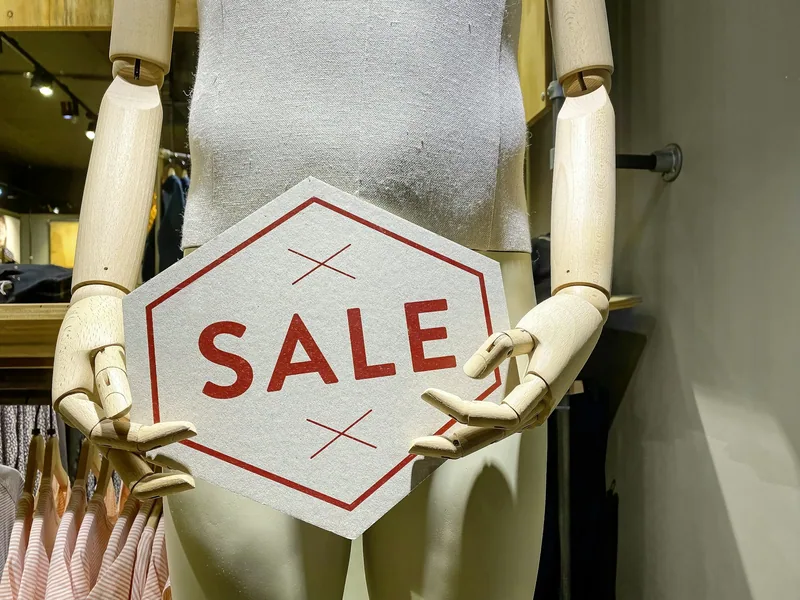
The queue on Oxford Street, and what it is actually for
Every year there are photographs of people waiting outside a large store on Oxford Street before it opens on Boxing Day, and every year they persuade somebody to build a holiday around it. The honest position is this: we could not verify any specific store's Boxing Day opening arrangements for 2026, because the retailers announce them in the middle of December, so anything you read now about a particular shop's hour or discount is a guess.
What can be said with confidence is what the queue is for. A doorbuster promotion works by cutting a limited quantity of specific lines very hard, and the queue rations them. If the thing you want is one of those lines, in your size, the queue is rational. If you are hoping to find general bargains, you are competing against several hundred thousand residents who know the shops better than you do, for stock that the price data says has barely moved in aggregate. Our guide to Oxford Street explains how the street works on an ordinary day; on Boxing Day it does not work at all until mid-afternoon.
If you want the sale without the street, the indoor centres are the better answer: everything under one roof, both Westfield centres sit directly on lines that run on 26 December, and Brent Cross and the suburban centres have free parking and a fraction of the crowd.
Your rights on a sale item are exactly the same
This is the most valuable paragraph on the page, and it comes straight from the government's own guidance to retailers. The wording is worth quoting: "Customers have exactly the same rights to refunds when they buy items in a sale as when they buy them at full price." And further: "It's illegal to restrict or take away customers' rights or to mislead them about their rights, for example by displaying a sign that says you do not accept returns or offer refunds."
So a sign in a January sale saying "no refunds on sale goods" is not merely unhelpful. In relation to your statutory rights it is unlawful. A shop must put right anything faulty, not as described, or not fit for purpose, whatever it cost and whatever the sign says.
But be clear about what those rights are, because visitors routinely overestimate them.
| Situation | What the shop must do |
|---|---|
| The item is faulty, not as described, or does not do what it should | Offer a full refund. This applies to sale goods exactly as to full-price goods |
| You bought it in the shop and changed your mind — wrong size, wrong colour | Nothing. There is no legal right to a refund on a change of mind for something you saw before buying. Most large chains offer one anyway, as their own policy |
| You bought it online, by phone or by mail order | You have 14 days from receiving it to say you are cancelling, and another 14 to return it. No reason required. The shop refunds within 14 days of getting it back, including standard delivery |
| The item was personalised or made to order | Refund only if faulty |
| Sealed items that cannot be returned for hygiene reasons, once opened | Refund only if faulty |
The practical lesson for a visitor is to ask about the shop's own change-of-mind policy before you pay, and to ask specifically how long it runs and whether it differs on sale stock. Many shops shorten the window in January. Our guide to complaining, returning and consumer rights in Britain sets out what to do if a shop refuses.
A change-of-mind return is worth nothing to you if you fly home first. A generous 28-day returns policy is useless when you are 5,000 miles away and the shop has no international returns route. Buy sale clothing you have tried on, in the shop, and treat everything else as final. This is the main reason a visitor should be more careful in a sale than a resident, not less.
Which day of the week is working against you
England's Sunday trading law does not relax for the sales. A shop with a relevant floor area of more than 280 square metres may open for one continuous period of six hours only, somewhere between 10am and 6pm, on a Sunday. Smaller shops are unrestricted. The same Act closes large shops entirely on Easter Day, and the Christmas Day (Trading) Act closes them on 25 December.
Map that onto the 2026 dates and the picture is unusually good. Boxing Day is a Saturday, so the large stores may trade full Saturday hours. Sunday 27 December is a six-hour day. Monday 28 December is the bank holiday but carries no trading restriction, so it is a full day in half-empty shops — and it is, in our view, the best of the four days. The same is true of Friday 1 January.
Then look at 2027, where the same calendar works against you. Boxing Day lands on Sunday 26 December, so the six-hour limit will apply on the opening day of the sales; Christmas Day is the Saturday before, and its substitute bank holiday is Monday 27 December, which will be the first unrestricted trading day. If you are planning next year rather than this one, that is the line to keep. Our guide to opening hours and Sunday trading has the rule in full, and what closes on public holidays covers the rest of the year.
What gets discounted, and what never does
The ONS series measures clothing and footwear because that is the category where the seasonal pattern is strongest. It is a fair guide to the rest.
- Falls hard and early: Christmas-specific stock — decorations, wrapping, cards, seasonal food. Often cut on Christmas Eve afternoon and again after Christmas, because none of it can be sold in February.
- Falls broadly in January: autumn and winter clothing, coats, boots, knitwear. This is the bulk of the January index fall.
- Falls late, if at all: new-season stock, which is arriving in the shops while the old season is still being cleared. A coat reduced in January is last winter's coat.
- Does not fall: the things visitors most often want to buy — tailoring, fragrance from the big houses, jewellery at the top end, and anything with a waiting list.
For the categories that never go on public sale, there are other routes. Our guide to London sample sales covers the invitation-only end of the trade, outlet shopping near London the permanent-discount version, and charity shops in London the genuinely cheap end, which is at its best in January when people clear out their wardrobes.
Prices already include tax, and you cannot claim it back
One thing that catches overseas visitors every January. The price on the ticket includes VAT at 20%, and there is no refund scheme for goods you carry home: the retail export scheme was withdrawn in Great Britain on 1 January 2021 and has not returned, despite an announcement in 2022 that was never implemented. So a 30% reduction is a 30% reduction and that is the end of it.
The one remaining route is having the shop send the goods directly to an address outside the UK, which some larger stores will do. Whether the shipping cost beats the tax saving depends on the value of what you are buying. Our guide to tax-free shopping in the UK sets out the position properly.
Two days that are better than either
If you are in London across the new year and you want the sales, our advice is to skip 26 December altogether and use these instead.
Monday 28 December 2026. A bank holiday that carries no trading restriction, so the big stores can keep full hours. By then the museums have reopened and the trains are running again, hotel rates have dropped from their December peak, and a good share of the city is still off work. The West End is busy but navigable.
The second week of January. The deepest reductions, the quietest shops and the lowest hotel prices of the year, in exchange for the worst weather. Our guide to London in January covers the month, what to do on a rainy day the likely weather, and your arrival day in London is worth reading if you land in the middle of it with luggage and nothing open yet.
Frequently asked questions
When do the January sales start in London?
The post-Christmas reductions begin on Boxing Day, 26 December, and many retailers open them online on Christmas Eve or Christmas Day. But the ONS clothing and footwear index shows the price level barely moving in December and falling about 3.4% in January, so the genuinely lower prices arrive after the new year rather than on the 26th.
Can a shop refuse to refund a sale item?
Not if it is faulty, not as described or not fit for purpose: GOV.UK's guidance states that customers have exactly the same refund rights on sale goods as at full price, and that a sign saying otherwise is illegal. A shop can refuse a refund simply because you changed your mind about something you bought in person, and many shorten that policy during a sale.
Are the shops open on 27 and 28 December 2026?
Yes to both, with one restriction. Sunday 27 December is a normal Sunday, so shops over 280 square metres may trade only six continuous hours between 10am and 6pm. Monday 28 December is the Boxing Day bank holiday but carries no trading restriction, so the large stores can open full hours.
Is Boxing Day a good day to shop in London?
Only if you want a specific heavily reduced item and are prepared to queue for it. For general bargain hunting it is the worst combination of the year: maximum crowds and, on the national data, almost no reduction in the overall price level. The same shops in the second week of January are cheaper and nearly empty.
Why will Boxing Day 2027 be worse?
Because 26 December 2027 falls on a Sunday, which brings the six-hour trading limit into force on the first day of the sales. Christmas Day that year is a Saturday and its bank holiday moves to Monday 27 December, which will be the first full trading day.
Sources
- Office for National Statistics - CPI INDEX 03: Clothing and Footwear, 2015=100 (series D7BW) (checked September 2026)
- GOV.UK - Accepting returns and giving refunds: the law (checked September 2026)
- legislation.gov.uk - Sunday Trading Act 1994, Schedule 1 (checked September 2026)
- legislation.gov.uk - Christmas Day (Trading) Act 2004, section 1 (checked September 2026)
- GOV.UK - UK bank holidays, England and Wales (checked September 2026)
- GOV.UK - Tax-free shopping (checked September 2026)