
London's Christmas shopping season runs from the first week of November to lunchtime on 24 December. The lights go on in early November, the shops add late-night hours from late November, and the two worst days of the whole period are the Saturdays either side of the middle of December. If you can shop on a weekday morning, you will have a completely different trip from someone who arrives at Oxford Circus at 2pm on a Saturday.
This page is about the shopping itself: which days work, what closes when, and how to get what you buy back home. For the lights, the tree in Trafalgar Square, the ice rinks and the pantomimes, see our guide to Christmas in London. For the shops themselves, our guides to Covent Garden and Seven Dials and London's department stores cover what is in them all year round.
Christmas 2026: the dates that affect shopping
- Carnaby Street lights switched on
- Wednesday 4 November 2026
- Regent Street, Oxford Street and Covent Garden lights
- Early to mid November; each street's website confirms the date in the autumn
- Black Friday
- Friday 27 November 2026
- Christmas Eve
- Thursday 24 December 2026; most shops close early afternoon
- Christmas Day
- Friday 25 December 2026; large shops must not open
- Boxing Day
- Saturday 26 December 2026; the bank holiday moves to Monday 28 December
The weeks to avoid, and the ones that work
Crowding in the West End in December is not evenly spread, and knowing the pattern is worth more than any shopping tip.
- Early November is the quiet secret. The lights are up, the Christmas windows are dressed, and the crowds have not arrived. If your trip is flexible, come now.
- The last weekend of November brings Black Friday and the first serious crush.
- The two Saturdays in the middle of December are the busiest shopping days of the London year. Oxford Street between Oxford Circus and Bond Street becomes a slow shuffle, and queues for changing rooms and tills run to twenty minutes and more.
- The final week, 21 to 24 December, is busy but different: it is mostly Londoners panic-buying, the stock is picked over, and shops close progressively earlier.
- Christmas Eve morning is surprisingly workable for food and gifts if you are up early, and dead by mid-afternoon because everything shuts.
Within any given day, the useful window is between opening and about 11.30am. Shops in central London generally open at 9am or 10am, and the first ninety minutes in December are calm in a way the rest of the day is not. Our guide to avoiding London's rush hour explains how to get there without the commuter crush at either end.
Tuesday and Wednesday mornings in the first half of December are the best shopping hours in London. The stock is complete, the late-night openings have not started for the day, and the Saturday crowds are three days away in either direction. If you have one morning to spend, spend it then.
Sunday in December: six hours and no more
England's Sunday trading law does not relax for Christmas. A shop larger than 280 square metres may open for only six continuous hours on a Sunday, between 10am and 6pm. In practice the big West End stores choose 11.30am or 12 noon to 6pm, and put a sign on the door saying browsing is allowed for half an hour before the tills open.
Small shops are not covered by the restriction and can open all day, which is why the independent shops of Seven Dials, Marylebone High Street and Carnaby Street are a better Sunday bet than a department store. Our guide to bank holidays and opening hours explains the rule in full, including the two days a year when the large shops close entirely.
The one Sunday to be careful about is the last one before Christmas, when the six-hour window is the busiest six hours of the year in the big stores.
Late-night openings
From roughly the third week of November, most West End shops extend their weekday closing time from 8pm to 9pm or 10pm, and the department stores often go later still in the final fortnight. The exact hours differ by shop and change year to year, so check the individual store's website rather than relying on a street-wide claim.
Late shopping is genuinely pleasant. The lights are the point of the exercise after dark, the crowds thin out after about 7.30pm, and the shops are warm. It also fits neatly around an early dinner or a theatre matinee. The practical limit is transport: you are shopping with bags on the Tube at the exact hour when everybody else is going home. If you can, leave the purchases in a shop's click-and-collect or delivery service rather than carrying them.
Where to buy presents, as opposed to where to look at them
The famous Christmas destinations and the useful ones are not quite the same list.
| If you want | Go to | Note |
|---|---|---|
| Food hampers and edible gifts | Fortnum & Mason, Borough Market | Hampers can be shipped abroad; check customs rules for meat and dairy |
| One-stop gift shopping under a roof | Selfridges, Liberty, Westfield | Westfield is far less crowded than the West End and has parking |
| Presents for children | Hamleys and the toy shops | Queues to get in on December weekends |
| Books, prints and small things | London's bookshops, museum shops | Museum shops are quiet, cheap and open when the museum is |
| Something old rather than new | The antiques markets | Most trade on one day a week only |
| Discounted brands | The outlet centres | A full day out; book the train in advance |
Museum shops deserve a line of their own. They are the single most underused source of good, portable, unmistakably British presents in London, they are almost never crowded, and the big ones are free to enter because the museums are. The shops at the British Museum, the V&A, the Natural History Museum and Tate Modern all stay open until the galleries close.
Christmas markets: which ones sell things
London's Christmas markets divide cleanly into two kinds, and it saves disappointment to know which you are visiting.
The first kind is a shopping market: wooden chalets with makers and small traders selling ceramics, prints, jewellery, candles and food. The riverside market beside the Southbank Centre is the largest of these, it runs for several weeks, and it is free to walk through. The second kind is an event with some stalls attached, of which Hyde Park's Winter Wonderland is the obvious example; it has rides, bars and a ticketed entry at busy times, and the shopping is incidental. Our guide to Winter Wonderland covers that side of it.
Prices at the chalet markets are high for what you get, and the same makers often sell the same work more cheaply at ordinary weekend markets such as Greenwich and Old Spitalfields. Go to the Christmas markets for the evening and the mulled wine; buy the presents somewhere else.
Black Friday, the sales and what actually gets discounted
Black Friday falls on 27 November 2026. In London it is now a week rather than a day, it is heavily weighted towards electronics, beauty and mid-market fashion, and the discounts on genuinely desirable stock are smaller than the advertising suggests. The West End is busy but not impossible; the online queues are worse than the physical ones.
The traditional post-Christmas sales begin on Boxing Day, Saturday 26 December 2026. Because the bank holiday moves to Monday 28 December, London gets a four-day stretch of sale trading, and that Saturday will be extremely busy in the West End. Most large stores open on Boxing Day, usually on shortened hours, but some do not open at all; check the individual shop.
Two things reliably do get discounted: seasonal stock that cannot be sold after 25 December, such as decorations, wrapping and Christmas food, which is often cut by half on Christmas Eve afternoon and again on Boxing Day; and end-of-season clothing. Full-price new-season items rarely move much.
Buy on Christmas Eve morning, not Christmas Eve afternoon. Large shops in central London typically close between 3pm and 6pm on 24 December, and some stop earlier without announcing it. Nothing large opens at all on Christmas Day, and the Tube does not run. If something has to be bought before Christmas, treat 24 December as a half day.
Getting it home
The three practical problems with Christmas shopping abroad are weight, tax and time, and all three have answers if you deal with them early.
Weight. Most large stores will hold purchases for collection later in the day, and several offer same-day delivery to a London hotel for a modest fee. Ask at the till rather than carrying bags round for six hours. If your hotel has checked you out, the storage options in our guide to left luggage in London take shopping bags as happily as suitcases, and our notes on luggage on the Tube will tell you which stations to avoid with an armful of boxes.
Tax. Visitors cannot reclaim VAT on goods carried home from Great Britain. The exception is goods the shop ships directly to an address abroad, which can be sold without UK VAT. On a large Christmas purchase this is worth asking about before you pay. Our page on tax-free shopping in the UK has the detail, and you should also check what your own country charges on arrival.
Time. If you are posting presents home yourself, the last posting dates for international mail fall well before Christmas, typically in the first half of December for surface and airmail services. Royal Mail publishes the exact dates each autumn; check them before you commit to posting rather than carrying.
A one-day route through the Christmas West End
If you have a single day, this order keeps you ahead of the crowds and ends with the lights.
- 9am Start at the quiet end: Marylebone or St Christopher's Place, north of Oxford Street, for independent shops before the crowds.
- 10.30am Selfridges or Liberty while the aisles are still passable.
- 12.30pm Lunch somewhere booked, not somewhere found. December walk-ins are hard.
- 2pm Cross to Carnaby Street and Soho, where the lanes are pedestrianised and the shops are smaller.
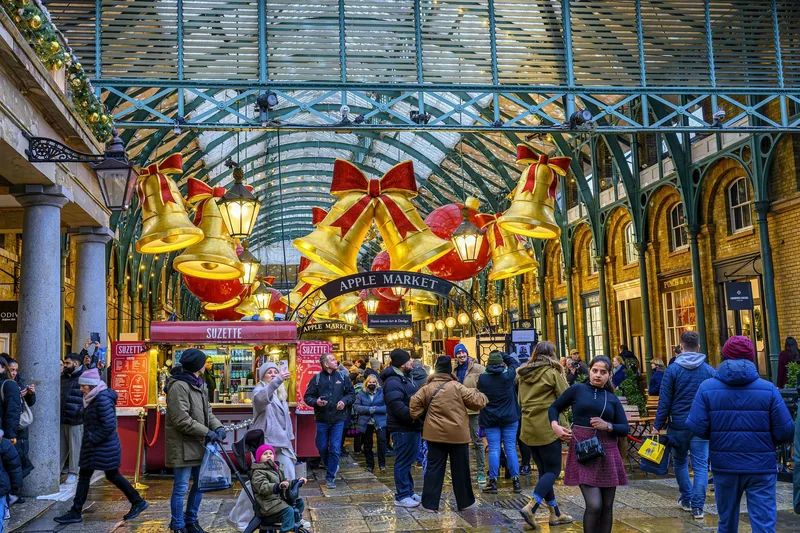
- 4pm Covent Garden as it gets dark, for the market building and the lights.
- 5.30pm Walk Regent Street north to Oxford Circus, which is the best view of the lights in the city and costs nothing.
Walking beats the Tube for all of this. The distances look longer on the map than they are, and our guide to walking in central London shows how close these streets sit to each other. For the longer view of the whole season, see our overview of London in December.
Frequently asked questions
When is the best time to go Christmas shopping in London?
Early November, before the crowds build but after the lights and the Christmas windows are in place. Within December, a weekday morning between opening and about 11.30am is far calmer than any afternoon. The two middle Saturdays of December are the busiest shopping days of the year in the West End.
Are shops in London open on Boxing Day?
Most large stores open on Boxing Day, Saturday 26 December 2026, usually on shortened hours, and the post-Christmas sales start then. Some shops choose not to open. Because 26 December is a Saturday in 2026, the bank holiday moves to Monday 28 December, so the sales run over four busy days.
What time do London shops close on Christmas Eve?
Most central London shops close between 3pm and 6pm on 24 December, and many stop serving earlier than the time on the door. Treat Christmas Eve as a morning only. Nothing large opens on Christmas Day, when shops over 280 square metres are not permitted to trade.
Do shops in London open late in December?
Yes. From around the third week of November most West End shops extend weekday closing to 9pm or 10pm, and the department stores often go later in the final fortnight. Hours vary by shop and year, so check the individual store's website rather than assuming the whole street is the same.
Can tourists claim back VAT on Christmas shopping in London?
Not on goods you carry out of Great Britain yourself; that scheme ended in 2021. The remaining route is to have the shop send the goods directly to an address abroad, which can be zero-rated for VAT. Ask before you pay, and check what your own country will charge on import.
Sources
- GOV.UK - UK bank holidays (England and Wales, 2026) (checked September 2026)
- Carnaby - Christmas lights switch-on, 4 November 2026 (checked September 2026)
- GOV.UK - Sunday working (checked September 2026)
- GOV.UK - Tax on shopping and services: tax-free shopping (checked September 2026)
- Christmas Day (Trading) Act 2004 (checked September 2026)
- Sunday Trading Act 1994 (checked September 2026)