
London has hundreds of charity shops, and they are the cheapest clothes shops in the city. The rule that matters is simple: the price reflects the neighbourhood the donations came from, so the same jacket costs three times more in Chelsea than in Wood Green. Prices are fixed, nobody haggles, and everything is sold as seen.
Our guide to vintage and second-hand shopping in London covers the dedicated vintage trade, where clothes have been selected, cleaned and priced by specialists. Charity shops are the other half of that world: unsorted, unpredictable, run largely by volunteers, and far cheaper.
They are also a British institution rather than a tourist attraction, which is part of the appeal. You are shopping in the same places Londoners do, on ordinary high streets, and the money goes to the charity whose name is above the door.
Charity shops: the basics
- How many
- Around 9,000 across the UK; the Charity Retail Association represents over 85% of them
- Who runs them
- About 23,500 full-time-equivalent paid staff and some 203,600 volunteers
- Where the stock comes from
- More than 90% of sales are donated goods; about 6% is new
- Haggling
- Not done. Prices are set by the shop manager and are not negotiable
- Typical hours
- Roughly 09:00 or 10:00 to 17:00 or 17:30, with shorter Sundays
- Finding one
- The Charity Retail Association shop finder, searchable by postcode and by what you want
Where the good stuff is, and why
Charity shops sell what the surrounding streets donate. That single fact tells you where to go.
| Type of area | Examples | What you find | Prices |
|---|---|---|---|
| Wealthy inner neighbourhoods | Chelsea, Kensington, Marylebone, Hampstead, Primrose Hill | Designer labels, cashmere, good coats, occasional couture | Highest, but a fraction of retail |
| Comfortable suburbs | Richmond, Wimbledon Village, Dulwich, Blackheath, Chiswick | Good mainstream brands, children's clothes, homeware, books | Moderate |
| Mixed inner suburbs | Islington, Clapham, Crouch End, Stoke Newington, Walthamstow | The best balance of quality and price; strong on records and books | Low to moderate |
| Big outer high streets | Wood Green, Lewisham, Kilburn, Shepherd's Bush, Ilford | Volume rather than quality; lots of turnover | Lowest |
The best single strategy for a visitor is to pick one high street with several charity shops on it and work along the row, rather than travelling across London to a single shop someone recommended. Stock changes daily, so the shop that was excellent last week may have nothing today.
Chelsea and Kensington are the designer hunting ground, at designer-adjacent prices. The shops around Sloane Square and the King's Road receive donations from people who buy expensive clothes and wear them twice, and the managers know exactly what they have. Expect to pay more than in an ordinary charity shop and much less than the label would cost new. Our guide to shopping on the King's Road covers the rest of that street.
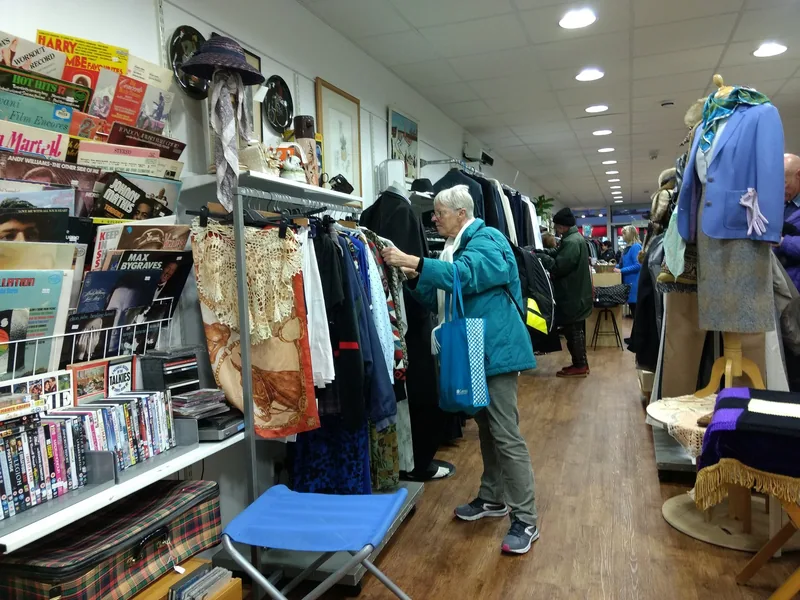
Photo: Philafrenzy · CC BY-SA 4.0 · Wikimedia Commons · resized
How the pricing actually works
Prices are set by the shop manager, usually with a guide supplied by the parent charity, and increasingly with reference to what the same item fetches online. That is why the system feels inconsistent: two branches of the same charity a mile apart will price the same coat differently.
It also explains why you rarely find something genuinely rare on the rail. Valuable or unusual items, including antiques, jewellery, art and musical instruments, are commonly pulled out and sold online by the charity instead, where they reach a wider market. What is left in the shop is good ordinary stock.
On the etiquette of haggling, there is none. Do not ask for a discount. The price on the label is the price, staff have no authority to change it, and offering less is read as rude rather than as bargaining. The one acceptable conversation is pointing out damage the shop has not noticed, which may lead to a reduction or to the item being withdrawn.
What to look for, and what to check
Charity shops sell goods as seen, and second-hand goods are not covered by the same return rights as new ones, so inspect before you buy:
- Clothes. Check underarms, cuffs, collars and hems, and run your hand over the whole garment for thin patches. Look at the care label: wool, cashmere, silk and linen are what you are hunting for.
- Zips, buttons and linings. A broken zip is the commonest hidden fault.
- Shoes. Look at the sole wear and the inside heel. Worn insoles are not worth the saving.
- Books and records. Charity shops are the best cheap source of both in London. Check records for scratches under the light near the window.
- Electricals. Only some branches accept and sell them, and anything you buy will have a UK three-pin plug and be made for 230 volts, so check it will work at home before you carry it there.
- Sizing. UK sizes differ from American, European and Japanese ones, and older British clothes run smaller than modern ones. Not every shop has a fitting room, so hold things against yourself and ask.
Books, records and furniture specialists
Several charities run specialist branches, which are the ones worth travelling for.
Book and music shops. Oxfam runs dedicated books and music branches in several London neighbourhoods, staffed by volunteers who know what they are handling and priced accordingly. They are a serious alternative to a second-hand bookshop; see our guide to the best bookshops in London for the commercial ones.
Records. Charity shops in music-heavy neighbourhoods turn up genuinely good vinyl, although the best stock is often removed for online sale. Our guide to record shops in London covers the proper diggers' shops.
Furniture and homeware. The British Heart Foundation and several other charities run large furniture stores, usually in retail parks or on wide outer high streets. Not much use to a visitor flying home, but excellent if you are staying for months.
Paying, and the two tax questions visitors ask
Almost all charity shops now take cards and contactless. Some very small ones are cash only, so carry a little.
VAT. There is no VAT on the sale of donated goods, which is one of the tax concessions charity shops receive. This does not give you anything to reclaim; it simply means the price you see already excludes it.
Gift Aid. If you see a sign asking donors to sign up for Gift Aid, that is for people giving goods, not buying them. It lets the charity claim an extra 25p for every £1 the donated item raises, and it requires the donor to be a UK taxpayer, so it generally does not apply to visitors.
If you buy a lot, remember that goods you take home count against your own country's customs allowance, second-hand or not. Our page on UK customs allowances explains how the British side of that works.
Donating is easy, and very welcome. If you are leaving London with more than you arrived with, clean, wearable clothes in a bag handed in over the counter during opening hours are genuinely useful. Do not leave bags outside a closed shop: they get rained on or taken, and the charity has to pay to dispose of them. For anything large, ring the shop first to check they have room.
Timing: the days that matter
Stock goes out when volunteers have had time to sort it, which in most shops means new items appear through the morning. Being there when the shop opens is worth more than any other tactic.
Mondays and Tuesdays are usually good, because weekend donations get processed at the start of the week. The days after Christmas and the first weeks of January bring a flood of unwanted presents and clear-outs. End of the university term and the end of a lease produce sudden good stock in student and rental areas.
Sunday is the weakest day. Many charity shops close on Sundays altogether, and those that open keep short hours.
Combining it with the rest of a London day
Charity shops sit on ordinary high streets, which is exactly where most visitors never go, so they pair well with a day spent outside the centre. A morning at Portobello Road Market and an afternoon in the charity shops of Notting Hill covers both ends of the second-hand trade in one neighbourhood. The same works for Camden Market and the shops up towards Kentish Town.
For anyone travelling on a tight budget, this is one of the highest-value things to do in London: an afternoon's entertainment that ends with clothes you will actually wear. See our pages on London on a budget and visiting as a student. If your interest is objects rather than clothes, our guide to London's antiques markets is the next step up.
Frequently asked questions
Are London charity shops cheap?
Much cheaper than new, though the price depends heavily on the neighbourhood. A charity shop on an outer high street is the cheapest clothing in London. One in Chelsea or Hampstead charges considerably more, because the donations are designer labels, but still far below the original price.
Can you haggle in a London charity shop?
No. Prices are set by the shop manager using the charity's own guidelines and are not negotiable, and staff have no authority to reduce them. Asking for a discount is considered impolite. The only exception is pointing out damage the shop has not spotted.
Which London areas have the best charity shops?
Chelsea, Kensington, Marylebone and Hampstead for designer labels at higher prices; Islington, Clapham, Crouch End, Stoke Newington and Walthamstow for the best balance of quality and price; and the big outer high streets such as Wood Green or Kilburn for the cheapest stock and the highest turnover.
How do I find charity shops near me in London?
The Charity Retail Association runs a shop finder that searches by postcode and lets you filter by what the shop sells, including books, music, furniture, electricals and children's clothing. It covers over 85% of UK charity shops, so a few independents will not appear.
Can I return something bought in a charity shop?
Usually not. Second-hand goods are generally sold as seen, and return policies vary from charity to charity and sometimes from shop to shop. Inspect the item carefully before paying, ask whether there is a fitting room, and treat the purchase as final.
Sources
- Charity Retail Association - How do charity shops work? (checked September 2026)
- Charity Retail Association - Find a charity shop (checked September 2026)
- Charity Retail Association - Donating to charity shops (checked September 2026)
- GOV.UK - Tax on shopping and services (checked September 2026)
- GOV.UK - Bringing goods into the UK for personal use (checked September 2026)