
Canary Wharf is London's second financial district, a cluster of glass skyscrapers built on the old West India Docks in East London. For visitors it offers striking modern architecture, waterside walks, outdoor art, a free museum about the docks and easy links to Greenwich, but it is at its liveliest on weekdays and very quiet at weekends.
Canary Wharf sits on the Isle of Dogs, a loop of land on the north bank of the Thames about six kilometres east of the City of London. For almost two centuries this was one of the busiest port areas in the world. The West India Docks opened in 1802, and ships brought sugar, rum, timber and other goods from across the British Empire. The docks declined after the Second World War and closed completely in 1980, leaving a large area of empty water and warehouses.
From the late 1980s the site was rebuilt as a new business district. One Canada Square, the tower with the pyramid roof, was completed in 1991 and was for many years the tallest building in the UK. Dozens more towers followed, housing banks, law firms and media companies, and more recently flats. Today tens of thousands of people work here on a normal weekday. Visitors come for the architecture, the museum, the waterside restaurants and as a stepping stone to Greenwich across the river.
Canary Wharf in brief
- Best for
- Modern architecture, waterside walks, public art, a free museum, weekday dining
- Main stations
- Canary Wharf (Jubilee line, Elizabeth line, DLR); West India Quay, Heron Quays (DLR)
- London Museum Docklands
- Free; daily 10am-5pm; 3 minutes from West India Quay DLR
- River bus
- Canary Wharf pier; cross-river ferry to Rotherhithe
- Busiest
- Weekday lunchtimes and early evenings
- Quietest
- Weekends and bank holidays
- Time needed
- Two to four hours, or combine with Greenwich for a full day
London Museum Docklands: the story of the river
The best reason to visit Canary Wharf as a tourist is the London Museum Docklands, housed in a Georgian sugar warehouse on the edge of West India Quay. It tells the story of the Thames and its port from Roman times to the present day, over several floors of old timber-framed rooms. There are models of the old docks and London Bridge, reconstructed streets and shops, and displays on the Blitz, the dock workers and the redevelopment of the area.
One of the most important galleries, "London, Sugar and Slavery", examines the city's role in the transatlantic slave trade. The West India Docks were built by merchants who grew rich from plantations worked by enslaved Africans, and the museum addresses that history directly. There is also a large interactive play area for young children.
According to the London Museum, entry is free and the museum is open daily from 10am to 5pm. It is about three minutes' walk from West India Quay DLR station and seven minutes from Canary Wharf. It is currently the only London Museum site open: the old London Wall building closed in December 2022, and the new museum at West Smithfield opens on 28 November 2026. Our guide to the London Museum and its sites has the details.
A rainy day fits Canary Wharf surprisingly well. Most of the area is linked by covered shopping malls and underground passages between the stations, towers and restaurants, and the Docklands museum takes a couple of hours. If the forecast is poor, you can spend a morning here with only a few minutes outdoors. Our guide to rainy-day London has more ideas.
Architecture, the towers and the new stations
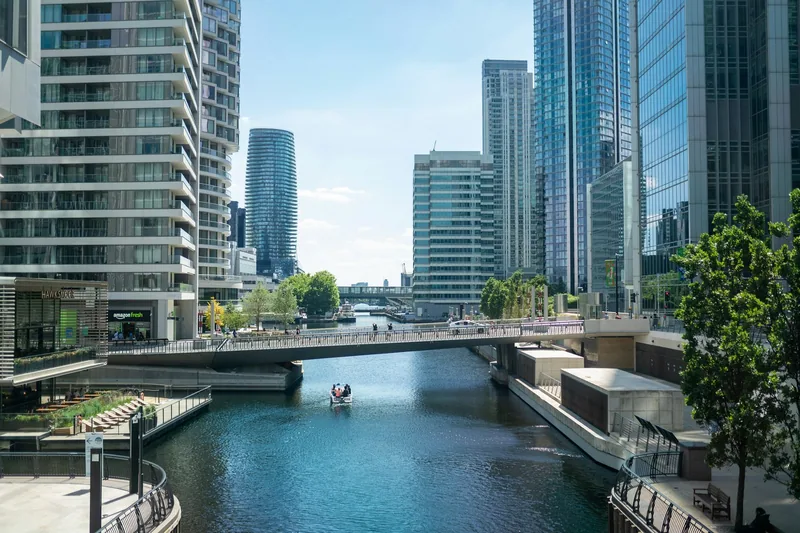
Canary Wharf is not beautiful in a traditional sense, but it is impressive. The towers cluster around Canada Square and along the old docks, and the reflections in the water and glass make it popular with architecture and photography fans. It is at its most dramatic at dusk, when the office lights come on.
The stations are worth a look in their own right. The Jubilee line station, designed by Foster and Partners and opened in 1999, is a huge, cathedral-like concrete hall under a glass canopy. The Elizabeth line station, sunk into the dock water at the north of the estate, has a long timber lattice roof. On top of it is Crossrail Place Roof Garden, a public garden planted with species from the countries that ships from the West India Docks once traded with. It is a calm place to sit under the timber roof.
If you want to see Canary Wharf from a distance, the best view is from across the river. The hill in Greenwich Park gives a classic view of the towers behind the Queen's House, and the riverside at Rotherhithe and Greenwich looks straight across at them. Our guide to free viewpoints over London lists more options.
Public art and waterside walks
The Canary Wharf estate has a large collection of outdoor sculpture and art installations, placed in its squares, parks and along the dock edges. Many visitors discover them by chance while walking between the stations. Temporary exhibitions and events change through the year, so look at the estate's own website for what is on during your visit.
The water is the other attraction. Paths run along the edges of the old docks, and footbridges cross between the quays. West India Quay, with its row of converted Georgian warehouses, is the most historic corner, and the Thames Path along the outer edge of the Isle of Dogs gives wide river views. Jubilee Park, a small park above the Jubilee line station, and Canada Square Park in front of the tallest towers are pleasant places to sit on a sunny day.
For a longer walk, follow the Thames Path south around the Isle of Dogs to Island Gardens, then take the foot tunnel under the river to Greenwich. Along the way, Mudchute Park and Farm is one of the largest city farms in London, with sheep, pigs, llamas and other animals. It is a good stop with children; see our guide to city farms and playgrounds.
Eating, drinking and shopping
Canary Wharf is full of restaurants, cafés and bars, many with terraces by the water. Most are aimed at office workers, which means they are busy and lively at weekday lunchtimes and after work, especially on Thursday and Friday evenings. Prices are generally similar to the West End, and there are plenty of chain restaurants alongside more upmarket places.
Several towers and hotels have high-level bars with views over the docks and the river. Our round-up of London's rooftop bars covers the city's best high places for a drink. Underneath the towers, a network of shopping malls holds fashion shops, supermarkets and services. They are useful rather than special, but open at weekends when the offices are closed.
What works well
- Free museum with real depth
- Striking modern skyline and water
- Clean, safe and easy to walk around
- Excellent transport, including the Elizabeth line
- Easy link to Greenwich
What may disappoint
- Corporate atmosphere, few historic streets
- Very quiet at weekends and in the evening
- Restaurants mostly aimed at office workers
- Few sights beyond the museum and the views
Weekdays against weekends: how the mood changes
Canary Wharf is two different places depending on the day. From Monday to Friday, tens of thousands of commuters pour out of the stations every morning. The squares are busy at lunchtime, and after work the bars along the water are packed with office workers. It feels like a small city, energetic and a little impersonal.
At weekends and on bank holidays, most offices are empty. The towers are dark, the streets are quiet and some cafés aimed at office workers do not open. The shopping malls and many restaurants stay open, and residents and families use the parks and waterfront, but there are far fewer people around. Some visitors enjoy this calm; others find it eerie.
Weekend quiet suits photographers and families. With the office crowds gone, the squares, bridges and dock edges are almost empty on Saturday and Sunday mornings, which makes it easier to photograph the towers and safer for small children on scooters. Just check that the restaurant you have in mind opens at weekends before you plan lunch around it.
Late in the evening, even on weekdays, the area empties quickly after the after-work crowd has gone home. It is well lit and patrolled by private security and generally considered safe, but it has little to offer for a night out. For that, head to Shoreditch or the West End.
Getting to Canary Wharf and moving on
Canary Wharf has three rail options, all accepting contactless and Oyster, and all within the Tube-style daily cap.
- Elizabeth line. The fastest link to Liverpool Street, Tottenham Court Road, Bond Street and Paddington. See our guide to riding the Elizabeth line.
- Jubilee line. Direct to London Bridge, Waterloo, Westminster, Green Park and Bond Street, and east to North Greenwich and Stratford.
- DLR. Driverless trains to Bank and Tower Gateway in the City, south to Island Gardens and Greenwich, and, with a change, east to the Royal Docks and London City Airport. Sit at the front for a view over the tracks. Our page on the DLR and the Overground explains the network.
The river is a pleasant alternative. Uber Boat by Thames Clippers serves Canary Wharf pier, and its RB6 route runs between Putney and Canary Wharf or North Greenwich, depending on the time of day. The RB4 cross-river ferry links Canary Wharf with Rotherhithe on the south bank for £4.10. River fares do not count towards the daily cap; see our guide to the Uber Boat river bus.
Canary Wharf is also a convenient starting point for a ride on the IFS Cloud Cable Car across the river from Royal Victoria, and for flights from London City Airport. Both are on the DLR, usually with one change of train.
Is Canary Wharf a good place to stay?
Canary Wharf has many modern business hotels and serviced apartments. They tend to be quiet, clean and well connected, and weekend prices can be lower when business travellers have gone home, so it is worth comparing. The Elizabeth line puts the West End within easy reach, and Greenwich is a short hop away.
The downside is atmosphere. In the evening and at weekends there is little going on, and you will travel into central London for most sightseeing and nightlife. It suits business travellers, families who want quiet nights and visitors who value transport links over character. Our overview of where to stay in London compares it with other areas.
Frequently asked questions
Is Canary Wharf worth visiting as a tourist?
It is worth a few hours if you like modern architecture, waterside walks or social history. The free London Museum Docklands is excellent, and the area combines well with Greenwich across the river. If you only have a short stay in London, there are more important sights in the centre.
Is Canary Wharf open at weekends?
Yes. The public spaces, shopping malls, museum and many restaurants are open at weekends, but the offices are closed, so the area is much quieter. Some cafés aimed at office workers do not open on Saturday and Sunday, so check before you go.
Is the London Museum Docklands free?
Yes. Entry is free, and the museum is open daily from 10am to 5pm. It is about three minutes' walk from West India Quay DLR station and seven minutes from Canary Wharf station.
How do I get from Canary Wharf to Greenwich?
Take the DLR south towards Lewisham and get off at Cutty Sark, which takes only a few minutes. Alternatively, walk to Island Gardens at the southern tip of the Isle of Dogs and use the foot tunnel under the Thames, which comes out next to the Cutty Sark.
What is the fastest way from Canary Wharf to central London?
The Elizabeth line is fastest to Liverpool Street, Tottenham Court Road and Bond Street. The Jubilee line is better for London Bridge, Waterloo and Westminster. Both accept contactless and Oyster and count towards the daily cap.
Sources
- London Museum - London Museum Docklands (checked September 2026)
- London Museum - Our locations (checked September 2026)
- Transport for London - About the River Bus (checked September 2026)
- Uber Boat by Thames Clippers - Route map (checked September 2026)
- Transport for London - Elizabeth line (checked September 2026)